
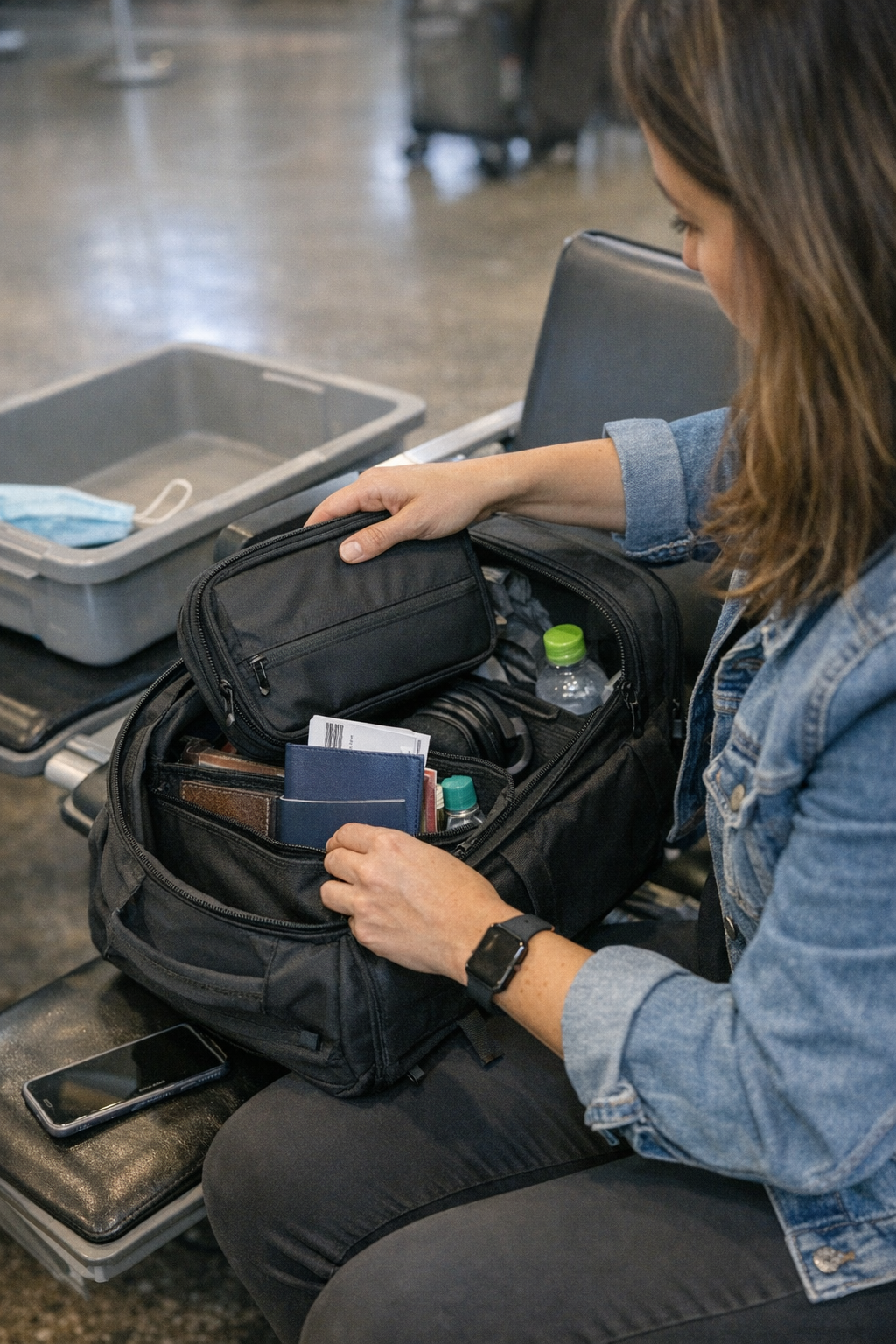
A carry-on that looks tidy on your bed can fall apart within minutes at the airport. At home, every pouch and pocket seems logical. But the walk from check-in through security, down crowded aisles, and into your seat forces your setup to prove itself—or quietly turn against you through every rushed transition. The real test isn’t how it looks before you leave. It’s that split-second when you need your passport and drag the wrong zipper, or find your phone charger tangled with gum wrappers and boarding stubs. Visual order collapses fast under real airport movement, slowing you down exactly when the pressure is highest. This isn’t just about gear. It’s about whether your tools actually keep up with your travel speed—or quietly create new friction at every stop.
When Order Breaks Down in Real Transit
Most carry-ons pass the “living room” test: everything zipped, pockets aligned, layout calm. The airport exposes the cracks immediately. You’re pulled out of “packed” mode by TSA trays, last-minute gate changes, or boarding calls. The failure point comes right when you reach for one thing and get three in your hand—or nothing at all. That moment: half-open pouches, wires roped around pens and chargers, comfort items popping out of order. Standing by the conveyor belt, you try to stuff stray items back with one hand as the line crowds behind you. What started as a system turns into a puzzle.
Stop after security and the weak points become obvious. The tech pouch slides into the main compartment, charger now loose after a tray scramble. Lip balm falls out with your passport at document check. Headphones drop to the bottom when you reshuffle in the boarding line. Every “temporary” fix multiplies friction. Restore order mid-transit and you’re just setting up a new mess for the next checkpoint—it’s not dramatic, but it wears you down with every transition.
The Quiet Cost of Overlap and “Temporary” Fixes
Each time you stuff one more “temporary” item into a quick-access pocket, the trouble stacks up. It starts as a lost pen, turns into mixed cords, and by your next stop—every zipping moment triggers a new slowdown.
- Fumbling through two organizers to find your ID at document check
- Digging for headphones wedged behind toiletries after finding your seat
- Grabbing the wrong pouch, only to pull out a tangled cord instead of a boarding pass
Nothing’s catastrophic. But the micro-delays stack: the “organized” carry-on becomes a source of repeated interruption. It’s not visible in the setup—it’s in every access moment that feels longer than it should.
Spotting the Distance Between Looks and Use
Visual “tidy” is a trap. A hotel-bed packing photo says nothing about performance in the security line, boarding zone, or tight seat row. If you ever find yourself zipping, sifting, or closing one pocket to hunt through another during a line move, that’s the warning sign. Structure that worked at rest doesn’t survive real movement flow.
Feel the gap when edge cases stack up: tray transfer at security, slow forward-lean in a boarding bottleneck, or awkward leaps over a neighbor’s knees to extract a document pouch. Two-second delays under pressure stretch and pile up. If grabbing your ID is a small adrenaline spike, your setup isn’t helping. One misplaced comfort pouch quickly buries your passport three layers deep. These aren’t disasters but they chip at control every leg of the trip.
Repeated Use: The Overhead Bin and Onboard Shuffle
The pattern repeats mid-flight. Lifting a carry-on from an overhead bin, you find your document holder trapped under the tech kit you shoved in after security—one quick grab now means an awkward stack spill. The pocket labeled “quick-access” is stuffed with snacks, gate stubs, and mystery receipts. Over time, every in-flight retrieval turns into a small repacking event. These quiet breakdowns add up. What passed for order at the beginning now feels clumsy and unpredictable, even as the packing grid looks intact.
The Two-Minute Reset That Changes the Pattern
There’s a concrete fix worth more than any extra gadget: the two-minute reset. After every major checkpoint—security, boarding, arrivals—pause to empty and repack your fast-access pocket in a set order: document holder, tech organizer, one comfort item (tissues, hand lotion), nothing else. This isn’t about minimalism. It blocks “just for now” item drift, so you don’t build hidden friction for the next rush. The reset becomes your stopgap against the slow mess that sabotages real-time retrieval.
Less Is Smoother: Limiting Repeated Access Points
Keep the fast-access zone predictable: one document pouch, one tech kit. Anything else—snacks, receipts, loose pens—get repacked or moved before zipping up. What feels like two extra minutes at a checkpoint can spare you twenty minutes of silent irritation later. Next time you need something in line or mid-flight, it comes out in one motion, without the slow reveal of random stowaways. No repeated searching, no repack loop. You reclaim speed not by carrying less, but by beating the root of travel friction: unpredictable “temporary” overlap.
How to Tell When Your Setup Needs a Reset
If you find yourself hesitating in motion—scanning, digging, double-checking which pocket holds what—your structure is slipping. Frequent re-sorting, delayed document pulls, or not remembering which pouch you used last are all signs: reset overdue. Often it hits just after forced adjustments—after a gate change, or seat swap, or when you realize an “easy fix” now blocks three steps instead of one.
Even Single-Compartment Bags Benefit
You don’t need a maze of pockets to build this pattern. One main compartment can still keep “high-frequency” items stacked in a fixed top-down order—if you resist dropping extra objects on top for convenience. “Just for now” is how the old mess returns. The reset works because it quietly resists that drift before it turns permanent, no matter how simple your bag’s layout seems.
Travel That Feels Smoother—Not Just Looks It
The goal isn’t obsessive minimalism. It’s a setup that resists the invisible mess—the kind that slows your movement at every real pressure point and leaves you irritated in the line, the seat, or the aisle. The two-minute reset turns your carry-on from something you manage into a tool that actually moves at travel speed—especially when every pause feels longer and every retrieval exposes the gaps. Visual order might return for a photo, but real travel flow is only possible when repeated interruption stops.
Find practical, movement-ready carry-on tools at CarryOnSupply.