
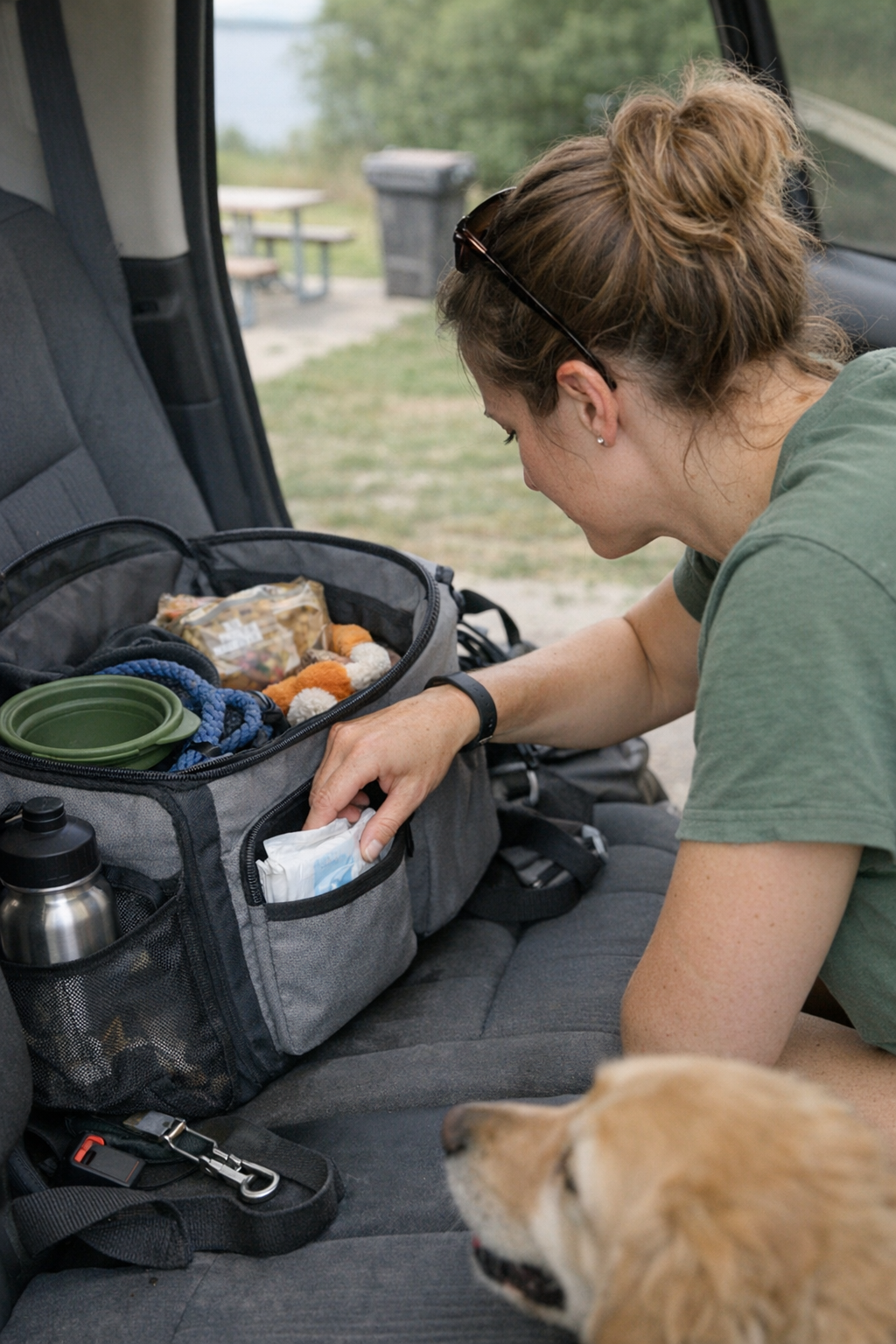
The moment of truth for any pet travel bag isn’t how organized it looks at home—it’s what happens after your third pit stop on the road. Early confidence—zipped pockets, tidy compartments—collides with reality the first time you need a wipe and find it wedged behind a water bowl, or realize a leash has managed to knot itself around your own snacks. What started out as prepared quickly slips into an untidy tangle, exposing every overlooked weakness in your setup. At that point, every rest stop isn’t just a pause, but a minor reset that keeps stealing attention and momentum.
From Calm Organization to Chaotic Pause: The Real Travel Test
Every pet owner recognizes the pattern: hour one, you reach for treats and they’re right where you expect. By hour three, seat-side space is cluttered, essentials compete for the same pocket, and cleanup supplies vanish behind collapsed bowls or your travel mug. Now, it takes both hands and three guesses—often while your dog tugs at the leash—to get to a basic item like wipes. Each break becomes slower, less restorative, and more like untangling a closet than a quick reset for you and your pet.
Instead of refreshing the trip, these interruptions repeat. You squeeze a bowl past loose snacks. You chase a single wipe lost under your phone charger. You fumble for a leash clip with your pet nosing for treats. Suddenly, the bag’s so-called “organization” just means more moments lost and more seat-side clutter piling up after every stop.
Why the Right Structure Matters—Especially After the First Few Stops
Some travel bags look ready on day one but fall apart when the trip heats up. Every quick stop adds another layer of overlap: you dig for a waste bag, but it slides under a toy; grab a treat, only to push comfort items deeper inside. Repeated motion exposes what wasn’t separated. It’s not a minor annoyance—every small friction builds, until simple grabs require full-blown reshuffling, and cleanup becomes a one-handed scramble while containing both your pet and a mounting mess.
These little delays bleed momentum from the drive. A bag promising all-in-one access often turns on you as repeated use piles on friction. Visual order at the start becomes functional chaos in practice, and you realize you’re re-solving problems you thought packing had already fixed.
Separating Function: How to Build a Bag That Works Repeatedly
Most pet travel setups fall short not from a lack of pouches, but from a lack of smart boundaries. It isn’t about the total pocket count or bag size—it’s about what’s sharing space. As soon as high-use items like wipes, bags, and sanitizer overlap with snacks, bowls, or personal items, every stop becomes slower. Even a slightly expanded pouch crowds out what you need, pushing must-grab items deeper each time you move.
The effect is immediate: urgent items get buried; every extra second you dig, your pet gets more restless; your own routine loses pace. Interruptions compound—few of them major, all of them stealing attention and crowding your seat-side reset. The right structure replaces this friction with reliable muscle memory: high-frequency wipes and bags in one pocket, treats in another, no overlap. You know exactly where to reach, even mid-chaos.
What Actually Happens in Real Use: Scenes from the Road
Picture a typical highway pull-off. Your dog presses against the seat, you one-hand the leash out, and reach for a wipe—only to find it trapped under a folded bowl and yesterday’s treat bag. Cleanup turns into a shuffle-and-search operation. Every second, your pet gets jumpier. Your bag gets more disordered. Compare that with a separated setup: wipes in a stand-alone quick-grab pocket, one motion away. Clean up, leash reset, and back on the road—no buildup, no spillover, no wasted time or energy.
Spotting Red Flags: When “Organized” Doesn’t Mean “Usable”
Repeated use exposes patterns the pack-and-go test never reveals. Early warning signs are easy to miss—until you notice these in action:
- Needing to move one item to reach another—bowls blocking wipes, or your phone buried under snack bags
- Struggling to open zippers or fling open a pocket with one hand balancing both the leash and the bag
- Comfort accessories, meant to smooth travel, actually wedging essentials away from fast access
- Pet and owner items in the same section, so you hesitate or mentally track what’s mixed together every time you stop
These friction points don’t go away—they multiply. At each stop, a tidy section at departure becomes an obstacle course, making every grab or reset a little slower. As the trip goes on, the cost isn’t just inconvenience, but routine interruptions that break up travel flow and increase cleanup after each pause.
Practical Solutions: Structure That Actually Survives Travel
What actually works for real-world, repeated stops? Not more space or flashy compartments, but single-function pockets for high-frequency items. When wipes, bags, and sanitizer never overlap with treats or comfort gear, each stop is faster, with less accidental spillover. The travel kit’s flow hinges on clear separation—not just for looks, but because it controls the chaos that repeats with every interruption. Less time spent untangling; more quick resets and easier seat-side movement—by the fourth stop, this difference is obvious every single time.
Real-World Tweaks That Make a Difference
- Test your setup at home: simulate a roadside pause. Can you reliably grab wipes or waste bags one-handed while holding the leash?
- Spot pocket overlap before leaving: do urgent items sit with toys or comfort things that will get in the way as soon as you move repeatedly?
- After each trip, notice which pocket or zone was always out of order—the spot you kept needing to fix is the first to streamline for next time.
Travel Calm That Actually Endures
Every pet travel setup looks put-together when zipped at home. Only repeated stops reveal what really works: the bag that gives you exactly what you need, every single time, without slowing down or dragging your attention away. Real calm is built in the friction—the spaces where a smartly structured carrier turns a messy pause into a true reset, and lets you get straight back to moving. That’s the split: an organized bag vs. one that reliably streamlines the scramble of seat-side travel again and again.
Ready to build a setup that survives actual travel, not just the packing phase? Find practical travel-tested carriers and organizers at PawGoTravel.