
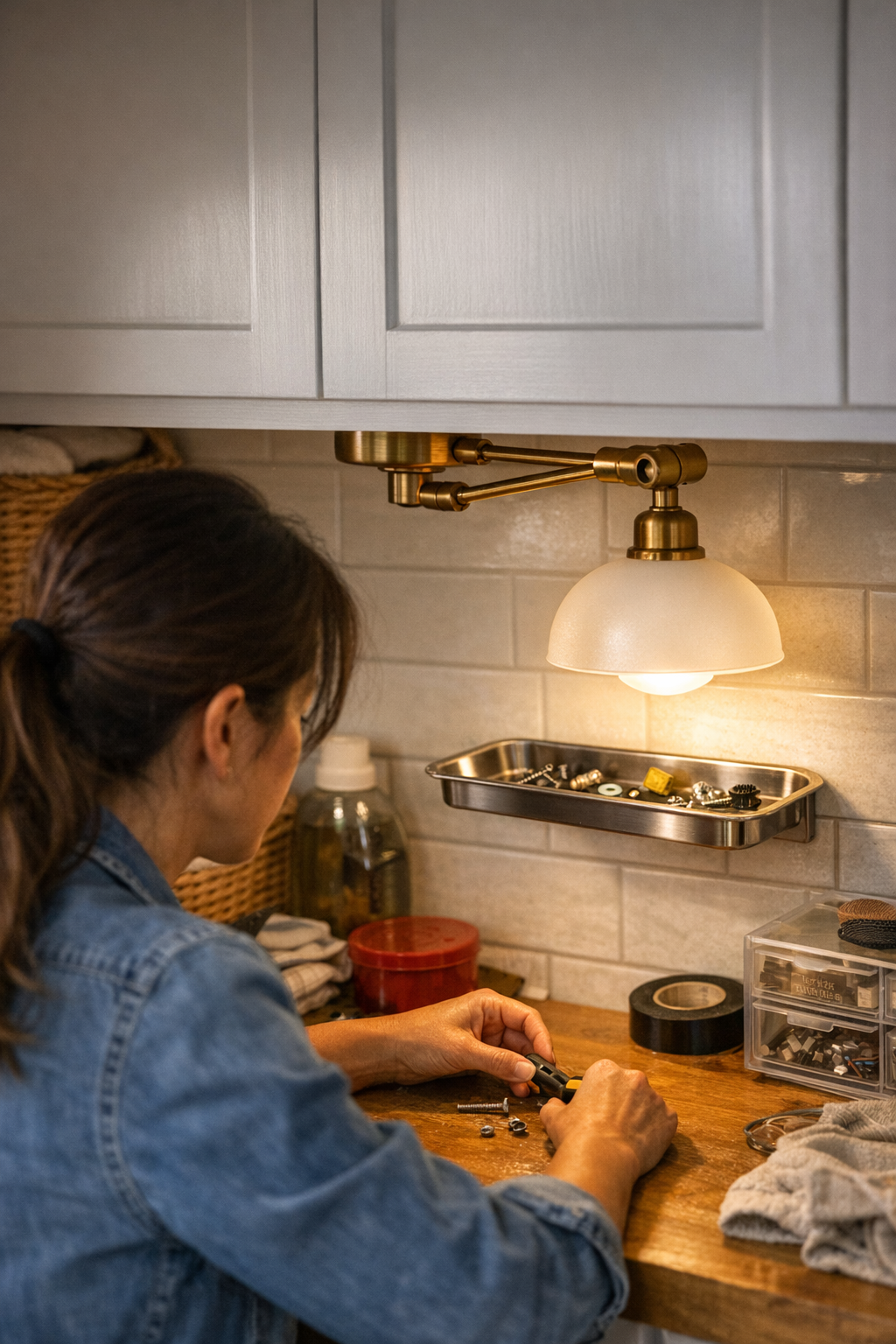
Bright ceiling and wall lights rarely fix what actually goes wrong during real tasks. In laundry nooks, utility counters, or entry shelves, rooms can look fully lit but still sabotage small jobs: dropping a screw while changing hardware, then watching it vanish at the exact moment both hands are busy. The pressure isn’t just dimness—it’s that fasteners, washers, or fuses reach the edge of the counter, escape the strongest beam, and drop straight into shadow right when you need them most. It’s a problem that doesn’t show up in walkthroughs—it reveals itself every time you lose track of something crucial mid-routine, no matter how many fixtures you switch on.
Day-to-Day Frustrations: When Light Isn’t Enough
Picture a laundry area with a flush-mount ceiling light and under-cabinet LEDs flooding the surface—a textbook “well-lit” setup. But start a quick repair, and small parts tell the real story. A screw slips. In one blink, it leaves the central pool of light, picks up a dense shadow at the counter’s edge, and drops out of sight. Every routine brings this pattern: the room glows but safe, clear grabbing distance fizzles away the moment a piece bounces or slides. The illusion of plenty falls apart in seconds as you lean, search, or trace your hand around the border, interrupting flow and patience.
Stair landings, mirrored vanities, even long hallway shelves repeat the same disguise. Floors and counters look bright yet leave edges unpredictable and awkward: screws hide along uneven light, batteries roll to corners, and you find yourself lunging or twisting, breaking rhythm for something that should have stayed easy. Most lighting solutions leave these blind spots untested—until the friction builds with every routine task.
How Shadows and Glare Create “Lost Zones”
No matter how well ceiling lights promise broad coverage, in real rooms, shadows cling to seams—under shelves, at wall junctions, behind faucet necks, along deep counter edges. Even flush and semi-flush mounts with impressive specs let light fade too soon at sidewalls or where the work surface meets a tall item. Small under-cabinet strips often streak glare into your eyes but leave a gap near the front lip where the action happens. The net effect: hardware drifts or bounces once, and vanishes out of the visible zone, while glare makes seeing detail harder, not easier.
Every lost minute is a repeatable problem, not a fluke. You don’t notice it on a product label—but you feel it on your third tilt of a lamp, or fourth time sweeping a hand along the edge to recover something barely out of reach. These aren’t “bad” lighting plans; they’re setups that weren’t forced to answer to hands-on, edge-of-counter tasks or moments when storage and visibility need to work the same beat.
The Role of Magnetic Trays: Anchoring Visibility and Flow
Enter one stealthy fix—a slim magnetic tray snapped under the task beam or under-cabinet glow. It isn’t just storage. It is an anchor: fasteners and electrical bits stick where the real light falls, not wherever a shelf happens to be clear. The friction vanishes—no more fingers fumbling into shadow, no more routine broken by another round of hide-and-seek with rolling washers. Every retrieval is clean, not a rescue.
Example: on a three-foot counter, a single tray placed dead center under ceiling task light stopped the worst pattern. Dropped hardware stayed inside view; no more switching on your phone’s flashlight to spot a missing nut, no more crawling to scan underneath detergent bottles. The upgrade is not about new brightness—it’s about ending constant detours from the usable zone.
Where Placement Makes the Real Difference
Most setups fail on this point: mounting the tray out of the main beam. Off to the side, and each part still disappears; the glare-free sweet spot is missed. Place it directly within the task light—under a wall sconce, centered beneath strips, or in the clear footprint of a flush mount—and you take away the edge zone where parts vanish.
Real example: Setting the tray immediately to the right of the washer, directly inside the hardwired task light, kept screws visible during a shelf repair. Before: hardware rolled under containers, gone for days. After: everything locked in reach, no surprises even after a clumsy drop. Placement, not the tray itself, changed the routine.
“Looks Good” vs. Actually Works: Lighting That Supports Repeated Use
Upgrading to brighter flush mounts, semi-flushes, or contemporary linear panels promises relief, but for detailed tasks, the shadow trap lingers. Edges still go dark, especially at night or when the angle shifts. The room feels “done,” but you still break stride to hunt for lost bits. It’s the oldest trap in household lighting: the appearance of brightness replaces functional clarity at the margins. Until a tray or anchor gets placed under true working light, the surface stays unreliable.
This is the real split: a space that looks completed versus one that quietly eliminates the old interruption. When the anchor supports your actual hands-on routine, you move without hesitating—no more squinting into corners or shaking containers hoping for the missing screw. The difference? No slow decline in mood, no break in pace, and nothing “just out of reach.”
Quick, Concrete Tips for Better Setup
- Test at night, not just midday: Drop a washer or screw during after-dinner chores. Notice where it lands; keep adjusting tray and light until nothing slips into the dark edge zone.
- Go slim for tight counters: On shallow shelves and laundry surfaces, low-profile trays avoid blocking movement or crowding the beam—crucial for real working space.
- Declutter before you trouble-shoot lighting: Even a perfectly-lit tray fails if surrounded by old batteries or tangled cords. Only clear edges turn brightness into true usability.
From Repeated Frustration to Reliable Routine
The difference between high-spec fixtures and truly usable rooms appears in the routine—not the catalog photo. Hallways, laundry corners, stair turns, and repair counters prove lighting setups by how well they handle constant, boring, invisible problems. One tray, anchored right in the task-zone lighting, quietly ends endless side-searching and momentum-killing interruptions. The “polished” look matters less than daily reliability where your hands move most.
Forget glamorous pivots—dependable fixes come from matching the placement of every anchor to where task light and movement meet, not just where a fixture lands. That gap, overlooked by nearly every walkthrough, is what turns “well-lit” spaces into rooms you can actually use—no more fight with edges, shadows, or vanishing hardware.