
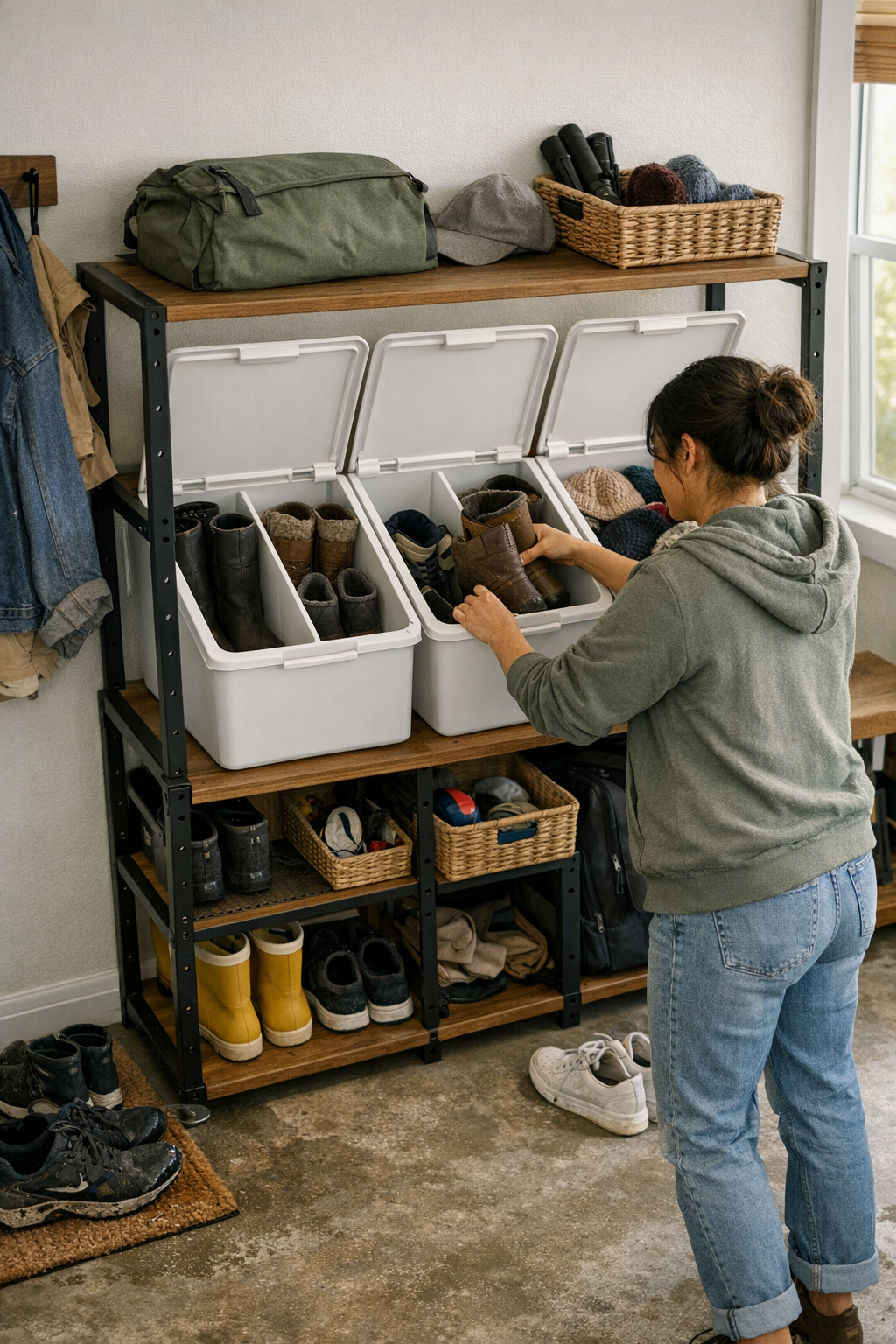
The trouble with entryway storage isn’t starting out messy—it’s watching what seemed organized become a daily slowdown. You get a sharp setup: bins for boots, a bench for bags, walls clear. But by midweek, shoe rows bleed into bag zones, hats cover what you need to grab next, and one quick drop-off turns into a clumsy search for keys. Instead of smooth transitions, you’re stepping over pileups or pausing to reshuffle before you can even leave the house. The very spot meant to speed you up becomes a choke point in the routine.
How Category Drift Builds Friction at the Entryway
Entryway storage rarely crashes outright—it erodes. Category drift starts everything sliding: summer sneakers stacked with wet boots, hats tangled with backpacks, the bench barely visible under overflow. Every time categories mix, routines stall. Instead of walking in, grabbing what you need, and heading out, you’re tracing circles around misplaced gear. Not just a visual mess—the real loss is time at the threshold, with each step interrupted by invisible clutter that suddenly needs sorting.
Picture the afternoon crunch: muddy sneakers bump up against dry shoes, umbrellas block gym bags, and you’re rifling through a scarf heap just to find your keys. What should take ten seconds now means sidestepping bags, pushing aside overflow, redoing yesterday’s order. It’s a speed bump in disguise—tiny slowdowns adding up, turning the entry from a reset zone into an unpredictable obstacle every day.
Why Rotation Falls Apart When Boundaries Blur
Seasonal rotation always sounds manageable—on paper. Rotate bins, switch winter for summer, keep things in play. But real use breaks the plan: boundaries soften, categories overlap, and swap-outs stall. You dig for a winter hat, but gym socks and goggles block the way. Instead of a quick seasonal reset, you’re unearthing the whole pile. Rushed mornings or visitors only make it worse—whatever doesn’t fit lands in the nearest gap, and soon every category is murky. The system dissolves quietly under repeated, normal use, leaving resets harder each cycle.
Matching Bins: Order or Illusion?
A matching set of entryway bins delivers surface calm—at first. Labels line up, everything looks ready, but the system can’t enforce discipline where there isn’t any. When the family’s in a rush, wet boots go with clean ones, grocery bags fill the nearest slot, and the labeled order shifts almost imperceptibly. Open baskets offer quick access, but invite faster spread: off-season gear sneaks in, and separation disappears as more hands reach for space.
Even precisely stacked, lidded bins can’t fix the core flaw if internal structure is missing. Gloves slide under boots, umbrellas wedge into bags, and the original system blurs away. Look away for a weekend, and no one really knows what’s in which bin. Organization lives and dies by practical separation—not just by appearances.
The Tipping Point: When Movement Gets Blocked
The real system failure never announces itself with a grand mess—it sneaks up as blocked movement, where routines jam:
- Wet boots dumped at the door, dry pairs stranded behind, clear tray gone
- Bags crowded onto the bench, blocking the only seat and forcing a stand-up boot pull
- Edge clutter—hats, gloves, mail—collecting in pass-throughs, tightening your path until you step sideways to get out
Suddenly, the entry isn’t just untidy—it’s slow and barely functional. Movement stalls, decisions pile up, and what once felt like a set-and-forget solution becomes a maintenance burden every trip through the door.
Structural Clarity: Why Real Dividers Matter
Beneath every genuinely functional entryway is structure that can take a beating. Bins with rigid, vertical dividers or fixed-lid constraints don’t just look controlled—they hold the line, physically and visually. Shoes keep to their section. Hats can’t wander over to the glove zone. It’s not about looking neat; it’s about preventing slow leaks between categories that gum up even basic routines.
Dividers set hard boundaries the daily shuffle can’t easily cross. The moment a divider is missing, overflow seeps in—bags slip into shoe slots, mittens end up with mail, and each reset gets more exhausting. One overlooked divider, one flexible bin, and the system returns to “organized for a day, scattered by the weekend.”
In Practice: How a Better Structure Holds Up
Switching from open baskets to divider-equipped bins in a busy entry changes more than appearance—it changes flow. Now, each item lands where it should. No cramming a backpack where scarves go. Boots stand, gloves stop migrating, and standing in the doorway, a glance is enough to spot where drift is just beginning. Cleanup shrinks from full-on reshuffling to quick sweeps—stray items are obvious, not camouflaged by overflow.
Importantly, small mistakes don’t become broad messes. Missed a drop-off? One slot is out of order—not the whole system. End-of-season swaps become one fast motion, not a mini excavation. The structure itself does most of the work, not the user. Instead of reorganizing from scratch each week, you’re only correcting the outliers.
Scenes from the Threshold: Where Setup Fails and Succeeds
- Lining up shoes and gradually watching the row expand, toes straying into different “zones.”
- Sitting to tie a shoe, but the bench is crowded with bags—forcing a shuffle and a quick recalibration of space.
- Coming home, trying to drop a backpack in its place, only to find the slot blocked, setting off a cascade of misplacements.
- Wall storage looks neat until the first rush—wet hats and paperwork blend together and blur the system from the inside.
- Trying to reset: one accidental shuffle, and suddenly you’re re-sorting half the bins, every few days.
Tips for Enforcing Category Boundaries in Entry Spaces
- Pick bins with non-negotiable dividers. Internal walls or upright slots maintain strict lanes, reducing accidental blending and category creep.
- Prevent overflow from finding spare capacity. If bins stretch to absorb “just one more” item, boundaries weaken—tight, defined space acts as a failsafe.
- Reserve open storage for low-impact, low-traffic locations. High-turnover zones—family entries, weather shift points—need structure, not just surface order.
- Reset fast, before drift sets in. Brief checks midweek, correcting spillover at the first sign, stop the problem from growing. Waiting for “the weekend reset” lets small errors escalate.
Less Is More: The Value of Uncompromising Structure
The payoff isn’t a prettier entryway. It’s the way movement stays frictionless, how little time is spent repeating the same fix, and how order survives the randomness of guests, kids, weather, and routine. Strong physical dividers unlock a difference you can feel each morning: returning the wrong item stops at one slot, not infecting the whole entryway. Seasonal swaps don’t become a chore. A tidy look is secondary—the big gain is daily stay-clear, with no hidden collapse waiting underneath.
When the structure holds firm, your entryway stops being another soft project. It becomes a working part of the house—surviving daily pressure, making resets faster, and keeping the zone clear enough to actually work. If a storage setup can’t do that, every improvement is temporary—and stranger, slower, more frustrating each return trip.