
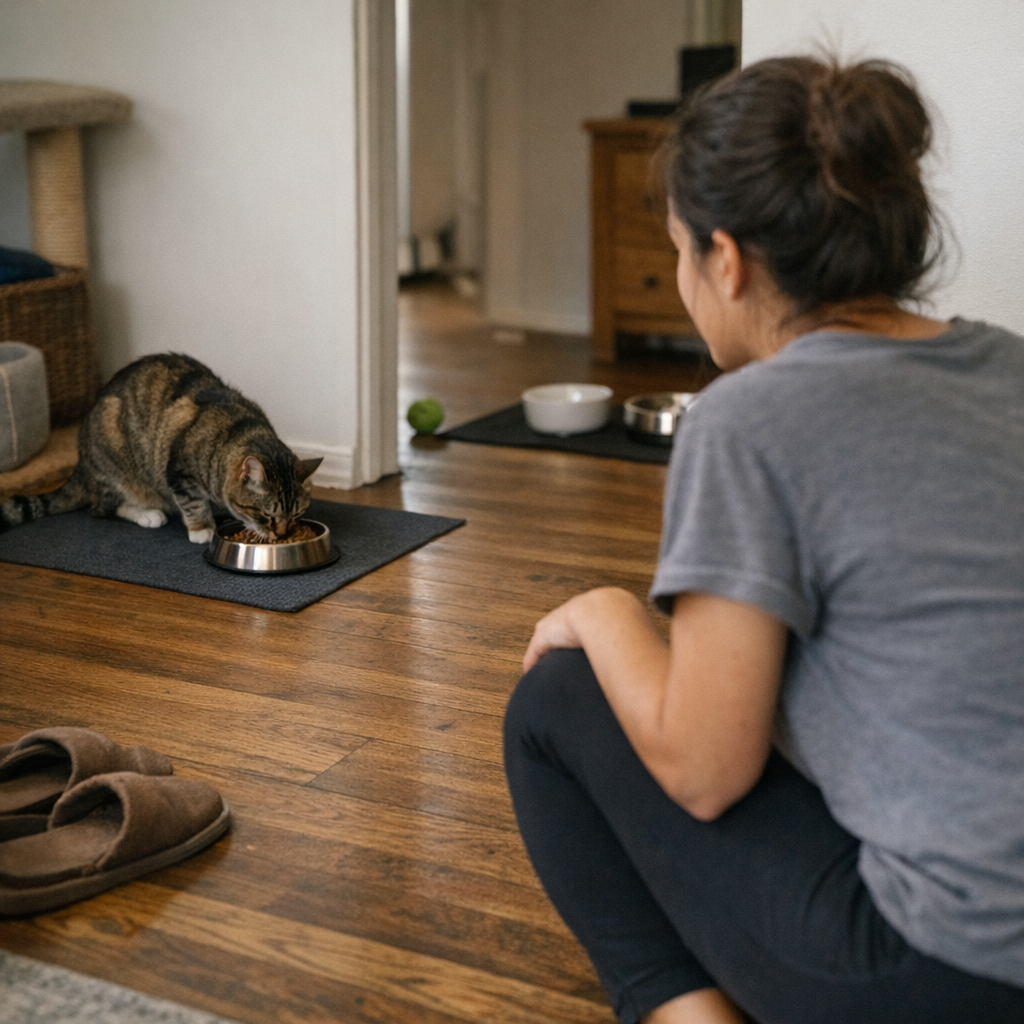
The difference between a feeding setup that just “looks settled” and one that actually works appears within days. Most indoor-cat homes start with matching bowls lined up on a mat, everything photo-ready. But fast-forward a week: the same mat now slides off-center, food bits stick just beyond reach, and one cat keeps pausing mid-step, waiting for the other to move. If every meal ends with crumbs edging past the mat and a silent standoff over who eats first, you’re dealing with the real limits of a standard shared feeding zone. What looked organized is quietly draining minutes—and momentum—from your routine. In the StillWhisker world, that gap between tidy appearance and practical function matters.
The Hidden Friction of Shared Indoor Feeding Spots
At first glance, a shared cat feeding area with bowls lined up on a mat appears fine. But daily patterns expose what the photo misses. If you find yourself scrubbing the same stubborn mat edges or watching one cat linger on the fringe while the other circles in—those are early signals of a setup that’s slowing your day. Seams become obvious: bowls push further apart after each meal, wipedown feels never quite complete, one cat darts away before finishing because the shared space pushes them both into uneasy negotiation.
These frictions aren’t always dramatic, but over time, they’re hard to ignore. Food piles up where the mat doesn’t reach; cats pace and retreat instead of eating together; bowls migrate out of line as if pulled by routine tension. The clearest sign? Spotting yourself, once again, fishing stray kibble from under the baseboard just as you’re trying to leave for work. That’s the sound of a setup creating new chores by being only “good enough.”
When “Looks Settled” Isn’t the Same as “Works Well”
Most problems aren’t about mess—they’re about setups that clash with your cats’ rhythms. When bowls bump up against each other or share a mat without boundaries, both cats stall. One circles, one hesitates, and neither fully commits to eating. Even with spotless surfaces, you end up with half-finished meals and repeat wipe-downs. The silent negotiation between cats isn’t just background drama—it adds invisible seconds and cumulative friction for you too.
In practice, you take extra steps: another sweep after every meal, a double-take at that bowl lingering half-full near the edge, a sinking feeling of “not quite done” that shadows every feeding. The signals stack up:
- Stray food always escapes the mat, pulling your broom out every time
- Bowls creep out of position or wedge into corners, forcing awkward cat approach
- Cats flick between approaching, circling, and avoiding the food space altogether
- Water bowls crowd the entry—meaning you step over them, detour after detour
- Organization that looks good on Sunday, but piles up new micro-tasks by Tuesday
Day-to-Day: What Friction Really Looks Like in a Busy Home
Picture the ordinary work-morning cycle: you’re juggling your coffee, and one cat edges up to the bowl, stalling and peering at her housemate. The other paces at the mat’s edge or hides around the doorframe. Food sits untouched, or both make hurried, incomplete visits, leaving half the meal behind. Within minutes, you notice a few rogue kibbles trailing toward the living room, and the mat’s shifted again—resetting the bowls for the third time that week.
The true problem isn’t just crumbs—it’s the way every feeding drags in more steps: fidgeting with bowl placement, shaking crumbs free, straightening the mat, redirecting traffic around a too-close water dish. Add it up, and breakfast for your cats takes longer than your own. Worse: even after resetting, the lingering feeling that the problem is waiting for you at the next meal never quite disappears.
The Overlap Problem: Where Cat, Human, and Space Collide
Most feeding spots end up squeezed into corners or run alongside doorways. Bowls technically fit, but your day keeps running into them. The water bowl blocks your route to the fridge; the mat’s short edge lets food pile up just out of easy reach. Instead of a quick mat shake, you’re stuck sweeping the entire area—and the setup slowly tugs your routine toward more cleanup, more adjusting, and more small avoidable interruptions. “Organized” counts for little if your real flow falls apart over a few inches of misplaced mat or a bowl nudged into walk space.
Some issues only reveal themselves after living with the setup: that “tidy” plan becomes cleanup glue, drawing your attention back every meal. A bowl always off-kilter, a mat caught on the table leg, a cantankerous bit of wall that blocks a cat’s favorite path—each is a trigger for hesitation, owner interruption, or both. Fixing them once rarely holds; the repeat work sneaks right back in.
How Personal Space Impacts Meal Flow
Cleanliness is only half the story; the rest is about respect for invisible boundaries. Every shared mat or clustered bowl arrangement pushes cats into close quarters, raising tension even without a scuffle. Direct line-of-sight, overlapping mats, and unbuffered corners are the usual suspects for stalling routines. Watch for the adaptation you don’t hear—slower eating, food abandoned in the bowl, one cat hovering until the other retreats, a wave of toy drop or litter scatter right after feeding fails.
Real-World Adjustment: Spacing Bowls Further Apart
If you see the signs—hesitation, slow starts, or meals that seem to drag—one of the most reliable fixes is simple: space the bowls out. Leave three to four feet between feeding spots. Create visual breaks so each cat eats without staring down her housemate. Set bowls at the room’s edge or around a corner, out of frequent foot traffic. Use mats that actually extend several inches past the bowl (not just beneath), so stray food lands where you expect—and nowhere else.
This low-effort reset quickly changes the routine: cats eat faster, leave fewer scraps, and the work zone shrinks. What felt like a battleground that needed constant resetting becomes a background process that rarely interrupts your day—and stops pulling you back for more cleaning.
Bowls and Mats: Tiny Details That Change Daily Cleanup
The most stubborn messes aren’t solved by new gadgets, but by structure tweaks that cut repeat work. The mat should catch the actual spill zone, not just be present. A mat that’s too narrow or short means you’re vacuuming the perimeter after every meal. Stable bowls, not just pretty ones, prevent sideways drag and food scatter. If you keep resetting the same spot after every feeding, that’s where the system is quietly siphoning your time.
Placement of cleaning tools is just as real—if your broom, paper towel, or sanitizer stays a detour away from the feeding spot, cleanup multiplies. Store supplies within arm’s reach but tucked from view, so you’re never forced to cross the room or bend awkwardly around furniture mid-reset. Every task that costs one more step is a setup asking for redesign.
Recognizing When the Setup Needs an Overhaul
Multi-cat homes know the “fix and slip” cycle: after a deep reset, the area looks solid—then bowls creep closer, mats crumple, crumbs reappear in the same corner, and suddenly one cat’s hanging back again. If you’re resetting more often than seems reasonable, or see the same hesitation in your cats, the setup isn’t just slightly off—it’s repeating its own weak point.
Ask these silent diagnostics:
- Am I wiping the same area after every meal?
- Do both cats finish eating in the intended spots?
- Is one bowl always half-full, ignored, or sidestepped?
- Are cleanup tasks carving into my own flow every day?
- Why do cleaning and feeding tools never feel instantly accessible?
If these resonate, skip lineup upgrades and focus on small, structural adjustments: add space, realign bowl and mat boundaries, and store tools for real-time use. These micro-resets outperform nearly any product switch.
Building a Setup That Holds Up—Even After Hundreds of Resets
The only measure that matters for an indoor-cat feeding zone is whether daily friction stays low after endless cycles—not how neat it looks right after a reset. The goal isn’t a photoshoot moment. Instead, aim for a layout where you refill, wipe, and walk away without hesitation—where repeated resets shrink down, not pile up. The feeding zone you can use, reset, and ignore for the rest of your morning is the only one that really proves itself after months in a lived-in home.
The strongest feeding setups quietly contain food to defined areas, minimize micro-cleanup, keep cats from crowding and stalling, and store all supplies within arm’s reach—without creating new clutter or detours. If your setup still demands attention after each meal, or you find yourself dodging bowls and regrouping mats yet again, it’s a