
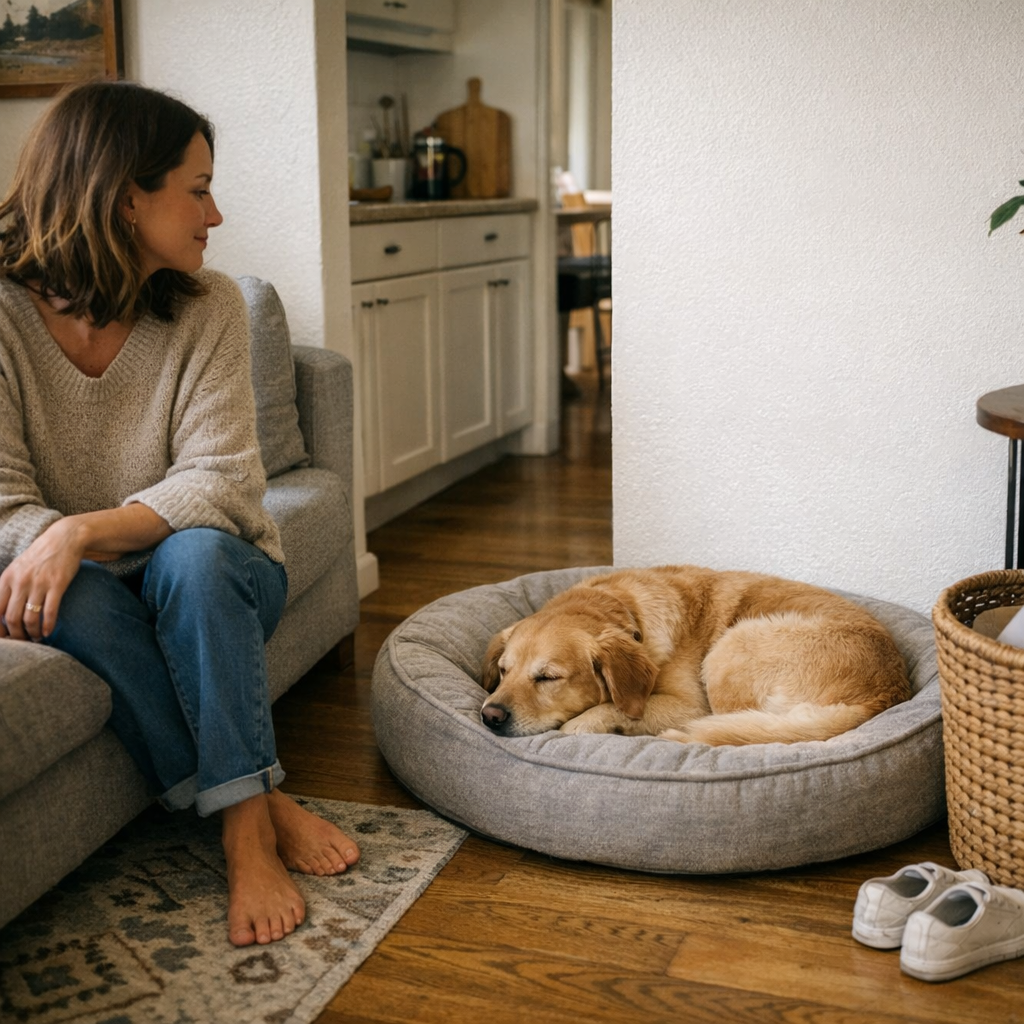
A dog bed looks like a solution—until you’re nudging it aside for the third time in one morning. You tell yourself it’s temporary: after the next vacuum, once the groceries are in, when the dog finally settles. What actually happens is a steady crawl of small hassles: squeezed footpaths, a dog that hovers awkwardly at the doorway, and a spot that never quite feels “set.” Underneath the neat surface, a drifting bed jams up daily routines, trips up transitions after walks, and chips away at both your dog’s comfort and your own flow. At DogPile, the real test isn’t how the setup looks—but how much daily drag it adds, or removes.
The Invisible Cost of a Wandering Dog Bed
You shift the bed to vacuum, wedge it near the door hoping your dog will settle, or push it out of the way before friends arrive. Each tweak feels inconsequential—until your dog stops at the threshold, waiting for a cue, or you find yourself awkwardly kicking the bed aside with an armful of laundry. The “just for now” habit creeps into every routine. Return from a walk, and the bed is blocking access to wipes. Go to put away dog gear, and you’re sidestepping padding that drifted back into your path. Your dog paces, circles, sometimes hesitates before committing to a spot that’s always on the move.
It’s not just your patience wearing thin. As the weeks go by, these resets begin to stick out. The living room slants out of symmetry. Your walk from front door to kitchen gets choppy. Your dog senses the shift, lingering in walkways or avoiding that spot altogether. Tiny interruptions stack up into a routine drag: the day never feels reset, and your dog’s rest is unsettled without ever being obviously wrong.
Spotting the Signs of Bed Drift in Daily Life
Rarely does “bed drift” slam routines all at once. Instead, friction shows up in moments you barely register—until you realize how often they repeat:
- A bed edge blocks the hallway when you’re hauling in groceries or crossing with laundry.
- The bed migrates into your walking lane—sometimes after a quick guest cleanup, sometimes thanks to a careless nudge.
- Your dog pauses at doorways, waiting for the obstacle to be shifted instead of just settling down.
- The endless micro-reset: straighten, fluff, align, repeat, until your hands do it automatically without thinking.
- You delay cleanup because moving the bed feels like one ask too many—never fully committing to leaving it or shifting it again.
By week’s end, the collective detours and hesitations slow everyone down. You feel it most during routines that ought to flow: leash-off at the door, grabbing a clean towel, prepping for bed.
Routine Friction: When Function Loses to Tidiness
A tidy placement rarely survives the day. The bed that looked neatly tucked after breakfast now crowds the kitchen as your dog follows you for snacks. By lunch, it’s catching stray water or blocking storage bins. Come evening, it’s worked its way across the living room, edging into the walk path you need for a clear reset before bed.
The trouble isn’t moving the bed once—it’s the cascade of small fixes. Each repositioning answers an immediate problem but sows new chaos a little later. A “nice” room gets harder to use. A predictable rest zone for your dog turns into a puzzle, which means more circling, more hesitation, maybe a flop in exactly the worst spot. Visible order isn’t routine order. The more often you rearrange, the less functional the setup becomes during ordinary, repeated use.
Common Scenes Where the Drift Shows Up
- After a walk: You drop the leash, reach for wipes—blocked once again by the bed, right when you need fast paw cleanup.
- During chores: Vacuuming pulls the bed askew, and nobody bothers resetting it, so the next crossing becomes a sidestep or stubbed toe.
- Hosting: Someone sets the bed “out of the way,” and now your dog waits, adrift, for a cue that never comes, the spot never fully restored.
- At bedtime: Your dog searches for “their” place, circles longer, or nudges the bed until it’s closer to where it was—meanwhile, you notice your own sense of calm hasn’t quite arrived.
Building a Steady Resting Zone: Why a Fixed Bed Beats a Mobile One
Some owners eventually get fed up, pick a spot, and keep the bed there—resisting the urge to optimize for a quick tidy-up or better photo. The right location isn’t always obvious, but it consistently works better if it frees up footpaths, keeps gear reachable, and doesn’t need another move each time life shifts.
Visible differences in daily life when the bed is fixed:
- Smoother routines: Physical flow improves—a deliberate gap of two feet keeps walkways clear, no more juggling laundry and maneuvering around dog padding at once.
- More predictable settling: Your dog heads straight to their one spot after walks or play, cutting out circling and hesitation.
- Less daily wear: Since the bed isn’t dragged or bunched, it holds its shape, corners stay tidy, and you’re not fluffing or re-centering after every reset.
Often, nothing else at home changes—but the days suddenly run smoother, and rest becomes more reliable for both dog and owner. No single routine is “transformed,” but the subtle friction fades. The room stops fighting you back.
How Much Distance is Enough? Finding the Buffer That Works
Is there a perfect distance from the bed to the walkway or door? There’s no formula, but in ordinary routines, a two-foot buffer is usually enough to avoid the worst crowding. The goal isn’t exile—it’s keeping walk lines hazard-free, so you aren’t always calculating angles carrying towels, meal bowls, or gear.
The right buffer solves repeated hangups:
- Keeps foot traffic flowing, especially when hands are full or the pace is quick
- Kills the endless debate—move the bed now, or later?—by making placement automatic and out of the way
- Stops the cycle where you ask your dog to move, apologize for nudges, or disrupt their rest to regain floor space
Your dog settles faster; so do you. There’s no scramble, no “almost-tripped” feeling, and the house structure finally works for both species.
What If You Actually Need Several Beds?
If your dog tracks you around the house, or the living space is open and busy, one fixed bed isn’t always enough. Multiple reliable spots—by the door for checking outside, near the sofa for evening downtime, and a quiet rest corner near a crate—means nobody is stuck shuttling bedding twice a day. The trick is consistency: each location needs to remain stable, not get shuffled in a panic before guests or after chores.
That way, your dog never has to guess where they belong, and you’re not the one dragging gear from one end of the house to the other just to regain access or fix a suddenly crowded routine.
When to Move the Bed (and When Not To)
Some moves make sense: deep cleaning, big gatherings, or trialing new zones to see how flow improves. What doesn’t help is moving a bed to patch a cosmetic gap, or because you haven’t yet found a spot that solves the real daily annoyances. Every unplanned move creates a churn that outpaces any gain in tidiness.
Think of fixed bed placement—and the steady routines it unlocks—as a daily tool, not an afterthought. Persistent drift signals the setup isn’t working for actual lived routines, not just for quiet moments when the house looks perfect.
Small Fix, Real Impact: Recognizing What’s Working
The difference between a drifting bed and a stable resting zone sounds insignificant—until routines unfold without the slow drag of constant adjustments. The next time you catch yourself or your dog hesitating at a half-blocked doorway, or stalling out mid-chore, pause and notice: the setup isn’t just about dog comfort or appearance, but about practical, repeated function that holds up under ordinary home pressure. Getting this one point right opens up the rest. See how the right setup can stabilize your dog’s routine at DogPile.