
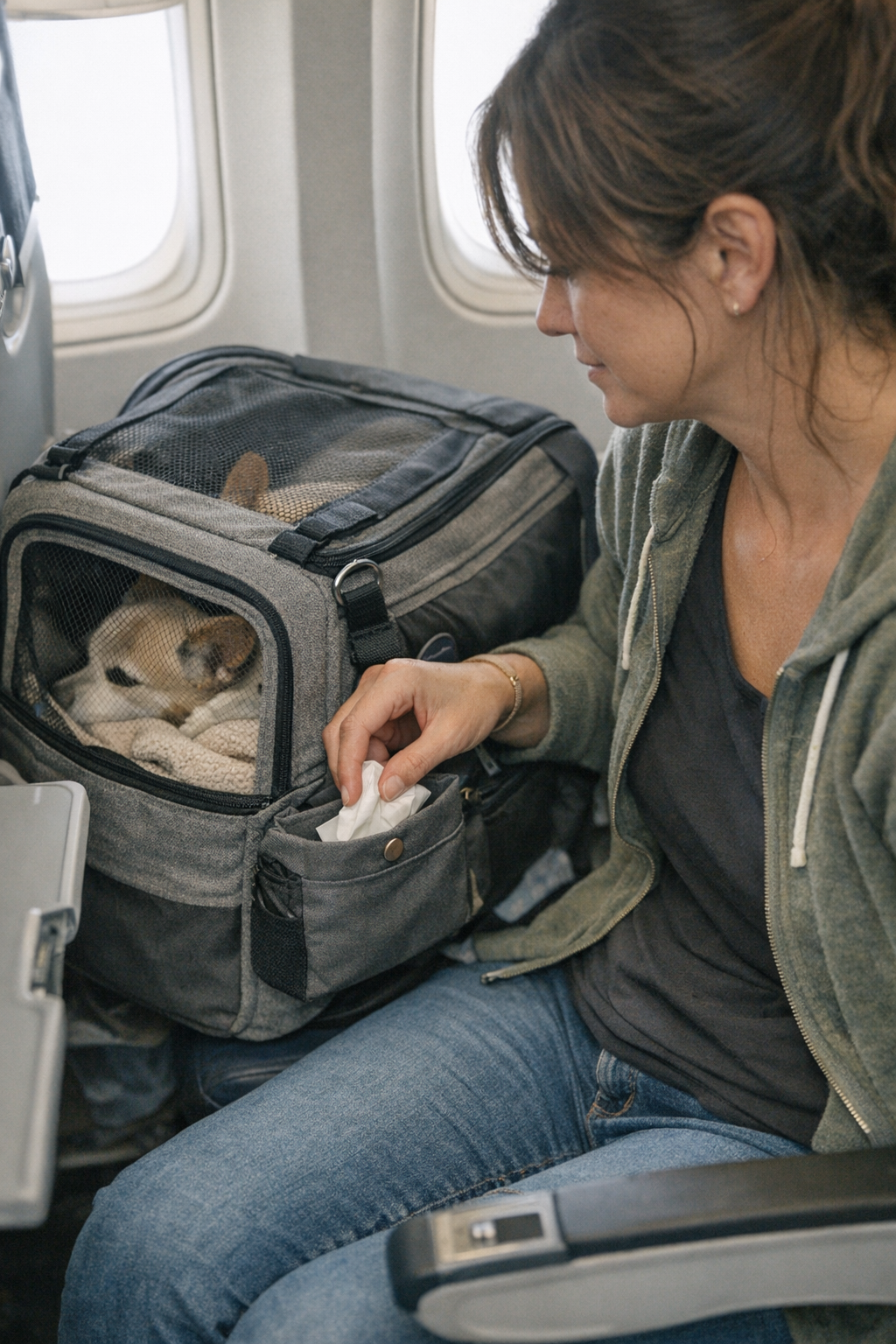
The weak point in a pet-travel setup usually isn’t obvious when you first zip it closed—it shows up in the middle of a trip, when every reach and every stop drags more than it should. That “ready-to-go” bag on your kitchen floor transforms under real-world pressure: the moment you need a wipe for a small accident in a cramped airplane row or try to fish out a toy when your pet’s anxiety suddenly spikes. In too many setups, grab points are hidden beneath seat belts, pockets get blocked by blankets or straps, and the neat organization from home becomes a chain of small hassles that stack up minute by minute. Those aren’t isolated problems; they’re the cracks that disrupt your whole trip.
When “Organized” Bags Become Obstacles
Most pet-travel bags look disciplined right up until the rules of motion change. That stack of labeled pouches? Now jammed behind a carrier handle that’s pinned by a seatbelt. A zip pocket meant for “quick access” gets trapped by another bag’s shoulder strap. As soon as you need an urgent cleanup after a tiny spill, instead of one clean reach, you’re bending, twisting, and temporarily blocking your pet’s air space just to reach a buried supply. For every planned spot, there always seems to be one move that’s either out of order or twice as slow as you need. The tidy setup you trusted at the start is now stealing time and calm at every turn.
The real stress isn’t the one-off emergency—it’s in the routine moves that should be easy and aren’t. Reach for a chew at a stoplight, only to have to shift the entire carrier. Go for a water bowl, but the comfort blanket is wedged on top. Instead of smooth resets, every attempt means digging under, lifting aside, or repacking afterward. These frictions don’t explode your trip, but they chip away at comfort and control—a constant restart tax for setups that work better as a photo than on the actual road or runway.
The Cost of Slow Access: Real-World Travel Scenarios
Take the standard airplane moment: you’re seatbelted in with your pet at your feet, turbulence gets announced, and your pet’s getting fidgety from cabin noise. You try to calmly pull a toy or treat, but your current bag’s best compartment demands two hands and three moves: pull the bag from under a seat, unzip around an awkward corner, shuffle items dry or wet. If pressing through a crowd or under a tray table, you end up juggling with your knees, only to finally locate the right object just as the stressful moment crests and passes. In the rush, you can’t maintain a smooth handoff to your pet or yourself; it’s easy to drop supplies, bend awkwardly, or block your pet’s space—each detail slowing you down right when you need to be quick.
Now switch to a road trip, pausing for a short rest stop. Your organizer—attractive, well-labeled, full of pockets—starts to work against you when you need a single wipe: it’s under a second set of food pouches, nested inside a sub-pocket that looked “logical” at home. Each delay magnifies the pressure: windows down, ambient noise swirling, your pet half out of a harness, you’re forced to juggle layers of kit mid-parking lot. If you’ve ever had cleanup supplies spill or had to awkwardly shove everything back in on a sloping seat, you know that elegant at-home setups rarely stand up to repeated stop-go reality.
How Overlapping Items Slow You Down
The friction gets worse once pet gear starts bleeding into owner gear: your own charger cords tangled with spare leashes, snack pouches swapped between your needs and theirs. Every motion back to your seat brings another round of separation and reshuffling—one bag, too many jobs, no pause in the irritation. These overlaps create invisible setup debt, with each restart costing more attention and time than you notice at first.
What Actually Changes the Trip Flow
The answer isn’t doubling down on more compartments or chasing a “perfectly packed” checklist. The fix is structural: moving the true repeat-use essentials—cleanup, comfort, and hydration—out from buried or zippered spots and into unlocked, right-at-hand pockets that actually function in motion. A seat-side or outer pouch may not look spotless, but it wins every time you can complete a wipe, hand over a treat, or reset your kit without forcing your pet to shift, lifting the carrier, or spilling contents mid-turbulence.
In real use: you grab a chewable in two seconds, one hand, no drama. The carrier stays anchored, your pet stays calm, you get order instead of an unplanned mess. Repeat that small win five or ten times per trip and the pattern emerges—your routine becomes less fragile, interruptions get neutralized quickly, and your travel setup starts working for you, not against you.
Repeated Stops: The Hidden Test
The real verdict isn’t at takeoff—it’s after several stops or restarts, when speed and smoothness matter most. Every new reach is a test: will your item slide smoothly back into its home, or will you leave it out, building clutter and stress for the next round? If an essential returns to a visible, seat-level pocket, reset is instant. If not, you’re setting up tomorrow’s frustration today, stacking future problems with every round of forced neatness and hidden organization.
From “Packed Right” to “Works in Motion”
Every frequent pet traveler knows that what passes as “done” at home can be exposed in motion, especially on a day with multiple stops or tired, anxious moments. When you keep running into the same slight snag—dragging out the whole carrier just to retrieve a single wipe, reaching around the blanket you used ten minutes ago, repeating the same awkward stretch each time—it’s no longer a minor annoyance; it’s a recurring weak point that slows the whole trip. Prioritizing surface tidiness too often means trading fewer messes for more moments of sudden interruption and reset, costing real energy and calm at the worst times.
True progress is measured in friction, not appearances. Even a smarter layout won’t erase every awkward move. You’ll still snag the wrong latch or block your pet’s view in a rush. But a structure built on real repeated use—and not just theoretical organization—shrinks the need for handling acrobatics and stops those small, familiar stalls from eating into your routine. That is what actually lifts repeated travel from barely manageable to reliably workable, trip after trip.
If you’re burned out by the same movement slowing you down every time, don’t just swap gear—look at where, how, and when your essentials get put back into reach. For pet travel kits tested against seat-side access and real trip flow, check out PawGoTravel.