
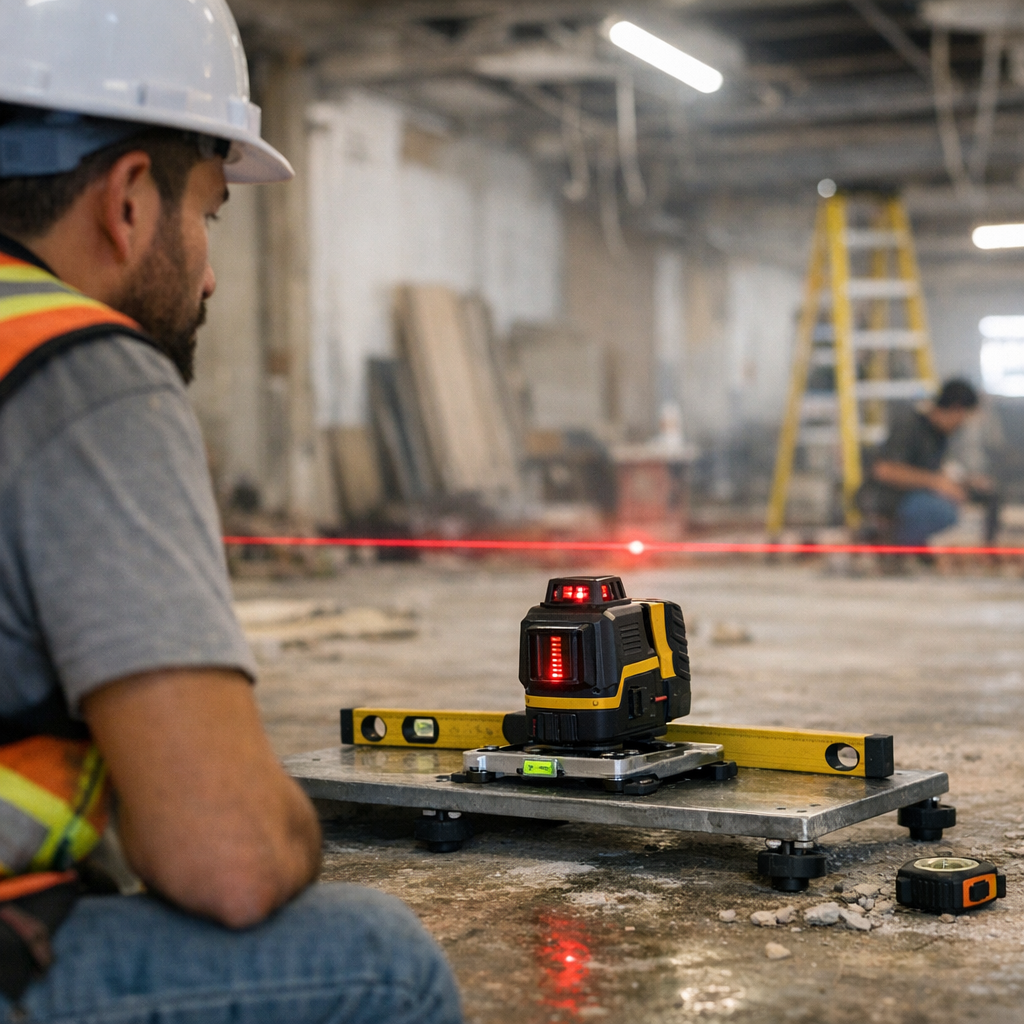
The concrete looks fine—until your laser level proves otherwise. In the haze of jobsite LEDs, the slab tells a simple lie: “I’m flat enough.” Then comes the reality check. As soon as that crisp laser line cuts across the workspace, it wavers, jittering with every subtle imperfection beneath your boots. Anyone who’s tried to mark, drill, or hang long runs on questionable floors knows the feeling—the slow, creeping drift that turns a straight line into a source of second-guessing and wasted time.
The Real Fight: Floor Drift Versus Laser Truth
On paper, setting a laser is quick: tripod up, flip the switch, get to work. In real-world interiors, nothing cooperates that easily. Beneath fresh overlays and patched composite lurk dips, spongy rot, and echoes of old repairs. It doesn’t take much—just a shallow hump, a thin seam, or another trade hammering in the distance—to trip up even the best self-leveling system. The laser isn’t blind; it responds to everything the floor throws its way, magnifying small errors over every extra foot you try to cover.
Tripods: Friends Until They Fail You
Try this: set your laser where you always do. Everything looks solid, until a few steps or one stray hammer strike sends the line sliding. The problem isn’t always dramatic. Sometimes it’s nothing more than a tripod leg sunk into a hidden pocket, or a setup parked too close to an expansion seam. But those tiny missteps have outsized consequences—a wall track slightly skewed, a drill line that slowly inches off spec, an afternoon of corrections for what should have been a one-and-done.
I’ve watched a laser track perfectly for layout drills—then lose integrity the second the HVAC crew thundered past, leaving my anchors chasing an imaginary straight. Finished measurements on paper always promise accuracy ±1/8 inch, but that spec shreds fast if your base flexes or talks back. Even a half-soft subfloor forces you to redraw, re-measure, and remake your cuts, grinding your schedule and your patience at the same time.
Two Floors, Opposite Outcomes
It’s never just the surface look. One week, two jobs: both slabs claimed to be flawless. On Project One, the laser line was sharp and faithful sunup to sundown—straight drill runs, bracket installs, and no surprise adjustments. On Project Two, under nearly identical light and tools, the line snaked away from initial marks just minutes after setup. The culprit? Buried rises that carried every small vibration straight into the laser’s core, making precision a moving target every time a dolly rolled past or someone dropped tools behind me.
Invisible Flaws, Visible Cost
At distance, both floors seemed trustworthy. Only when the first cut went wrong or drill bit started biting a shade off mark did the underlying reality show itself. A hidden pocket of fill, an old leveling patch—these details don’t advertise themselves, but their effects echo across every measurement. That gap between “looks fine” and “is actually fine” expands quickly, especially for jobs where dozens of fastenings and lines have to dovetail over long spans.
The Chaos of Renovation: Floors That Won’t Behave
Mid-strip retail jobs are a masterclass in instability. There’s never just one surface—a roll of tile glue, exposed trowel marks, stubborn mastic—all layered atop each other. Getting lines for gridwork or bulkhead channels across 40 feet seems straightforward until the foot traffic ramps up or bins slide out of the way. The laser’s line starts drifting after lunch, not because the tool gave up, but because the world underneath is always in motion. Ignore it, and next thing you’re ripping anchors and patching mistakes instead of wrapping up the day.
Adapting: From Blind Faith to Hands-On Checks
There’s a point where you stop blaming the tool and adjust your approach. I started leaving the stock tripod in the van, swapping in plywood scraps for a broad, low-touch surface right on the most solid section of concrete I could find. Tripod legs spread as far out as possible, not perched in some tight cluster. Before so much as firing up the laser, I took a trusted four-foot level and mapped for dips and rises by hand. The right platform killed half the ghost-drift instantly. Floor too soft? Skip it—move to another spot, or layer plywood until you’ve got some consistency. After that, the lines stayed tight, making it through breaks and fit-ups without needing another full do-over.
Your best tool is still limited by the ground you trust it to. Losing five minutes to verify and re-level is better than sacrificing half your anchors to bad marks. On longer runs, I now re-check both ends every hour or so, not out of paranoia, but because I’ve learned that floors make their own rules the moment your back is turned.
Small Tweaks: Where Precision Becomes Habit
Practical reality: even the most rugged laser is only as precise as its perch. A stray sander on the next room, low battery roulette mid-cut, or the flex of an aging subfloor—all can tip what’s “level” into a guessing game. This applies across the board: mounting tool racks, setting shelf levels, even punch-list fixes when you’re already exhausted from layout corrections. Shaky support multiplies fatigue and forces you to work slower, sometimes with a hand always on the tool, never fully trusting it will hold its mark when you step away.
Tip: Spread Out and Stay Low
If the laser betrays you once, don’t just readjust—rethink your stance. Flatten your base. Go wide. The broader the tripod or board, the less wobble and the fewer aftershocks. Bring everything as close to the slab as possible. Before you lock in, sweep the chosen zone with a box or digital level—five minutes spent there pays you back through faster progress and fewer costly resets. Working over suspect flooring? Layer up with plywood or find a clean patch. It might seem like overkill, but it means you’re not correcting for mystery shifts you can’t see coming. The goal is predictable performance, not gambling on “good enough.”
On Alert: Catch Surface Drift Before It Costs You
The worst kind of trouble hides in subtlety—a gradual drift you fail to spot until patching is unavoidable. If your lines aren’t matching up at distant marks, or if the laser visibly wobbles after someone walks past, take the hint. Pause, re-examine, and—if needed—pick up the rig and start again one bay over. Floors aren’t evil, just indifferent. They don’t care how careful your measurements are if your support slips each time the room vibrates.
Most mistakes aren’t dramatic—they’re slow creeps you can head off if you’re watching for them. Plumb accuracy is about constant adjustment, not naive trust. Good marks and clean work only become routine when your process is grounded—literally—in surfaces you’ve tested and tamed.
Next install, next cut, next round of bracket holes: treat the ground as an active part of your setup, not just blank scenery. Bad runs are part of the job, but finding your own fix means you’ll make fewer of them, and waste less time chasing the perfect line that never quite settles without your help.
Visit Gumboll for practical tool solutions built for real jobsites.