
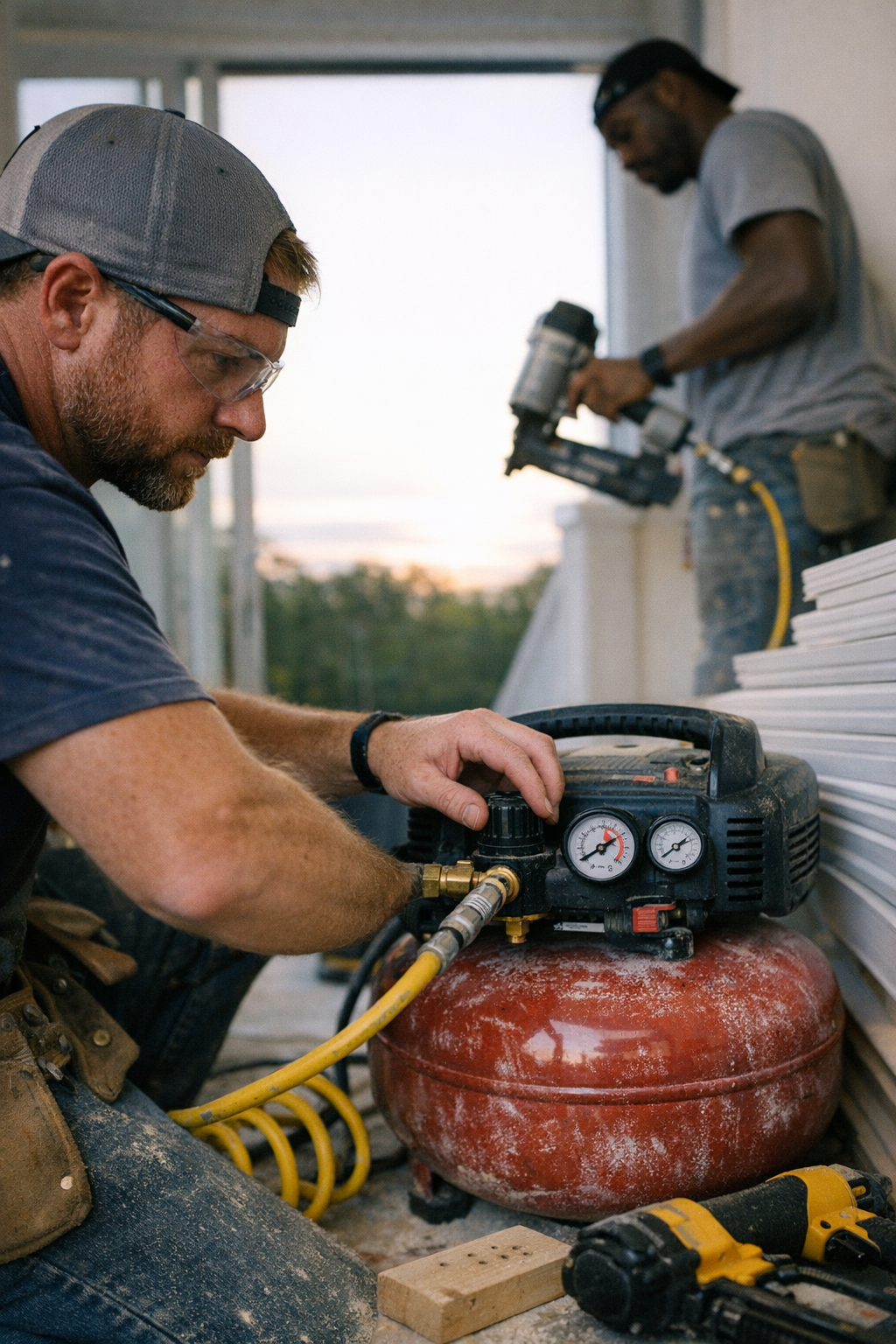
The sharp kick of a compressor firing up isn’t just background noise—it’s a signal that the real work is about to start. Whether you’re gunning baseboards in a tight hallway or piecing together crown molding at the top of a shaky ladder, every trade person knows: your setup is the difference between a day that flows and a day you spend fighting your own tools.
When Nailer Depth Throws You Off
The routine starts smooth—a fresh box of nails, regulator needle steady at 100 PSI. Then you sink the first finish nail and—of course—the head stands proud, snagging your fingertip as you sweep the board. Next shot buries itself deep, a crescent divot in the trim you’ll be patching later. That’s the reality: even after years with the same trim nailer, depth inconsistencies pop up and break your workflow.
The manuals say, “Keep pressure between 70–120 PSI.” But jobs aren’t static. You switch from MDF to maple, swap out 1 1/4” nails for 2-inchers, or walk your compressor into a colder room—what held steady an hour ago is suddenly unpredictable. The regulator doesn’t warn you about a swollen hose or a bit of grit in the nose, and it definitely won’t fix a nailer that’s due for a cleaning.
When the Regulator Lies and the Work Shows It
Maybe you’ve done the side-by-side test: two nailers, both at 100 PSI, on the same chunk of trim. One drives flush, the other leaves the head exposed. A hidden air leak? Gummy piston return? Sometimes it’s as simple as a sticky trigger or old oil thickening in cold air. The result doesn’t show up on the dial—it shows up in your finish work, every time you have to stop and patch a mistake.
It’s mechanical small talk. Worn seals, aging springs, compressor thumps echoing on cold mornings—you’re always chasing some variable. Even with all the dials in the “green zone,” you get streaks of nails needing a re-do. It’s the jobsite reality: there’s no set-and-forget, not if you care about finish quality and keeping your pace steady.
Switching Materials: The Job Changes Under Your Hands
If you’ve ever watched a nailer skate flawlessly into pine, only to split the fibers on poplar or sink invisibly into MDF, you’ll know: the board itself rewrites the rules. Nail heads start riding high, marring visible seams, or dive too deep and threaten the joint’s hold. And it’s not just woods—angled cuts, overhead shots, or switching from 18-gauge to 16-gauge fasteners all add friction.
This is the point where confidence tilts toward caution. No experienced crew just trusts yesterday’s setup. Adjustments become ritual: slight tweaks to pressure, swapping out punchy batteries, testing bits or blades after a few runs—each variable gets its moment in the spotlight. The faster you can pivot, check, and re-tune, the less you end up chasing lost time or ugly surprises.
Forget Memory—Build a Reset Habit
It’s easy to go by feel, glancing at the regulator and trusting your rhythm—but that’s where most trip-ups happen. Maybe you’re moving fast on a high bid and decide not to bleed air when something feels off, promising yourself you’ll “deal with it after this run.” That shortcut almost always costs you more: the nailhead that won’t sink, or worse, a board ruined by a blow-through.
Start at 90 PSI for most finish work in pine or basic MDF—yes. But as soon as you change materials, switch up fastener size, or relocate gear, you need to reset. Grab scrap, pop a few test nails, actually check the result. On dense hardwoods or thicker boards, count on needing extra tweaks mid-batch. These aren’t wasted seconds—they’re how experienced crews make up the difference between constant fixes and clean, continuous progress.
Tip: New Batch, Fresh Setup
Whenever something changes—the wood type, the weather, the tool—take a brief pause. Shoot test nails into off-cuts. Feel for that perfect head: sitting just under the surface, no filler needed. Those five seconds head-off much bigger problems: split trim, ugly shiners, endless sanding later.
Beyond PSI: The Ghosts in the System
Pressure alone can’t explain every problem. A dry driver blade, uneven lube on slides, or debris jamming the magazine can play havoc, sometimes more than a pressure dip. Swapping out blades, topping off oil, or actually cleaning a gunked-up mechanism does more for precision than ratcheting up PSI ever will.
And don’t forget the jobsite itself. Morning humidity, extension cords dragging power down, hoses snaking across rubble—all introduce variables that undermine the most careful prep. Light at a bad angle hides proud nail heads until too late. Always test in the actual light where you’ll be working. Trust your eyes and hands, not just numbers on a gauge.
Habits That Kill Surprises (and Saves Your Day)
After a while, muscle memory alone won’t cover you—the pros separate themselves by having tight, repeatable routines. Checking pressure every batch. Test-driving a fresh battery or new bit before an important cut. Running sandpaper over a blade to clear pitch before starting a run. It’s a string of small checks—less glamorous than speed but far more likely to keep your work trouble-free.
Every workday has its curveballs: hoses that snag on debris, fasteners that seem just a hair different from last week’s, boards that don’t cooperate. Learning to expect those quirks and pause for an extra check is what keeps your jobsites humming. These aren’t time drains—they’re the habits that separate “good enough” from sharp, clean results you can walk away from proud.
In the end, the gauge is only advice. Every nailer acts a little different, every batch of trim comes with its own attitude. Trust what you see, what you feel in each strike—reset, recheck, and let your rhythm be shaped by the small deliberate habits that actually keep things moving.
Find practical, work-ready tools and accessories at Gumboll.