
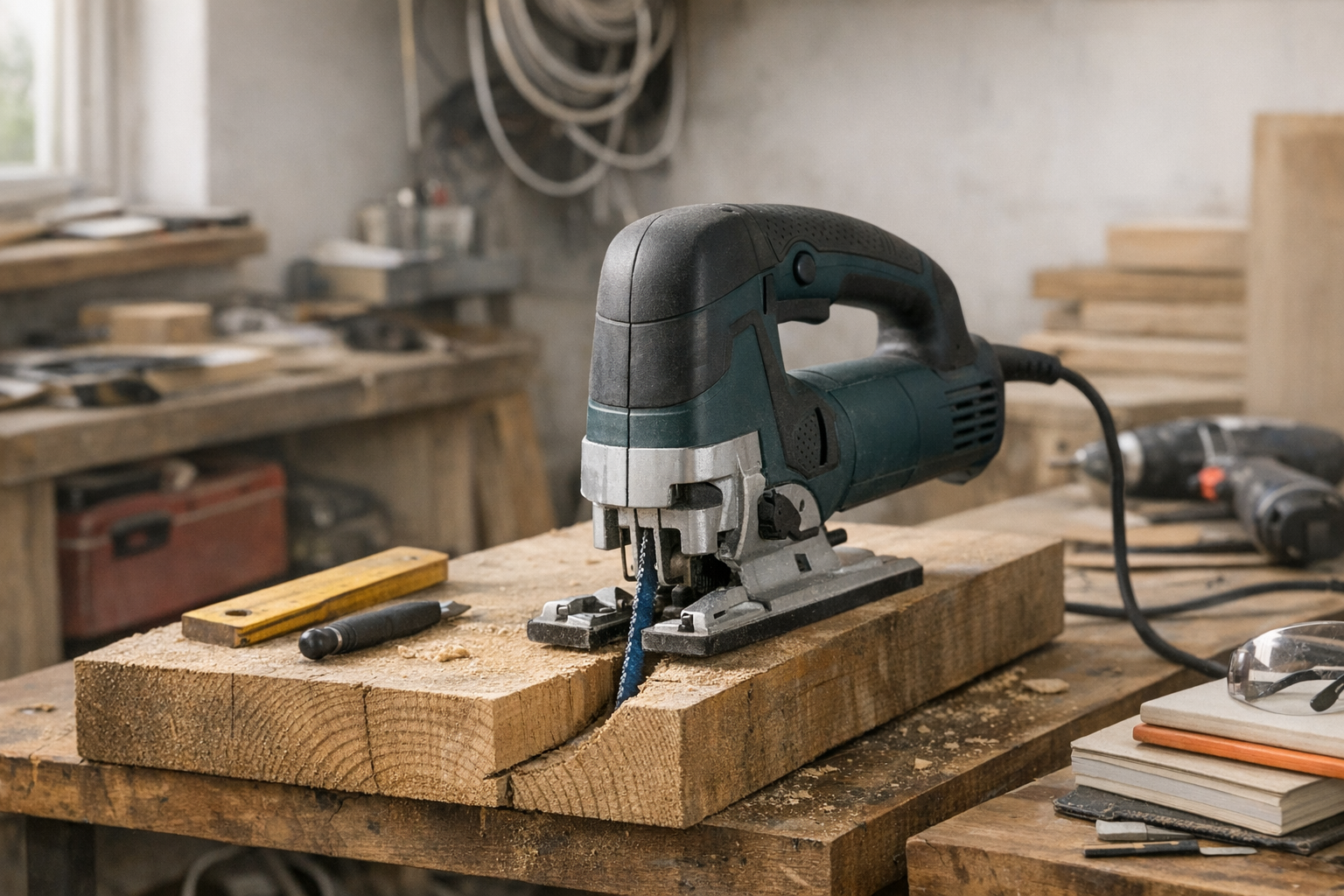
Understanding Why Jigsaw Blades Bend on Thick Material
If you’ve ever struggled to make a straight cut with a jigsaw through thick wood or plastic, you know how frustrating it can be when the blade starts to bend or wander off course. Despite how simple jigsaws seem, cutting deeper into thick stock often reveals an unexpected challenge: the blade flexes, causing curved or uneven cuts.
This isn’t just a matter of a cheap blade or faulty tool. It’s a complex interaction involving blade design, material characteristics, and technique. Let’s break down what’s really happening inside your jigsaw as you cut through thick material.
The Physics of Blade Bending
Jigsaw blades are intentionally thin—usually between 0.6 mm and 1.2 mm thick—to allow them to move quickly and make curved cuts easily. However, this thinness also makes them vulnerable to deflecting under pressure. When a blade is cutting through wood thicker than about 2 inches (50 mm), more material pushes against both sides of the blade, creating friction and resistance.
The deeper the cut, the more leverage the blade has to bend sideways. If you push or speed up the cut too much, the blade bows under the load instead of cutting straight down.
Common Causes of Blade Bending and How to Avoid Them
1. Blade Selection and Geometry
Blades with fewer teeth per inch (TPI), such as 6–10 TPI, allow faster cutting but tend to be more flexible. Finer blades (14–24 TPI) have higher stiffness and hold straighter cuts in thick materials, though they cut more slowly. Also, blades designed for deep cuts are usually wider and thicker (around 7 mm wide and 1.2 mm thick) and made from bi-metal or high-speed steel (HSS), which offer better resistance to bending.
2. Incorrect Orbital or Pendulum Action Settings
Many jigsaws feature orbital action that moves the blade in an elliptical pattern for faster and more aggressive cuts. While great for thin or soft materials, orbital action increases lateral forces on the blade when cutting thick stock, causing it to flex and wander.
Solution: When working with thick materials, set the orbital action to zero or the lowest setting. This keeps the blade moving straight up and down, minimizing side stress.
3. Excessive Feed Pressure and Speed
Applying too much pressure or pushing the saw through thick material too quickly forces the blade to bend. Conversely, cutting too fast increases friction and heat, further softening the blade and leading to deflection.
Solution: Let the blade set the cutting pace. A typical speed range for thick hardwoods or dense plastics is 500–1000 strokes per minute (SPM). Resist the urge to muscle your way through the cut.
4. Tool Misalignment and Base Plate Angles
If the base plate isn’t perfectly square to the blade—often a subtle 1–2 degree tilt—it worsens blade deflection on deep cuts. Over time or with impacts, your jigsaw’s shoe can become misaligned.
Solution: Use a carpenter’s square or try cutting a test board. If the cut isn’t perpendicular, inspect and adjust the base plate or seek repairs. Even small angles off vertical translate to visibly crooked deep cuts.
5. Dull or Damaged Blades
A dull blade doesn’t cut efficiently; it scrapes instead, generating excessive heat and causing the blade to soften and bend. You may also notice burn marks or smoke.
Solution: Replace blades regularly, especially before deep cuts. Keep extra stiff bi-metal blades on hand designed for your material type.
Real-World Experience: Lessons from the Workshop
Early in my woodworking journey, I treated jigsaws like magic sticks: point, cut, done. But thicker boards revealed the limits quickly. My blades would bend, wander, and sometimes break.
The game-changer came when I consciously slowed my pace and paid attention to the blade’s behavior. Instead of forcing a cut, I allowed the blade to “lead.” If the blade moaned or the cut started to stray, it was a signal to relax my grip and ease off straight away.
I also started to pause every 30 to 60 seconds during thick cuts. This brief rest lets the blade cool down, preventing heat-induced warping and increasing blade longevity.
Refresh Tip: Shift Your Mindset from Rushing to Listening
It’s easy to get tunnel vision when focused on finishing a project quickly, but stepping back can bring surprising improvements. The next time you feel tension or frustration while cutting, pause and listen to your saw. How does the blade sound? Is it cutting smoothly or laboring? Does it seem to be bending? Let this feedback guide you rather than pushing harder.
Tips to Achieve Straighter Cuts on Thick Material
Choose the Right Blade
- Opt for wide, stiff bi-metal blades with a thickness around 1.2 mm for stability.
- Match TPI to material density: 10–14 TPI works well on hardwoods and plastics.
- Consider blades labeled for plunge cuts or thick-stock use.
Adjust Your Saw Settings
- Set orbital/pendulum action to zero for cleaner, straighter cuts in thick stock.
- Use moderate speed (500–1000 SPM) based on material resistance.
Perfect Your Technique
- Feed the blade gently, let it do the cutting.
- Pause regularly to let the blade cool, especially on cuts deeper than 1–1/2 inches.
- Inspect and straighten the base plate if necessary.
When Cutting Thick Materials, Patience Pays Off
Blade bending isn’t a failure or a sign that your jigsaw can’t handle the job—it’s a natural consequence of physics. The right combination of blade choice, saw settings, and a bit of patience transforms a frustrating challenge into a manageable process.
Once you master these subtle adjustments, you’ll notice straighter, cleaner cuts and less material waste. Your blades last longer, and your confidence in tackling thick stock will grow.
Remember, a jigsaw that feels like an extension of your hand—not a tool you fight against—comes from understanding the tool’s physics and tuning your technique accordingly.