
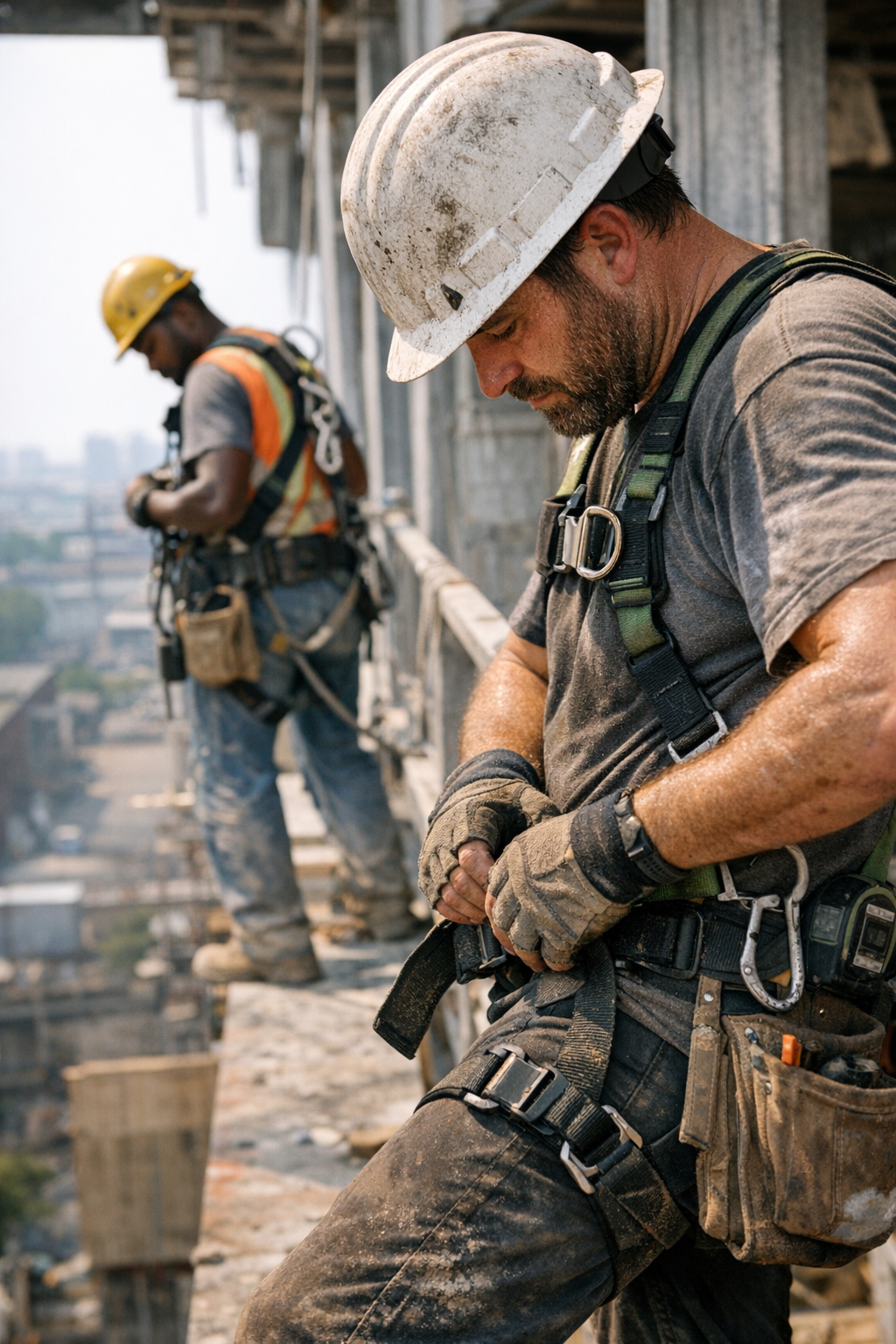
It’s that moment on site when your back feels drenched in sweat, scaffolding glints in the harsh light, and even the harness straps feel abrasive against your skin. As you twist at your waist, your hand instinctively checks the leg strap buckle—something feels pinched again. It’s a quick pause, but an important one. This hesitation comes from experience; remembering a close call years ago keeps you vigilant. This is often where fall arrest failures begin during long construction days: when discomfort turns into routine neglect and subtle changes in harness fit and tension go unnoticed amid fatigue and repetitive motion.
Why Fall Arrest Failures Happen Over Time
Most fall arrest failures do not result from faulty equipment or a neglected morning inspection. Instead, they start with gradual stretching of the webbing, shifts in anchor points, and a slow loss of tension compounded by hours of movement and sweat. A harness that feels tight and reassuring early in the day can loosen without you realizing it, increasing risk dramatically. When fatigue sets in, and tasks pile up, small changes in fit and equipment setup fade into the background. This buildup creates dangerous conditions that often emerge only during a slip or fall.
Consider this: you adjust your harness at 7 a.m. so it fits snugly. By midday, continuous movement—crawling under beams, climbing ladders, shuffling across platforms—causes straps to loosen, buckles to shift, and the dorsal D-ring to ride lower than intended. If unnoticed, these subtle changes compromise the harness’s ability to arrest a fall safely. Many workers feel the discomfort of a tight harness early on, but few recognize how that comfort deteriorates as hours pass.
The Real-World Impact of a Loose Harness
Imagine two carpenters side-by-side: both wear similar high-visibility harnesses, both have completed initial equipment checks. One has the D-ring properly aligned between the shoulder blades; the other’s D-ring has slipped half an inch lower after repeatedly ducking under scaffolding. Their lanyards are connected to anchor points, but the first has clipped onto a certified anchor rated for fall arrest, while the second uses a sturdy but non-rated pipe.
When a slip happens, the outcomes differ significantly. The properly adjusted harness safely absorbs the shock, arresting the fall with controlled force. The misaligned harness combined with an uncertified anchor results in webbing sliding upward dangerously during the fall, increasing the risk of injury. I’ve witnessed incidents where these small differences—imperceptible to the eye but critical in safety—determined whether a worker safely caught themselves or suffered a serious injury.
Case Study: A Real Spring Shift Incident
During an intense spring session on east-line truss assembly, our crew was hauling heavy, awkward beams. The afternoon heat made everyone sluggish, movement was slower, sweat leaked under helmets. Suddenly, a loud snap and a shout broke the rhythm. Two carpenters fell simultaneously, wearing nearly identical harnesses and lanyards, yet their falls had very different outcomes.
One’s lanyard, left slightly slack and hooked onto a makeshift bracket, almost let him fall over the edge. His feet dropped below floor level before he managed to grab the truss beams, thanks largely to his quick reflexes. The other, who regularly adjusted the lifeline tension as he moved, remained upright and stable, his harness absorbing the sudden load. Both started the day with proper gear and checks, but their choices to maintain tension and manage slack mid-shift made all the difference.
The Importance of Rechecking Harness Fit Every Few Hours
From that day forward, I adopted a personal rule: carry out a “three-hour recheck” on my harness. At least every three hours, especially during long, strenuous shifts, stop and evaluate fit and tension. This quick pause focuses on key areas:
- Checking the dorsal D-ring position—centered between shoulder blades, no lower than mid-scapula, and aligned within an inch
- Feeling for thigh strap tension—there should be no more than a flat hand’s width of gap; straps should never sag or twist
- Ensuring lanyards remain properly connected to certified anchors, without excess slack
This proactive approach prevents unnoticed fit drift caused by sweat, friction loss, and repetitive movements. Even during noisy, distracting afternoon shifts, these frequent hands-on checks catch rotated D-rings, loosened straps, or improperly secured lanyards before they become hazards.
Practical Tip: Use Visual and Tactile Cues
Make a habit of using both visual checks and tactile feedback during your rechecks. Look for the D-ring’s position using a mirror or a coworker’s help. Run your hands along the webbing to detect slack or twists. Muscle memory will develop, allowing faster and more accurate corrections throughout your shift.
Common Mistakes That Lead to Failures
Many workers assume that a harness approved in the morning inspection is safe all day long. However, this complacency overlooks how the workplace environment affects fit:
- Webbing shifts: Movement causes the harness to slide, and sweat decreases friction that normally holds straps in place.
- Anchor point errors: Connecting lanyards to handrails, non-rated brackets, or pipes that lack proper certification dramatically increases failure risk during a fall.
- Off-center D-ring: A D-ring positioned too low or off alignment exposes the body to harmful forces when stopping a fall, risking injury to the torso and spine.
Awareness of these pitfalls is crucial. I’ve seen experienced workers rely on substandard anchor points simply because they appeared sturdy, only for equipment to fail during a momentary slip.
Understanding Harness and Equipment Ratings
Modern fall arrest harnesses conform to standards like ANSI Z359.13, which specify maximum arrest forces of 1,800 pounds. This means a properly fitted and connected harness system will limit impact forces within a survivable range. But even the best equipment can’t perform as intended if slack develops, connectors are poorly secured, or the harness shifts during the day.
Think of it this way: an inch of slack in webbing or a slightly off-center D-ring doesn’t just reduce comfort; it fundamentally changes how the force is distributed. What should be a controlled stop can quickly become a jarring impact, increasing risk of injury and downtime.
Refreshing Your Workflow: A Small Shift that Makes a Big Impact
Try this simple refresh tip during your workday: use your scheduled breaks or transition moments as natural reminders to check your harness. Whether it’s a mid-morning coffee or the pause before a new task, take 60 seconds to perform a quick harness fit inspection and lanyard tension check. This shifts your perspective from “set it and forget it” to continuous safety vigilance without interrupting workflow significantly.
This small habit not only revitalizes your focus but reinforces safety as an active process, not a one-time task. Over time, these frequent checkpoints build muscle memory and keep you alert to subtle changes in equipment fit—often before discomfort or risk even registers.
Final Thoughts on Harness Safety in Long Shifts
Long, demanding days on construction sites rarely predict when equipment will need to perform in a fall. Straps loosen slowly, anchors flex slightly, and lines grow marginally longer as you move through noise and dust. Because these changes are gradual and often invisible, harness safety requires more than a morning inspection—it demands routine vigilance.
Always recheck your harness fit and anchorage points throughout your shift. Don’t let discomfort be the only signal you get. Even small corrections can prevent serious consequences.
Safety gear is your last line of defense—treat it with the same respect and diligence as you do your most critical tools. Your life depends on it.