
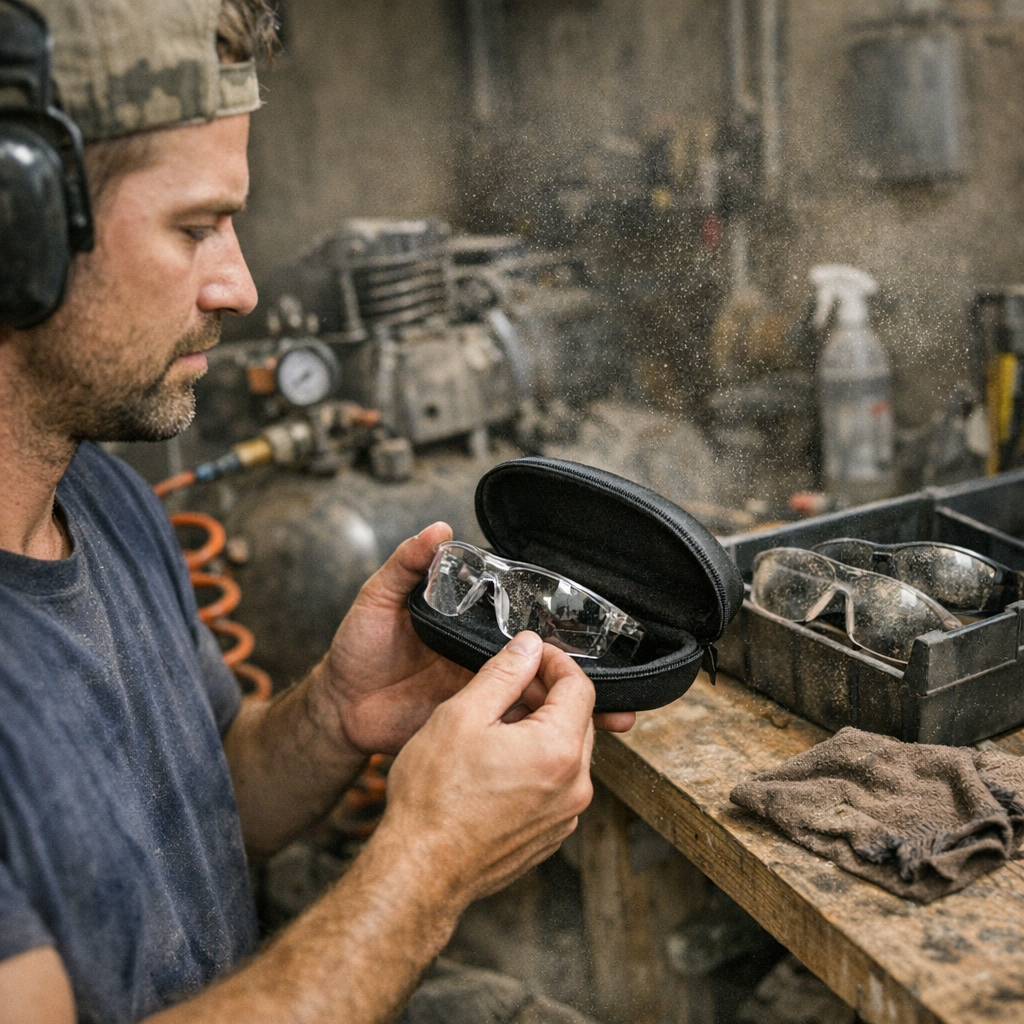
Scratches on your safety glasses don’t send a warning. Most days, you only realize what’s happening when the view gets hazy—right in the middle of a job that actually matters. It’s easy to shrug off those first faint marks as workshop grit, but by the time you’re threading a saw blade through finish work or lining up a pilot hole, you can’t wipe your way back to clarity. What started as simple storage—pouch, tray, edge of the bench—slowly turns into another layer of friction in your day: missed details, more squinting, a job that’s literally harder to see through.
It’s the Dust You Never Notice That Wears You Down
No two shops are the same, but every active bench has airborne crud floating around—whether it’s plywood fines from the miter saw or metal shavings kicked up by an angle grinder. Work means movement: drilling a run of holes, swapping bits, shooting compressed air across the vise. Each task adds to the dust in the air and—without noticing—onto the surfaces you trust. Set safety glasses on an open rack near a drill press, and it takes just a few cycles of air hose and tool change before new grit lands right where your eyes go next. By day’s end, that layer is ground in with every quick thumb-wipe.
Open storage works for a while because it’s fast. Glasses off for the close-in work with the router, back on for the sander, off again for a battery swap—seconds lost or gained. But the cost builds slowly, embedded in each micro-scratch and every time you grab the lenses without thinking where they sat last shift. After a week of work, that convenient tray starts clouding every line you’re trying to follow.
Why Exposed Storage Means Gradual Lens Ruin
Picture the real rhythm of the job: clamp, cut, brush debris, reach for glasses, repeat. A tray by the miter or a bin on the side of the bench feels like the obvious drop zone. But check the lenses after a few rounds—faint haze and scattered scratches show up long before the first big gouge. These don’t come from one careless moment; they creep in with every fine particle settling while you work, every casual toss back onto a dusty surface, every quick, gritty swipe to “clean” a lens mid-shift.
Wherever there’s traffic—crowded bench, power tools cycling, sawdust riding thermal currents—open storage is a silent liability. The glasses catch it all: sander dust in the afternoon, oily residue from a fastener change, even the blowback from a quick air nozzle blast. The more you task-hop, the faster the damage compounds, until you’re fighting to see center measurements or ghosting out score lines you could once follow without hesitation.
The Actual Difference: Closed, Lined Storage in Practice
The solution doesn’t need to be complicated—a hard case with a soft lining, stashed outside the main impact zone. What changes in real use? For starters, the case blocks that endless drift of fines and keeps the surface of your lens free from the fallout of every sander pass or exhaust blast. Mid-project, you knock out a dozen drive holes or clamp up for assembly. Glasses go off for intricate cuts, but if they wait in a closed case—rather than an open tray—they stay cleaner, with fewer interruptions to wipe or clear your view. Over the course of a build, the difference is less frustration, more accuracy where it actually counts, and one less excuse to reach for a replacement pair when you’d rather be finishing up your last battery pack of the day.
Work-Tested: One Case Versus the Open Rack
Try this over any real season. Place a set of glasses in a lined hard case a few feet upwind from grinder dust; keep a backup in the catch-all tray next to the drive station. Run through your regular pace—forty, fifty job cycles, switching from blade to bit, in and out of the compressor’s shadow. After two months, the cased pair shows just a few isolated scuff marks, mostly from hurried handling. The open-tray pair, though? It’s dulled all over, with scratches that glare out under shop lights, nagging you every time you need detail or contrast for a tight cut.
The Build-Up of Small Frustrations
Ignore the problem, and it finds you at the worst time. Trying to scribe a clean edge, crosscut a line, or check bit depth with foggy, dulled glasses is a direct hit to both accuracy and patience. The temptation is to blame the lens, but really it’s the daily shortcut—dumping glasses anywhere close, trusting last week’s pouch to still be clean—that adds up. The time spent re-cleaning, swapping pairs, or fighting through a blurred field of view is tool fatigue in disguise. It chips at job speed, confidence, and even safety, especially when each pause knocks you off your rhythm during a tricky assembly or deadline push.
Even the best polycarbonate lenses wear down if left exposed. The more you tool-hop, the faster the cycle—scratched lens, more cleaning, more replacement. The fix is neither expensive nor slow: use a soft-lined, rigid case and keep it clear of dust paths from saws and compressors. Over a full job cycle, the improvement is obvious in the time you save and the clarity you don’t have to fight for.
Habits That Protect Your Field of View
Buying a lined case is step one. But it’s where—and how—you use it that matters. Keep the case away from air hoses, exhaust, and sanding stations. Shake out the lining now and then, especially after a chaotic day. Build the reflex: glasses go into the case before you grab a rag, not after dust has had a chance to settle. These are ten-second changes that, repeated through daily cycles of cutting, battery swapping, and cleanup, keep your best view intact longer than you’d expect.
For anyone moving from miter saws to drill drivers in a single shift, or racking up dozens of tool changes before lunch, these routines pay back quickly. They don’t add friction—they smooth it out, reducing stop-start time and extending the life of every safety lens you depend on.
See Sharper, Work Smoother—Small Adjustments, Noticeable Difference
Serious scratches are a slow build: dozens of jobs, each one grinding in a little more clarity loss. But paying attention to how—and where—you store your glasses is an easy win when cumulative fatiguing problems are what you’re actually fighting. Whether you’re marking out sheet goods, running through cut lists, or prepping jigs for another pass on the router, the right storage choice isn’t about babying your tools—it’s about keeping them working at peak, so you can, too.
No fancy system required. Just a reliable lined case, used reflexively, is the difference between squinting through another shift or staying sharp for the work that pays. The clarity is in the habit—and the results turn up in every straight cut, every fine-line layout, day after day.
Find work-tested safety storage and more at Gumboll.