
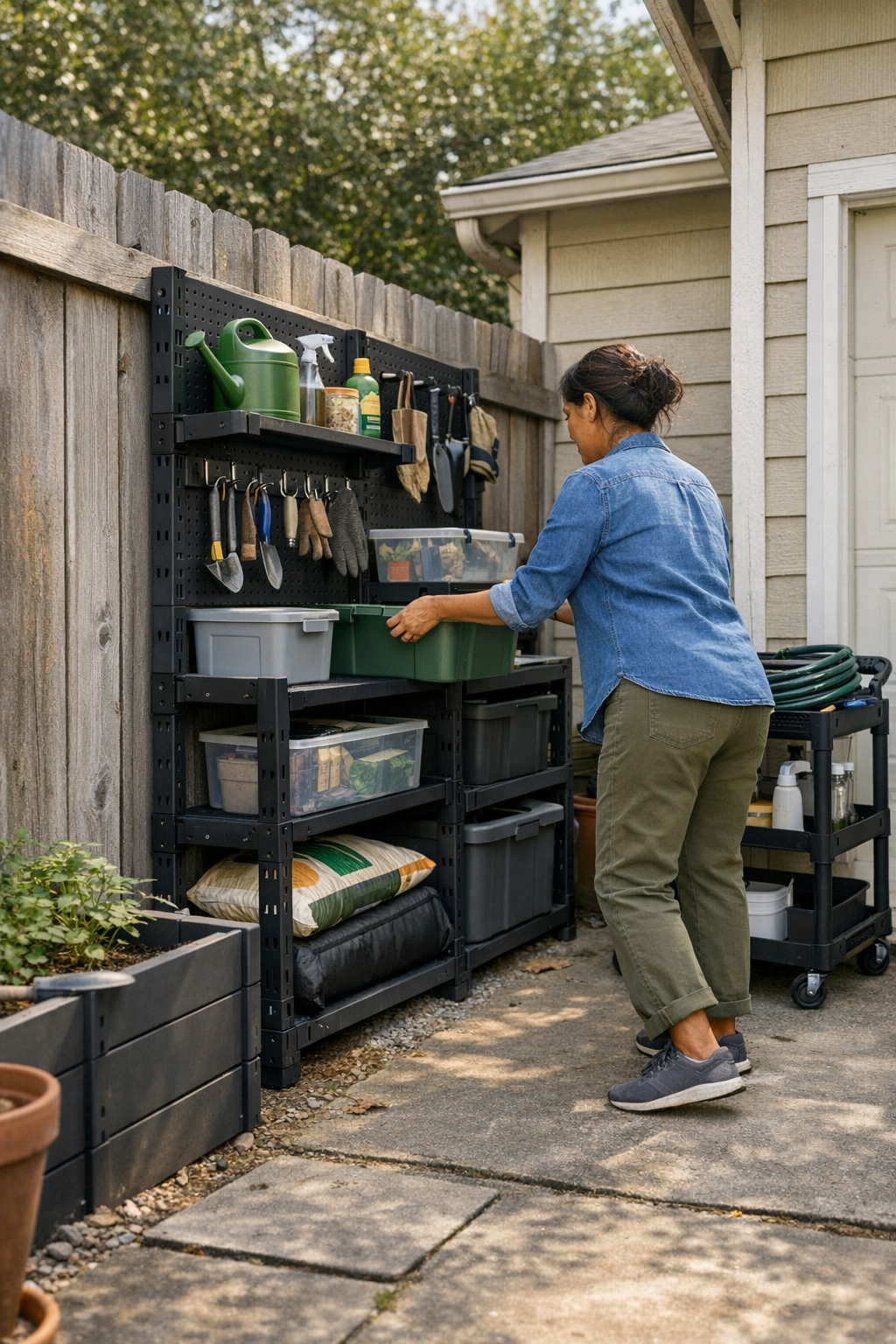
In a small yard, outdoor storage doesn’t just sit there—it quietly claims your route, squeezes your steps, and sets the rules for how you move. The “organizer” you picked for looks or capacity soon starts to redirect bikes, force sideways shuffles, and interrupt your flow in subtle ways. Real friction in tight outdoor spaces isn’t about how much stuff you can fit, but about how the setup actually collides with daily routine—when weather, chores, and family life keep cycling through.
How Storage Layout Shapes Every Step
Start with a side yard. It looks fine: bins lined against the fence, hooks spaced for each tool, nothing visibly crowded. But give it a week of use. A storage box nudges out just enough to knock your shin. Someone hangs the rake so it sticks into the walkway—“just for now.” By Thursday, your simple pass-through feels like navigating a slowly tightening maze.
The path shrinks without warning. Every time you grab a shovel or return a ball, you compensate—sidestepping that barely-there corner, pivoting extra to miss a bin lid, brushing sleeves on hooks meant for “convenience.” The space that looked organized Monday now drags on your patience by Friday. One lunch hour you’re wedging a garden cart through a spot that “should have fit,” realizing the layout only works when no one actually uses it.
The Compound Effect of Imperfect Layouts
Small yards punish loose planning fast. What starts as a tidy arrangement—deck bins hugging the fence, wall racks eating up air—quickly reveals its blind spots:
- Bins without a hard edge creep, sometimes quarter-inch by quarter-inch, until you’re rerouting your walk.
- Wall hooks designed for “maximum storage” become sleeve-catchers and hose tanglers the second routines heat up.
- Deck boxes morph from seasonal neat-fix to daily drop zones. Last Tuesday’s “just for now” compost pail is now blocking your morning bike exit.
Every inch gained is also an inch at risk. Small shifts—barely noticed during setup—amplify under real use. After a kids’ play session, bins overflow into foot traffic. Add weather, and now boots are drying where you used to walk. Suddenly, combining three purposes—tools, toys, sports gear—means you’re untangling a knot instead of moving on autopilot. The stress isn’t theoretical: it hits on real days, when someone’s late and the storage is in the way, not smoothening the rush.
Real Scenes: When Layout Meets Lived Routine
Returning One Thing—Blocking the Next
You finish chores, dump muddy boots in the storage box by the gate. By the third rainy morning, they spill out past the edge, forcing you to angle around just to bring in groceries. What was organized yesterday is now a toe-stubber. Bikes and chairs layer on, and suddenly one quick drop-off causes a cascade—you move one thing just to put away another. Routine resets become sprawling, tedious instead of quick.
The Sneaky Drift on the Fence Line
Hooks along the fence look sharp after a thorough reset—tools spaced, everything flush. By the week’s end, pruning shears have slid over, a rake now pokes out several inches beyond its lane. It’s not more stuff, just Stretched spacing. Over time, you catch your sleeve or shorts on that “efficient” rack, irritation growing with every pass. The real loss isn’t capacity but a once-clear edge that now takes part of your route.
Overflow and the Disappearing Pathway
When a side yard doubles as tool storage, bike garage, and kid gear central, predictable routes dissolve fast. Bikes lean wherever the last person managed to squeeze them. Bags and boots sprawl outside bins. Suddenly, there’s only one awkward way through—or none at all on busy afternoons. The usual quick fixes just redistribute the overflow: you move the barrow to access the shovel, now the sports rack is blocked, and each “reset” looks more like shuffling deck chairs than restoring order. The space fights your routine instead of flowing with it.
Why Small Yards Need Path-First Planning
This isn’t about “perfect” storage. It’s about not having to solve a puzzle every single reset. The friction spikes not only when things get messy, but when:
- Zones overlap—“bike space” covertly eats into where you need to walk, or tools encroach on gear storage.
- Your return route forces you to shuffle, sidestep, or double-back, breaking any sense of rhythm.
- What passes for “organization” after setup can’t withstand three real-life uses before paths get blocked.
One game-changer: Declare hard visual boundaries—no-go lines for anything not in use. Use tape, a paver, a different color—anything to make it obvious when stuff is seeping where it shouldn’t. The simple act of enforcement makes daily resets almost thoughtless, pushing back against the slow crawl of “just for now” clutter before it turns into daily friction.
Choosing Wall, Floor, or Both? Make Every Inch Earn Its Place
Wall racks rescue square footage—right up until they stick out into the path or pull double-duty beyond their actual reach. Hooks for little-used tools work fine press-fit against the fence, but bulky items or frequently grabbed gear should never interrupt a walking line. Floor storage looks right in the empty yard but can’t spill past its footprint. Most small zones work best with a mix:
- Reserve wall racks for slim, seldom-used items, mounted so snag risk stays zero.
- Keep ground units only at high-use entry points or zones of constant exchange. If bins creep outward, reset—don’t just ignore.
- Every couple of weeks, scan for slow drift or choke points. If you’re still detouring, your system isn’t working—tune the boundaries, not just the bins.
These setups are never finished. Modular systems help only if the boundaries are maintained and floor space is more protected than filled. The magic isn’t in more storage—it comes from arranging what you need so nothing blocks the paths real people actually use, day after stubborn, weather-beaten day.
Protect the Last 24 Inches—Or Lose the Yard
If there’s a single after-the-fact test for small setups, it’s this: Can two people (plus a bike or wheelbarrow) move through cleanly with 24–30 inches of clear path? Give up that margin and the rest doesn’t matter; you’ll be resetting, shifting, and muttering at every turn. Let the walkway narrow “just a bit” and before long, even a perfectly modular system can’t save you from blocked movement and endless reset cycles. That last strip of pathway is your setup’s make-or-break edge—it decides whether the space actually works or just looks organized on a quiet day.
More Workable, Not More Full: The Real Yard Metric
Packing storage into a corner means little if each drop-off or pickup slows you down or forces you to resettle bins and hooks. The winning setups make themselves invisible during normal use—enough room to pass, nothing to step around, no recurring clutter. Every item returned should feel frictionless, not another reset-in-waiting. For small yards especially, “fitted” isn’t the finish line; “usable without thinking” is the gold standard. That’s when outdoor storage stops fighting your habits and quietly, finally, serves them.
For more practical outdoor storage ideas and modular systems that fit real-world setups, visit TidyYard.