
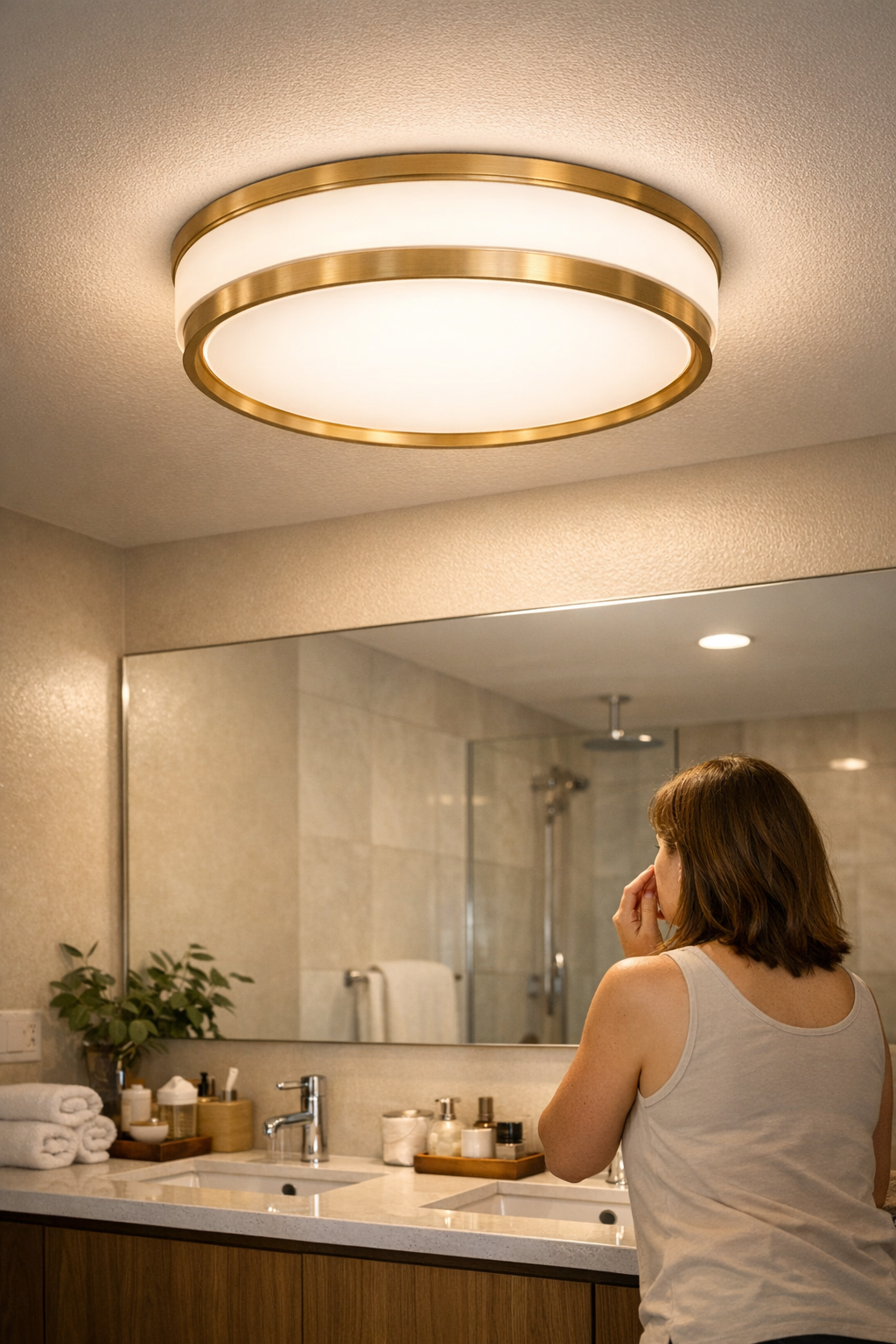
The real test of bathroom lighting isn’t how bright the room looks when you flick the switch—it’s what you see (and miss) at the mirror first thing in the morning. Glare off the glass makes you squint, one cheek is lost in muddled shadow, and overhead spots cast lines across your face that never match where you need clarity. You shift left, then right; you still can’t get both eyes evenly lit. The fixtures may look coordinated, but every routine—shaving, makeup, or helping kids brush teeth—turns into a pattern of squinting, repositioning, and second-guessing the setup. This disconnect isn’t rare. It’s what happens when ceiling points or narrow spots do the visual job, but not the practical one.
Where “Bright Enough” Leaves You Guessing
Rooms that look well-lit on paper often hide the actual friction points in daily routines. In many bathrooms, a lone ceiling light or a trio of compact spots flatten everything—until actual tasks start. Try shaving before sunrise or cleaning the counter after a late night and you meet the same issue: awkward shadows under the eyes, towel racks blinding from the side, peripherals lost in gloom. The room scores high on brightness, but low on usefulness when detail, comfort, or clarity really matter.
The struggle repeats itself: in front of the mirror, you chase a “sweet spot” where shadows ease off, but there’s no stable zone. On shared double sinks, people compete for that narrow band of usable light—one always in glare, the other teetering on the edge of shadow. Even ordinary cleaning takes longer: streaks and water spots appear and vanish depending on your angle, never visible in one clear sweep.
The Real Impact of Your Fixture Choice
What seems like a small decision—standard ceiling bulbs versus a wide linear or panel fixture—ends up driving your entire routine. Point-source lights (bulbs, cans, or flush-mounts) carve out ovals of brightness, leaving hard-edged shadows at the vanity and mirror. Surfaces and faces become a puzzle of “bright here, dim there.” The geometry feels tidy, but the practical cost is constant micro-adjustment: leaning, ducking, circling around a glare spot just to check the basics.
Switch to linear LED bars or a full-width panel fixture, and the shift is immediate—light spreads evenly over the entire mirror and countertop, not just one person or the center wedge. You stop scanning for shadow gaps. Both faces and all surface zones become visible, workable, and predictable. The bathroom stops feeling like a stage with a single spotlight and more like a space where every part is actually usable.
Routine Strain That Sneaks Up on You
Annoyances don’t show up as one big problem, but as dozens of small, daily detours. You end up hunching closer to the sink to avoid a glare spot, chasing a stubborn shadow with your razor, or stretching for something just out of the light’s reach. A favorite lotion hides in dim half-light no matter how many bulbs you add. When a morning rush hits, crossing from sink to mirror isn’t a simple step—it’s a dip in and out of usable light, each move reminding you what your “resolved” setup actually missed.
Good-looking lines above the sink— a matched pair of flush fixtures, a clean row of spots—don’t guarantee practical comfort. The real test is whether mirror edges and counter corners stay visible, or flicker between shadow and washout depending on who’s using the space and what task they’re tackling.
Case Study: Upgrading a Shared Sink
Take a typical upgrade: three ceiling spots centered over a double vanity swapped for a slim panel fixture almost as wide as the mirror (about 1.1m). The effect goes beyond aesthetics. Suddenly, the entire counter and both users have consistent, usable coverage—there’s no more negotiating for the “good slice” of light or leaning awkwardly to catch full brightness. Old project constraints still applied: keeping brackets low-profile and bundling cables out of sight. But the difference wasn’t theoretical. Routines sped up. No one had to squint or re-lean to check a detail, and toiletries stopped casting deep, fussy shadows across the work surface. Morning routines stopped being a light-dodging act; the space just worked.
Hidden Clutter, Visible Friction
It’s easy to assume more fixtures or cleaner mounting hardware will solve the problem, but even supposedly “minimal” upgrades can backfire if support clutter creeps into view. Exposed cords snake down the wall, bracket arms glare in the reflection, and extra hardware blocks sightlines that matter. Distractions pile up. Real lighting support means less cable noise, fewer chunky mount points, and maintaining a direct, open space at the mirror—not just stacking new pieces into the field of view.
Small Adjustments That Add Up
Switching to linear or panel lighting changes the rules: the old “choreography” of ducking and dodging shadows just to get a task done fades away. Mirror edges, faucet lines, and shared bowl surfaces act like real work zones—everything stays visible and accessible, not just tidy in photos. The improvement isn’t flash or trend. It’s stability: tools, products, and faces stay clear with no need to overthink your position or lighting angle. A good setup shrinks the mental checklist of workarounds you need every morning.
Tip: Don’t ignore the structural side when replacing fixtures. Most linear panels fit existing ceiling boxes, but if the upgrade is much wider, plan for a bit of patching to conceal bracket marks or wire channels. Mount support hardware and route cables with edge clarity in mind—keep everything low-profile and out of your main line of sight, not just out of the way.
Common Questions and Practical Pointers
Can new panels reuse old wiring?
Most bathroom setups allow this. Linear or panel fixtures often slot into the old bulb or spot location, but always measure: wide installations may need ceiling touch-up to hide bracket marks. Check whether the new panel’s mounting points line up for low-profile support—you want the hardware to vanish, not create new distractions.
Do larger rooms need extra lighting?
In L-shaped or extra-deep bathrooms, wall lights or accent sources can fill the dead zones. But be careful with color mixing: cool LEDs blended with hidden warm light may add new color shadows and unevenness you thought you’d fixed. The priority remains smooth, even coverage—subtle mismatches can reset old problems in a new form.
Does a panel completely cure glare?
No panel can eliminate glare everywhere, but mounting a wide panel or linear light directly above the mirror—aligned with the main task area—radically reduces sharp reflection and surface hotspots. Avoid crowding fixtures too close or too far from the action: cramped placement or off-center panels still make trouble at the edges where you work most.
Day-to-Day Changes You’ll Actually Notice
The real value of better ceiling lighting only shows in the days and weeks after upgrade—when nuisance routines quietly disappear. Mirror time becomes focused and direct, not a dance around harsh edges. Surfaces are steady and accessible every time, not opportunistically clear. Support hardware and cables fade out of the background. You stop managing yourself around the light; the setup lets you keep routines steady.
It’s easy to live with “bright enough” or believe a room that looks streamlined will feel better in use. But in shared and busy bathrooms, small blindspots, lingering shadows, and visible brackets grow more irritating over time, not less. Every structure decision—from how wide your fixture runs, to how cables are managed, to what hardware remains visible—turns a room from looking polished to actually suiting repeated daily routines. That’s the shift from a bathroom you adapt to, to one that just adapts to you.