
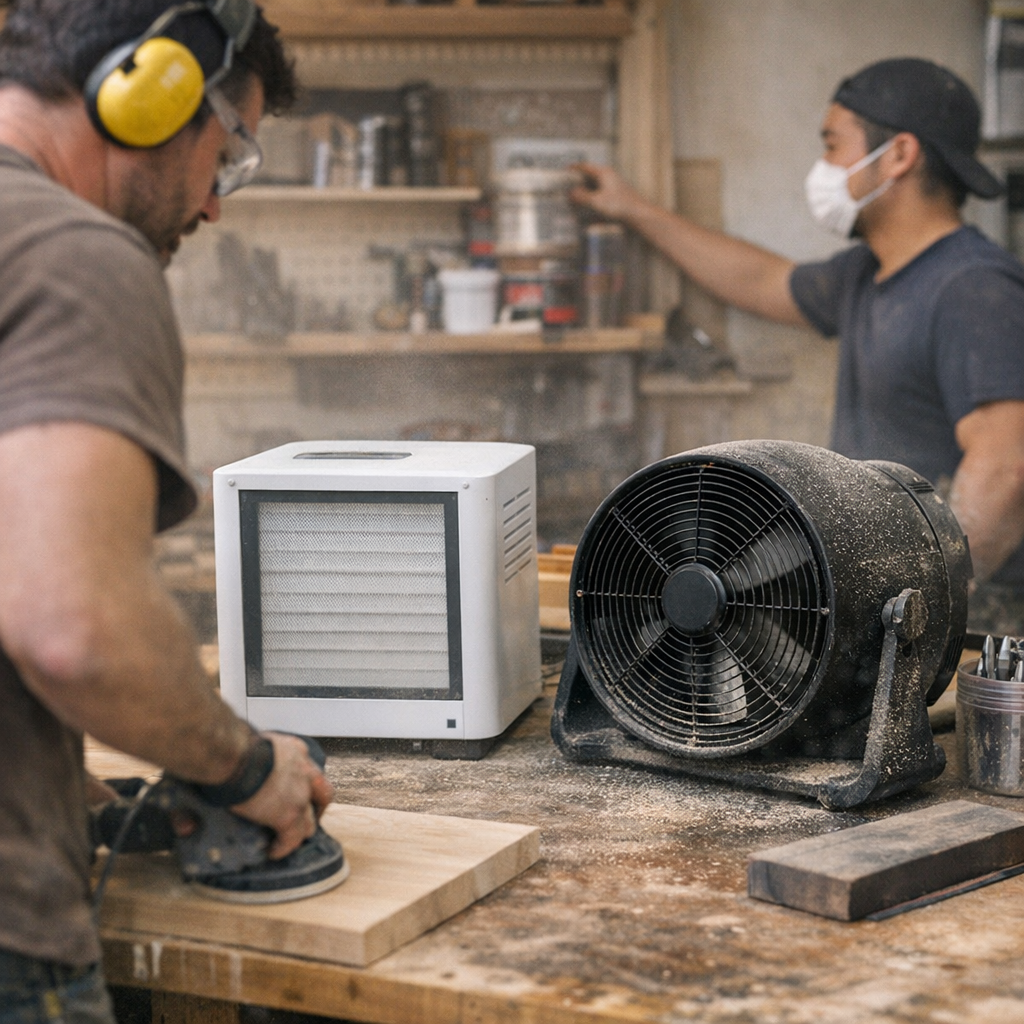
The real verdict on a workshop ventilation fan doesn’t arrive in the first quiet minutes—it hits once the saws, sanders, and drills have been running nonstop and you’re elbow-deep in dust, watching your cleanup window evaporate. Whether you’re running a router down edge profiles, grinding screw heads flush, or putting in hours cutting trim, you learn fast: not every fan with a promising spec sheet can keep up with actual shop conditions. That seemingly harmless cloud of airborne dust is not a minor detail—it’s the deciding factor for finish quality, tool performance, and, day after day, how much energy you have left when the job is finally done.
When Dust Won’t Settle: The Trap of “Good Enough” Fans
Imagine a real shop afternoon: you’ve just spent two hours smoothing MDF, the floor’s a web of sawdust under your miter saw, and tool trays start to look matte instead of clean. You vacuum. You wipe. You hit the fan. But a thin film keeps reappearing across your panel edges and even your drill case—settling onto surfaces you were sure you’d cleared moments before. If your fan can’t keep pace with the constant output, those fine particles just keep circling back.
The trouble goes beyond appearances. Slipshod airflow or cheap filters let dust tuck into clamp threads, land in open glue-ups, even drift into drill chucks—turning simple sanding into a cycle of repeat wiping and reworking. Cutting corners here means more than a few flecks on the floor: it means extra battery swaps as tools overheat, faster blade dulling from embedded grit, and finishing delays as you chase sneaky dust into every seam. In a team shop or on a tight delivery, these delays don’t just irritate—they multiply.
Spec Sheets Lie: Fan Numbers vs. Real Work
Anyone can get seduced by CFM ratings and shiny housings, but dust management rarely goes as planned. In practice, a fan that’s “enough” in the packaging copy might fail completely once the drum sander and orbital both spin up. The best fans maintain visible air movement, even after hours in the zone: you’ll notice bench tops feel crisp, layout lines remain visible, and the next tool doesn’t emerge coated in unseen grit. The weaker fan—same size, same price—struggles as filters clog, letting dust accumulate along the bases of your table saw or drill press right when precision is at a premium.
The difference is sharpest during changing tasks. Drill pilot holes, then jump to sanding edges: the air can turn stale shockingly fast. Gloves gum up, saw handles feel sticky, and bit changes become fumbly as dust coats everything, barely visible. Over time, these tiny, cumulative losses—blurred pencil marks, clogged bits, gritty battery contacts—slow down your workflow, inviting errors and fatigue. Instead of flowing from step to step, you fall into a frustrating rhythm of cleaning, checking, and doubling back.
On the Floor: Where Real Fans Prove Themselves (or Don’t)
Grinding, Sanding, and Constant Cleanup Fatigue
Set up: two similar fans on opposite ends of the space, one shop full of noise and airborne debris. You run the tablesaw on hardwood, then move to hours of non-stop sanding. The result? One fan keeps air and surfaces under control—every clamp and blade holder just needs a quick brush-off. The other? Tool trays get that greasy, sticky layer; clamps need full wipe-downs between each use. Suddenly, every shift between cutting and fastening becomes a slow-motion slog. The right ventilation cuts this cycle short, letting you switch tasks without the drag of constant re-cleaning.
Finishing Touches: Dust That Can Undo Hours
It’s almost criminal to watch a freshly painted shelf go gritty as soon as the air stagnates. Shared workspaces and batch jobs only make this problem worse—a “clean” zone turns hazy in minutes. The difference becomes undeniable in direct light: a web of fine debris appearing just as a topcoat is tacky. Choose wrong, and you’re hunting down dust rings in hardware recesses or resticking painters’ tape. Mistakes here mean lost time: you resand, recoat, and retouch, derailing your finish schedule.
What Actually Changed the Game—A Real-World Upgrade
After enough reruns of resanding and filter-caked tools, making the leap to a variable-speed 650 CFM fan with real HEPA filtration changes the rhythm of the shop. Instead of random pulses of “almost clean” air, you get steady extraction where it matters. A test showed particle counts in high-traffic zones dropped by a third. The trick wasn’t brute force—it was matching airflow to real output, dialing it up when planing half a dozen boards, backing off during fine detail or glue-ups. Suddenly you catch yourself using fewer rags, reaching for the dust mask less, and changing blades or bits not because of hidden grit but according to schedule. Cleanup becomes routine, not a marathon.
Don’t Let CFM Alone Guide You—Match Performance to Workflow
Cranking a fan to max isn’t always the answer. Full blast can lift settled dust, blowing it across fresh finish or into open electronics and battery packs. Run it too low, and those dead zones—around your drill press base, behind the chop saw—become a permanent frustration. Choosing right means understanding your routine: do you drill a dozen pocket holes between every cut, or do marathon sanding sessions? For nimble benches, a mid-output fan that travels with you does the trick. For stationary, tool-packed corners, dedicated high-volume units pay for themselves in tool lifespan and reduced redo work.
Filter Discipline: Don’t Sabotage Your Own Results
Replace filters as soon as you see dust buildup on the intake—don’t wait for airflow to lag. Some shops need this every three weeks; others, after each heavy run of softwood or MDF. If filament brushes and painted edges aren’t coming clean, or you’re blowing dust off screws before driving them home, it’s time for a swap. Delaying just resets the cleaning grind and eats into results on your next task.
Know the Signs: Early Warnings That Your System’s Slipping
Subtle clues crop up before things get out of hand: a dry tickle in your throat late in the day, a finishing pass that feels snaggy despite careful prep, or blades that seem dull after fewer cuts. If you’re reaching for extra sandpaper, noticing static latches or gummy fastener holes, or cleaning becomes an all-day affair, your ventilation isn’t keeping up. Ignoring these adds up to more downtime, blunted performance, and eventually, fatigue that follows you home.
The Real Payoff: Consistency, Comfort, and Fewer Redos
Shop progress isn’t about chasing the biggest badge or trendiest air mover—it’s about finding the fan that stands up to actual workflow, not just label promises. Proper extraction chops down time wasted, lets you work with focus, and means your results rely more on your skill and less on how much dust you missed last round. Set your ventilation to match your shop reality and you’ll notice it in finish quality, tool control, and in that rare feeling: a cleaned-up day that ends before the light’s gone outside.