
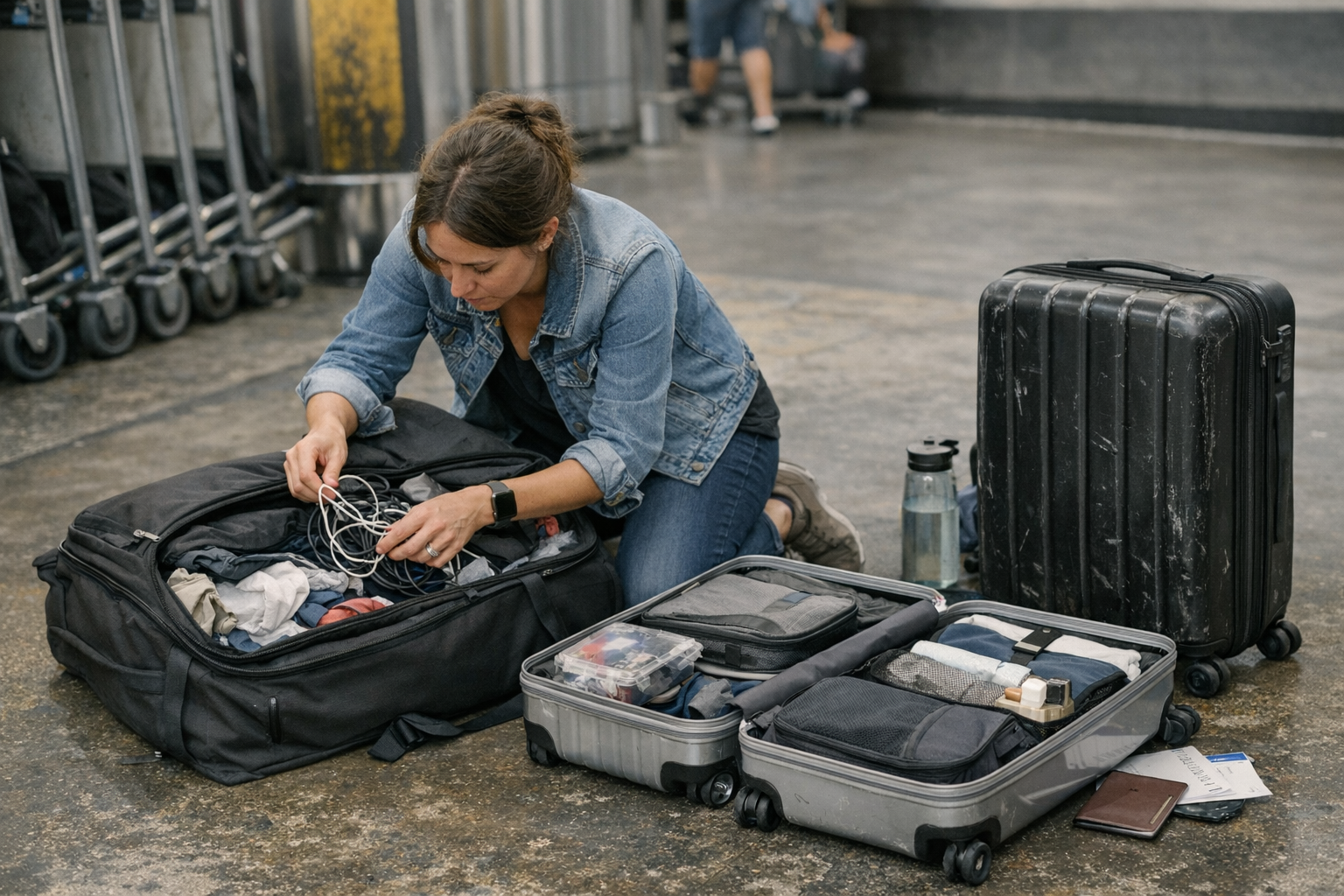
The difference between a hard shell and soft shell carry-on isn’t theory—it’s the moment you reach for your passport in the security line, only to find it buried again, or the way your cables and toiletries migrate after the second repack in three airports. On your living room floor, both bag types look controlled and ready. But as soon as you hit gate lines, tray transfers, and tight seat entry, organization breaks down or holds steady—depending on which structure you’re relying on. A choice that made sense at home starts to show real cost when speed and structure actually matter.
When Organization Meets Real Travel Motion
Most people notice after the first layover: what looked straight in the packing cubes at home starts pulling off-angle, or dropping out of view. Hard shell carry-ons open with a fixed lid and sides, keeping your pouches upright and gridlocked even after hours of being jostled and turned. Pull a tech pouch, and it’s in the same spot you left it. With soft shells, that order slips—power banks drift, shirt sleeves push out past zippers, and a single rushed shuffle at the gate requires another hunt for earphones that only seconds ago seemed within reach. The structure you counted on gets softer with each checkpoint, turning access into a repeat search instead of a smooth grab.
Hidden Downsides: How Structure Handles Repeated Use
Gliding on polished airport floors, both designs seem equal. That illusion cracks the first time you drag your hard shell over uneven ground—the clatter is obvious, but inside, everything stays where you packed it. Try to squeeze a rigid bag into an overhead bin with odd angles, and you hit a hard limit; there’s no give, so you’re either wrestling with the space or waiting for gate-check. Soft shell bags wedge in quietly, corners folding just enough, but after several cycles, the fabric stops supporting itself. Bags that flexed for your convenience now sag in the corners, and internal cubes tip sideways during a quick repack. When you pull the bag down in a rush, you find fragile items have slipped—nothing cracked, but the order has shifted and now blocks you every time you need to reach in.
Security Lines and Tray Transfers: The Real Test of Access
The airport security line exposes favorite setups. Hard shell bags open with exact limits on a too-short tray; their solid walls mean your liquids pouch slides out cleanly and documents sit angled precisely where you expect. You know how far you can unzip without spilling items across the conveyor. Soft shells flex, which looks helpful, but means side pockets can cave in and travel pouches shift out of view. Open it on the fly, and gravity moves charger cords, pens, or documents deeper, adding seconds—and stress—to each inspection. After a few rounds, the space that just held your passport now lets it shift into the padded middle, and every third retrieval turns bumpy and slow.
Overhead Bins, Seat Entry, and Real Retrieval Repeats
Lifting either bag into an overhead bin, the real contrast surfaces. Hard shell carry-ons hold shape: easy to grip, but inflexible when bins are slightly off-size, forcing last-minute reshuffling or an unplanned check at the gate. Soft shells squeeze into tight spaces, but each squeeze distorts whatever order you packed inside. After your bag absorbs the squeeze-under-seat or bin-shove, the packing cubes and pouches you lined up at home now lean into gaps from compressed fabric. Retrieving a cable or boarding pass means sorting sideways through what used to be a neat grid.
The Repeat Search Friction
Every traveler has an item that vanishes: a loose charger, a side-pocket card, sanitizer that’s always almost within reach but never quite there. In a hard shell, your carefully placed packing organizers maintain their sequence. Reach for a passport, find it where you left it—fast, every time. With a soft shell, repeated bending and twisting gradually rearrange your layout. By the middle of your trip, quick retrieval becomes a memory game, and a document or pouch that started up front now needs a deeper search—usually in the least convenient moments, like queuing for boarding or racing past a delayed connection.
How Internal Structure Survives or Fails Under Pressure
Rigid shells keep packing cubes, pouches, and stacked organizers exactly where you squeezed them—no bowing, no unexpected drift, even after overhead-bin bumps or uneven-floor dashes. Order survives, at the cost of visible scrapes and zero room for last-second extras. If your bag won’t fit, you’re out of luck, with no way to compress or flex into a tight spot. Soft shell carry-ons disguise scuffs, but the order unravels slowly: outer pockets bulge, zippers catch on bunched jackets, tech organizers are nudged out of their slot, and deep compartments collapse inward over time. During a long week of shifting between hotels, airports, and taxis, what started as flexibility turns into a demand for hours of small reorganizations—pushing cubes back into place, flattening items, fishing keys and chargers out from surprising corners.
The Tension in Every Segment
The true impact of your choice isn’t obvious on your bedroom floor—it shows up after the third rushed repack and the fourth document check. The real differences hinge on how well your bag’s structure keeps up with repeated access, speed moments, and forced compression under real-world pressure, not just how it looked for your packing photo.
- Rushed repacks: Do your cubes stay squared up, or is each seat-off moment another round of digging?
- Quick-access breakdown: Are your essentials in position for a fast grab, or does the flexible bag keep blending pockets and hiding what matters?
- Compression test: Does your carry-on’s outline hold when bins are crowded, or do you keep adjusting after every squeeze and shift?
- Visible structure fatigue: Does your bag just look more used, or is the repeated loss of internal order slowing you down every transit?
Finding the Carry-On That Fits Your Real Routine
No travel bag holds perfection for long, but it’s the frequency of reorganizing—not just surface wear—that signals when your carry-on setup is slowing you down. Hard shells enforce order and fast retrieval, but punish you with rigidity when space runs out. Soft shells absorb pressure, save you from an overfull bin panic—but their forgiving structure can slowly build up layers of inconvenience: pouches slouched, quick-access lost, and repeated micro packing sessions after every hand-off.
Test your current setup after actual use, not by how tidy it looks after day one. If you keep pausing to fix your cubes, repack your tech, or retrieve documents buried during boarding, it’s time to rethink for your real flow—whether that means swapping flexibility for repeatable structure, or the reverse. When the carry-on friction no longer feels worth it, the right configuration is the one that lets you move without losing order in the details that repeat most.
Need practical carry-on tools to make your routine smoother? See curated options at CarryOnSupply.