Author: jaesoon_admin

  • Why Flexible Cable Routing Improves Workflow and Reduces Desk Clutter

    If you’re starting every morning by dragging a power cord back onto the desk or untangling the same cluster of wires near your feet, it’s not just “clutter”—it’s an obstacle that keeps coming back. A desk might look spotless after a careful cable arrangement, but by Wednesday the friction wins: charger sliding out of reach, headset cable caught on the edge, plugs buried under a tray that’s supposed to tidy everything up. On a small desk, even one misplaced cable can push your keyboard forward, eat into notetaking space, or block your mouse. The setup might pass as organized, but every phone charge, device swap, or late-afternoon monitor shift exposes the gap between “looks fine” and “actually functions.” In real work, workstation order is constantly tested—not by mess, but by the simple motions that keep getting interrupted.

    Where “clean” cable setups break down in real work

    That chasing-after-perfect order breaks the moment you work for real. Hiding every cable in a box or squeezing all wires through a single tight sleeve promises a calm surface—but using the desk quickly reveals the trap. Unplug a laptop, add a monitor, or swap devices on the fly, and suddenly you’re fishing through a packed tray, undoing zip ties, or crawling under the desk to free a stuck cable. What should take seconds—plugging in a drive, using a backup charger—turns into a hassle, especially if your routine swaps between setups for meetings, notes, or calls. Cable order that hides everything quickly becomes cable order that blocks everything.

    Relying on a “bare surface” look, you only notice resistance after sitting for a full session: cables tug as you move the mouse, headphone cords won’t reach the right side, and that neat box at the rear means stretching behind your monitor for every basic connection. Each reset, each adjustment starts to reveal just how fragile surface order really is.

    The friction that creeps back by midweek

    Real cable management fails or succeeds on repetition—not on day one. By midweek, the weak points stack up. Plug in a second device and suddenly half the bundle shifts, unseating another cable from the power strip. Slide your chair for a quick call and accidentally catch your heel on a wire running to a too-tight tray. The sleek setup that hid cables now requires both hands and a shoulder against the desk edge while you wrangle a lost plug—often with five minutes before your next deadline. These aren’t isolated annoyances: every rigid zip tie or tangle in a hidden box steals a few more moments, slows the reset, and chips away at focus.

    On compact desks, even a little extra cable slack steals keyboard or mouse space—or forces your notebook off the usable area. Tiny flow breaks—having to push a charger back, drag a monitor cord free, shift papers squeezed by a stray power cable—build into routines that sap energy and time, even if the desk still “looks” controlled to someone passing by.

    Why over-organized cables can drag down workflow

    Surface order often comes at the cost of movement. Stuffing every cable into a single tray, or binding everything tightly, leaves no flexibility for quick changes. Standing up for a different posture, sliding the chair for a team huddle, or running a second device for a short project should take seconds—not a careful unthreading of knots beneath the desk. The desk stops adapting and starts demanding: unfasten that tie, release the stuck cable, undo what yesterday kept tidy. Visual peace turns into a recurring job.

    Sacrifice flexibility, and you pay in effort for every reset. For anyone who adjusts setups daily—switching from writing to design, moving between devices, seating, or standing—the “perfect” concealment proves unsustainable. The time cost isn’t just in the initial install; it’s in every minute spent tracing a cord’s path or untangling after a simple device change. A desk can look calm but stay slow, every reset slightly grinding down your pace.

    A small shift: modular routing over rigid bundling

    Repeated resets finally push a change: more cable-boxes or tighter ties just don’t improve flexibility. The smallest real-world fix is usually spacing out modular cable clips at specific points—a few at the desk’s back edge, one or two along the nearest leg to an outlet. With each main cable—monitor, laptop, phone charger—anchored but not trapped, movement and reach return. Now, swap out the charger or shift a monitor and the motion stays local: nothing else tangles or pulls free.

    The benefit is instant but deepens over time. What used to involve tugging at one cable and disturbing three others shrinks to a single, visible move. The morning reset—grabbing a sliding charger or freeing a cord caught under the desk—becomes a matter of seconds, not a chore. The desk holds its organized look if you want it, but starts behaving properly: quick, frictionless device changes without a chain reaction of disorder.

    Scenario: A mid-afternoon device swap without the usual pause

    Late in the day, shifting from a laptop to a tablet for sketching highlights the impact. With all cables stiffly bundled, reaching the right charging cord means fighting the tray, disturbing the whole setup, and often re-adjusting your keyboard’s position. With spaced-out modular clips, you just lift the tablet cord from its clip, move it to the other side, and plug in—no forced shuffling, no accidental disconnections, no loss of surface order. The friction fades out, and you don’t lose your flow just for switching tools.

    Recognizing real cable friction in your setup

    Spot the signals before they build up:

    • Cables tangle near your feet or hook the chair as you move during longer sessions.
    • Charging cords drop behind the desk, turning every meeting into a cable hunt.
    • Adding a device means crawling under the surface or navigating a packed, hidden tray.
    • Resetting between tasks still feels awkward or slow, even with a tidy-looking setup.

    If you keep working around cable routing instead of through it, your setup is built for a diagram, not for daily work changes.

    Choosing cable tools that fit both order and daily fluidity

    Total cable concealment might win a photo, but real desk life rewards flexibility. Adhesive cable clips, open under-desk trays, and wisely spaced anchors give every cable a path and enough room to stay useful. You get visibility—quickly spot the right plug—with enough restraint to keep things from sliding everywhere. The main trick: never batch every cable just for tidiness. Modular spacing lets you swap or move gear without triggering a reboot of your whole setup, and keeps each disruption contained to a single cable.

    For anyone who shifts tasks often, stands part of the day, or rearranges devices depending on focus, modular cable control is the difference between a setup that quietly adapts and one that drains you with invisible interruptions. Shrinking those minor moments of wrestling with your desk pays off—not by erasing every wire, but by making every move easier and every reset less tiring, week after week.

    When cable order supports, and when it interrupts

    The make-or-break difference isn’t neatness—it’s whether the system actually keeps up. The desk that truly supports you is the one where every routine change—a charger grab before a call, switching screens late in the day, a batch-connect for several devices at once—happens without extra moves. The right route for each cable isn’t hidden away forever, but settles quietly into the background, never so rigid that one tweak brings down the rest of the system.

    Order only matters if it speeds up your work, not just sanitizes the look. Modular cable paths make visible clutter vanish—but also keep the physical friction off your mind. When resetting is quick, device swaps don’t mean chasing wires, and the desk feels responsive to your week (not just the morning), you notice: the real cost of messy or over-tight cable setups isn’t visual, it’s in every silent little battle lost to wasted effort. That’s the real case for better routing.
    Explore the full WorkBasic collection

  • Why Grounded Shoe Storage Improves Entryway Flow and Reduces Clutter

    Every garage entry or mudroom starts out with the promise of order—shoes off the floor, traffic flowing, everything in its place. By day three, that promise is already cracking. You’re sidestepping bins to wedge the door open, pausing to shove a runaway boot out of the walkway, looping around a storage rack that seemed “space-saving” on paper but shrinks your path in real life. Look closely, and it’s the difference between a setup that photographs as organized and one that actually lets a family move, pause, and repeat—all week, not just on a tidy Sunday.

    Where Storage Collides with Everyday Movement

    Shoe storage fails aren’t about clutter—they’re about collision. That rack near the door: does it quietly disappear, or are you bumping it every time you walk through with groceries? Does a bin keep shoes contained, or does it create a pile you have to shuffle just to pull out your bag? The issues surface fast: a wall bin hogs elbow room near the key hooks, a floor rack eats up the landing zone, or an “organizer” turns one easy trip into a circuit of interruptions and awkward pivots.

    It’s the repeated, barely-noticed obstacles that build up frustration. Those nudges to keep shoes aligned, the bending to re-catch a pair kicked aside, and the shoulder-turn to squeeze past—these are the signs your storage clashes with your routine, not fits it. And the longer a setup requires manual resets, the less it’s actually working.

    Wall-Mounted Storage: Out of Sight, In Your Flow

    Wall-mounted racks look neat until you live with them. Suspend the shoes: yes, less on the floor. But every inch they protrude matters when space is short. In reality, a “slim” rack can belly out into vital walkway. It stubs carts, snags bags, and narrows the spot where two people would otherwise pass side-by-side. Over time, marks and bumps appear exactly where you grip the doorframe or fumble for a tote.

    And when you’re under pressure—school rush, arms full—one stray pair topples right into the crossing. Storms just move the mess upward: now drips and mud drop directly into the stretch you want to keep clean. “Off the floor” is no help if it’s always in the line of fire.

    Floor Racks and Bins: Control or Clog?

    Set storage on the floor and you dodge some pitfalls, but you invite others. Bins that bulge just past the corner slow every pass. A big “catchall” tub looks clean on Monday and turns messy by Wednesday, shoes layered and spilling because nothing guides them back. Walkways shrink as overflow piles up until someone’s tripping, or—worse—skipping the bin entirely to toss shoes anywhere the path is clear.

    Here’s how setups reveal themselves: the area stops resetting itself. Pairs linger off to the side, left halfway in the bin or banked at weird angles. Cleaning gets skipped because of another step—moving the whole container, untangling laces, clearing mud from a traffic path now twice as dirty. If you’re ducking around the same obstacle more than once a day, the system has started to work against you.

    What Lasts: Layouts for Real-Life Use

    The setups that make it through a week mostly unscathed aren’t the showpieces—they’re the ones you barely notice. They create invisible lanes that accommodate the real choreography: carrying bags in, pushing the stroller out, getting multiple people past each other without stops or sidesteps.

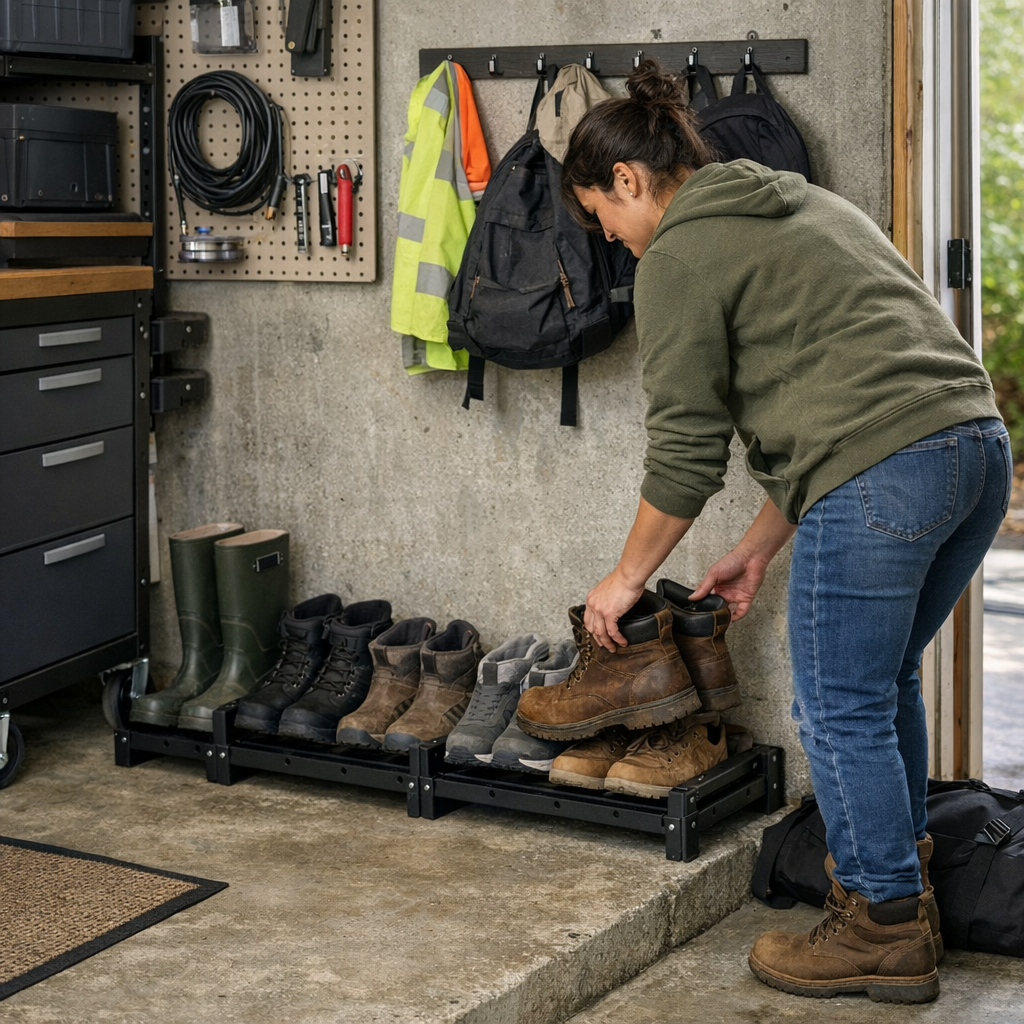
    Take a floor rack dropped parallel against the wall, set back far enough—not right up at the door, not jutting into the cold zone. In one honest test, switching from a wall unit to a slanted, low rack granted a full 22-inch clear lane. That’s not a number for a product tag; it’s enough for two kids to run by or to carry a week’s worth of groceries without a hip bump or a second glance. That angle meant shoes lined up on their own again, not stacked or turned awkwardly. Mud collected on the mat, not on the bags, and re-entry meant shoes landed where they belonged—no extra cleanup loop.

    Small Shifts, Real Impact

    It’s rarely a complete overhaul. Sometimes just pulling a unit four inches away from the bottleneck lets the zone breathe. Splitting one oversized bin into two shorter rows brings a sense of order—everyone finds their own spot, overflows stop, and the “always-in-the-way” area becomes a footnote instead of a daily headache. The best layouts don’t max out capacity at the cost of simplicity. With nothing blocking the obvious through-line, shoes move in and out naturally, and traffic no longer staggers or doubles back.

    Good Storage Lets Good Habits Settle

    Choke points spawn mess and apologies. Wall pegs stick out right where the sports bag hangs; a bin blocks the spot you pause to tie laces. These collection spots are magnets for unfinished resets, and the more often you have to apologize (“I’ll move this in a second”), the more the system is failing the routine. What works? Floor solutions so discreet they’re almost invisible—low, zone-conscious, never crowding the critical inches that make one space passable for all sizes and speeds.

    Quick Real-World Fixes

    • Do a real-life walkthrough: Carry laundry, wheel a cart, move through with kids or groceries. If a setup slows you down more than once, reposition or resize it.
    • Stop building upward: Tall bins and high racks encourage overstuffing and block sightlines. Priority is always width and clear access, never more vertical stacking.
    • Guard a clear lane (20–24 inches minimum): Never let racks or bins intrude here. This path isn’t for shoes—it’s for movement. Defend it, and even the smallest entry stays workable.

    The real win isn’t just a tidy floor—it’s frictionless movement. Shoe storage that respects the natural ways people move will always quietly outperform any system that only looks good in a product shot. The right setup isn’t what organizes the most—it’s what disappears from your daily routine almost entirely, every time you walk in or out.

    http://stacknest.myshopify.com

  • Why Tape Storage Needs More Than Just a Shelf for Lasting Order

    The Tape Roll Shelf: Neat for a Day, Chaos by the Weekend

    Open that storage closet or garage shelf and you’ll see it—those tape rolls lined up, labels facing out, offering a flash of “finally organized” relief. But let a weekend pass, or invite the real world of repairs, kids’ crafts, or frantic supply grabs, and the order collapses. Tape shifts. Rolls slide into new territories, pile into awkward stacks, or vanish behind battery bricks and bins. The promise of easy access becomes a cycle of digging, shuffling, and sighing—an old friction disguised as tidiness.

    How Tape Rolls Escape Organization

    It’s one thing to arrange a shelf so it looks organized for a photo, and another to keep it that way for more than two days of actual use. Tape rolls are especially notorious: grab one quickly and the others jostle out of line. Half-used rolls get tossed on top while searching for a specific label, and by Tuesday, painter’s tape is fraternizing with extension cords. You know the drill—reach for masking tape and move an entire stack aside, or find duct tape hiding two bins over. Open shelves do little to keep the chaos contained.

    The mess isn’t a sudden avalanche, but a slow shift. By week’s end, it takes two hands to rescue the right roll—carefully, unless you want tape tumbling onto cleaning sprays and sandpaper. Every retrieval is a minor negotiation with the shelf, dragging the job out longer than it should be.

    From Shelf Rows to Trays: When Enough is Enough

    That first, neat row appeals for speed—but never holds its ground. No one plans for mess; we line up tapes by type and call it done. But within days, open shelves turn into tape parking lots. Maybe you wedge an extra roll down the side after a rushed cleanup, only to return later and wonder why nothing is where it belongs. The shelf goes from showcase to scavenger hunt.

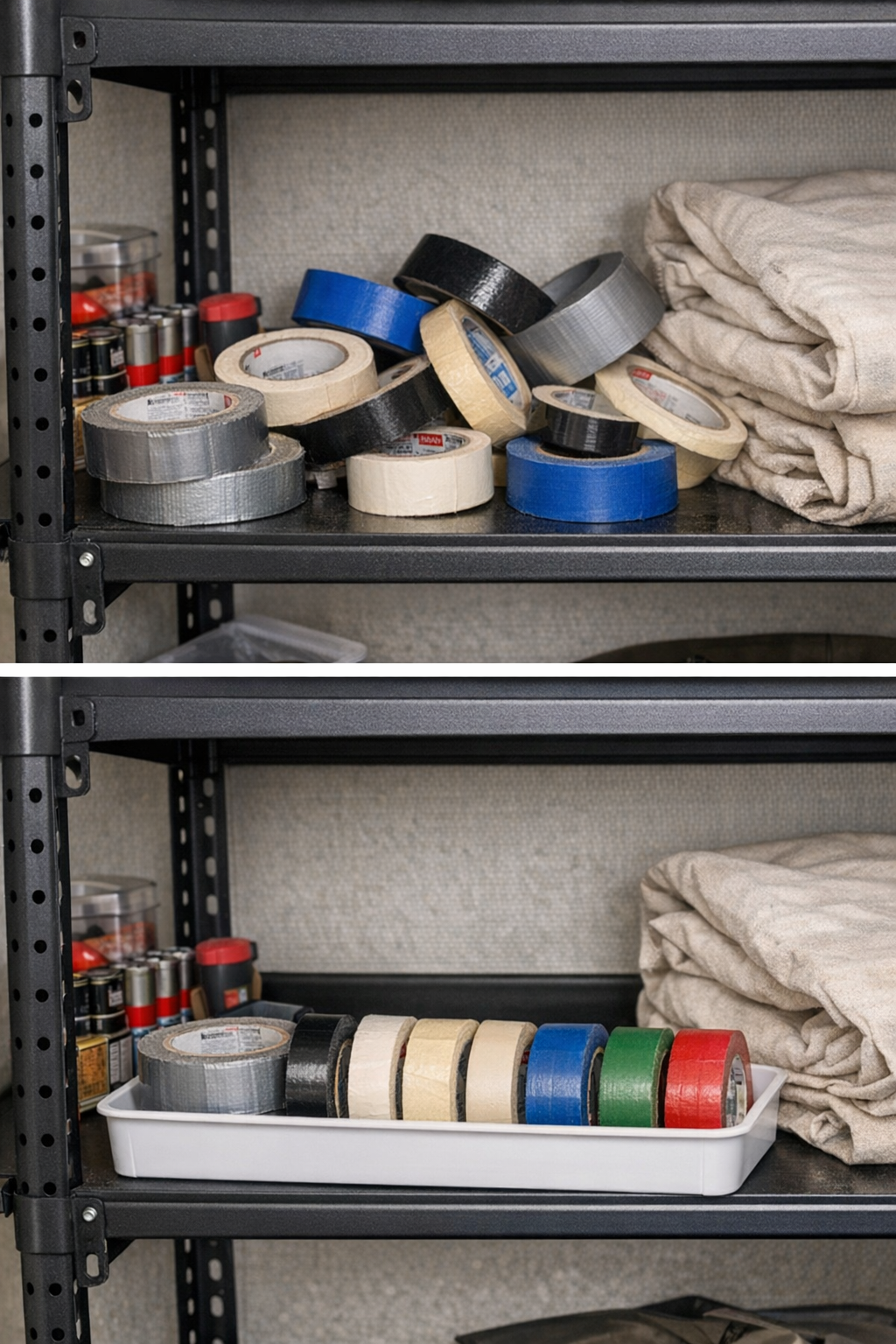
    This is the moment trays make their entrance—not as a grand solution, but as a practical boundary. Drop in a low bin, a shallow painter’s box, anything with sides. Suddenly, tape rolls stop wandering. One-handed resets are possible: finish the job, sweep the loose rolls back into the tray, and move on. It feels subtle—barely a change—but those thin edges quietly enforce order long after the photo-op is over.

    Clutter Outpaces Good Intentions

    Don’t underestimate the hidden toll of a shelf slipping into disarray. One day you’re spending an extra thirty seconds searching for the right tape. Next time, you’re inching a heavy bin to dig out a buried roll, or unstacking a pile just to grab something small. Categories blend: painter’s tape bumps up against cleaning supplies; electrical tape tumbles in with rags. The time spent hunting accumulates—not dramatic, but persistent enough to notice.

    Worse in shared or high-traffic spaces, this slow spread is almost inevitable. Hall closets, catch-all garage shelving, the laundry corner—it only takes a handful of misfiled supplies before every zone on the shelf starts to lose purpose. Tiny errors, like a roll out of place, stack up into regular disruptions. What should be one grab-and-go action becomes a mini reset every time.

    What Defined Boundaries Really Do

    Trays don’t guarantee perfect order, but they keep disorder from spreading unchecked. Add even a shallow tray and watch what changes. Tape rolls huddle together, easy to see and grab, instead of leaking into the next category. You skip “shelf Tetris” and accept some daily mess—now hemmed in and quick to reset before it takes over.

    There’s a visual difference. After a couple of busy days, a taped-off line of rolls is usually gone, but a tray holds steady. The tapes stay upfront, labels readable, always reachable without moving half the shelf. You’re not hunting around or stacking and restacking every time. The minimal boundary holds, turning a swirling mess into a managed little zone.

    Scenes from the Real Storage Trench

    You come home from a late project, toss tools and leftover tape onto the shelf, intending to regroup later. Two days later, painter’s tape is missing—it rolled across to the bin with batteries after a housemate’s cleanup. Another afternoon, you’re rushing and the duct tape falls behind a heavy bucket of screws, wedged out of sight. One roll in the wrong place means seven minutes rearranging, stacking, and moving things you didn’t mean to touch. The shelf’s organization crumbles under normal, even responsible, use.

    With everyone grabbing supplies—kids, partners, or just you over and over—the shelf never gets a true reset. Categories blur, patience thins, and the original logic is lost. Unless you put up some kind of resistance—a tray, a bin, just enough structure—the shelf keeps slipping from “set up” to “cluttered again.”

    Containment: Calm By Design, Not Accident

    What a tray does isn’t dramatic, but it’s steady. Instead of finding tape stuck in a box of light bulbs, you see categories reappear. Every tape roll stays visible, always in its home, accessible without digging. Best of all, the tray stays shallow—deep containers just hide the mess. Low sides mean quick visual checks, easy grab-and-go, and effortless returns. Resets take seconds, not minutes; frustration ebbs away because everything fights less for space.

    With a Tray, Shelf Friction Drops

    • Put-away is instant. Tapes don’t sprawl—they slide into their spot, every time.
    • Other supplies aren’t invaded. No more tape rolls crashing into paint, light bulbs, or batteries.
    • Lost rolls are a thing of the past. You look and see what’s missing, immediately.

    Most critically, you get a shelf that keeps working, not just for show. Order that endures through quick grabs, messy projects, and real rotation—not a showroom-perfect fantasy, but a usable reality.

    Small, Real Fixes for Tapes That Behave

    Pick a tray that fits just your main tape types—too roomy, and you’ll stack; too tight, and you’ll choke the system. Don’t overload it: cramming every last roll invites a whole new jumble. Opt for low-front trays for that one-glance label check. Every couple of weeks, do a quick scan: if you spot a roll that’s gone rogue, toss it back before it builds a new pile-up. A few short habits, one thin tray—suddenly, your shelf starts holding the line, not dragging you back into another hunt.

    For storage fixes that hold up to lived-in routines—closets, shelves, and the daily shuffle—visit ClosetWorks.

  • How Benches with Cubbies Transform Entryway Shoe Storage and Organization

    The real friction shows up fast: A crowded entryway is less design problem, more daily choke point. Step inside after work, after school, or during the morning rush—one loose pile of shoes turns the whole front zone into a slow-motion shuffle. Flat benches and open baskets might pass for order on day one, but after just a few cycles of real family traffic, they’re tripping hazards disguised as “solutions.” Resetting that space starts to mean repeated scanning, reshuffling, and zig-zag paths just to get out the door. For anyone with kids, housemates, or guests, these frictions compound—what looks organized at first melts into a mess that drags time and movement, every single day.

    Why Simple Storage Fails When Real Life Takes Over

    Order fades faster than you think. The photo-ready shoe row? By day three, it’s scattered into clumps—boots blocking the middle, loose sneakers buried, lighter pairs missing. Every departure turns into a repeating hunt: scan, dig, move shoes around, bend further, and hope a match emerges. Instead of helping, those seemingly “easy” benches or baskets pile on small delays. The system drains energy hour by hour, as finding the right pair requires breaking through its own clutter wall.

    Blocked paths and lost shoes aren’t flukes—they’re built-ins for flat or open storage in high-traffic halls. Missed pairs slow departures. The “sorted” look vanishes within days, replaced by a cycle of rearrangement and silent annoyance. Over time, it’s not just about lost minutes. It’s the steady irritation each time you navigate that same bottleneck.

    The Cubbies Solution: Small Dividers Make a Big Difference

    This is where cubby benches flip the script entirely. Instead of dumping all pairs into one unchecked zone, the bench is split into real boundaries: each shoe set gets its own cubby slot. The difference isn’t subtle in actual use:

    • No more shoe heap. Daily churn doesn’t blend boots and sandals into one tangled pile—pairs are corralled and don’t migrate with every step.
    • Clear assignment, visible resets. Each person gets a designated space—no debate, no hidden clutter. Even overflow stands out, so the “I’ll clean this later” pile doesn’t clog the main traffic line.
    • Problems surface sooner. Try to wedge two pairs into one cubby, and it’s instantly obvious—no more quietly burying messes under the surface.

    Real payoff arrives in the messiest moments: wet sneakers dry away from clean ones, kids immediately spot missing shoes by the empty slot, and retrieving or returning anything takes seconds, not a round of shuffling.

    Where Flat Benches and Baskets Break Down

    Flat seats and baskets collapse under repeated use. The first day’s calm is gone as heavy boots swallow kids’ shoes, someone claims the best spot, and by midweek the floor is back to a bottleneck. Baskets hide more than they help—lost pairs settle at the bottom, and the reset burden grows. If finding or returning shoes means a shuffle every time, order is doomed. The “organized” look holds for a photo, not a real week.

    Unsegmented storage doesn’t organize—it hides, delays, and adds steps. Piles form, the main path shrinks, and every return trip means either bending, restacking, or digging blindly. No one wants to play shoe Tetris before leaving the house.

    Real Entryway Traffic: How Routine Makes or Breaks a Setup

    Picture three evenings: A mud-splattered pair is left at the door. Rain boots, finding no open slot, get wedged on top. Groceries come in, someone dumps sneakers in the only visible gap. Overnight, the hall shrinks as shoes migrate sideways, stacking, or partially blocking the exit. By morning, every quick departure is a sidestep-and-search. The system isn’t broken by “messy people”—it’s broken by a setup that can’t keep up with routine, never mind busy days or extra guests.

    What Lasts: Real Organization Holds Up to Repeat Use

    Swap in a bench with six cubbies—two columns, three rows—and the entryway rewrites its own script. Each person (even guests) claims a home base. Overflow goes up top, not across the floor. When something’s missing, the hole is obvious; too much in one slot flags a problem that standard baskets would bury until the next clean-out. After a three-week test run, one family found the walkway still clear after rainstorms and playdates—a first. The only stray pile was an overflow, never a tripping hazard in the middle of the path. The entry reset went from minutes of sifting to a few quick returns, even on the worst days.

    Seeing Problem Spots Sooner

    Cubby benches double as instant diagnostics. When a boot needs to wedge sideways or chunkier shoes block the next space, the setup tells you it’s time to adjust—reevaluate spacing, shift overflow to a utility shelf, move seasonal pairs elsewhere. Failures don’t fester unseen; they’re signaled and can be corrected before chaos creeps back in. That’s real feedback—routine checks itself, not just on cleaning day.

    Tips for Getting the Most from a Cubby Bench

    • Start with the largest shoes. Size for big boots and sports shoes—tight cubbies defeat the whole point.
    • Assign each slot up front. Adults, kids, guest pairs—set the map early so no one fights for access (or dumps in the nearest gap).
    • Let overflow surface, not hide. Stack extra pairs on top, not on the floor—visible mess is easier to address than hidden build-up.
    • Watch for trouble spots. If one zone collects all the overflow or no one returns shoes to the right slots, rethink the count or add another zone nearby.

    This isn’t about looking neat—it’s about not losing time to avoidable reshuffling. The real win? How little you think about the entry once the cubby system takes over. No bench or basket promises zero mess, but this setup breaks the cycle of slowdowns and sidesteps that open storage quietly builds into the routine.

    When your storage matches the real return flow—not just what fits in theory—the area resets itself. Fewer interruptions, less spillover, and a front hall that doesn’t hijack your day. That’s the difference you can see after a week of actual use—and keep seeing, season after season.

    Shop more storage solutions at Gridry.

  • Ensuring Consistent Ceiling Lighting with Proper Support and Cable Management

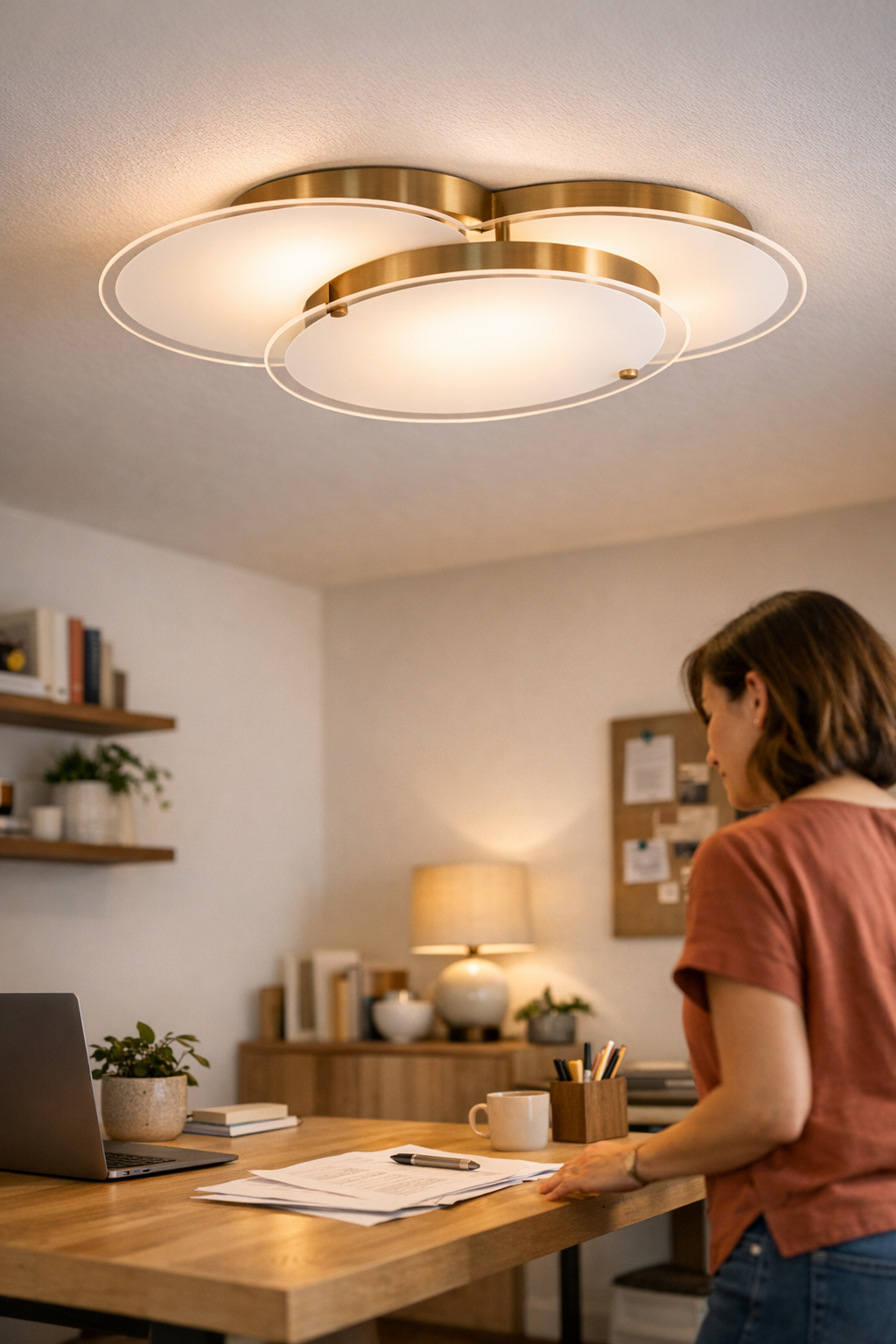
    Lighting setups break down at the edges—fast. That ceiling panel looked perfect when you stepped back on install day. But a week later, one bracket has slipped, and now the light throws glare across your desk while leaving your keyboard in shadow. Instead of blending in, a sagging cable starts competing with your monitor for attention. One dim shelf edge, one dangling wire, and your “finished” room turns into a tangle of quick fixes and small daily annoyances. These aren’t cosmetic irritations. Misaligned lights, exposed cables, and loose brackets make clear surfaces harder to use and routines slower to finish.

    The Subtle Impact of Uneven Lighting Support

    Perfect symmetry rarely survives real life. A row of slim LED panels, level on day one, shows the first weak spot when a bracket sags half a centimeter and throws your walkway into uneven shadow. Cable channels come loose the moment you add a new device or slide a shelf. The result: you’re shifting chairs to avoid glare, reaching for the brightest spot just to read a label, or pausing mid-task because a cable blocks an outlet you need. The smallest misalignment multiplies over time, slowly turning easy routines into repeated, visible friction that never fully disappears.

    From Install Day to Real Use: What Changes?

    Visual neatness rarely survives contact with real use. Symmetry and clean lines fall apart the first time you unplug a charger, dust a shelf, or nudge a lamp for a project. What looked flush now tilts. Cables that once hugged the wall droop or slide out of place, especially when anything plugged in gets moved. One bracket, out by a washer’s width, starts a chain reaction: the fixture leans, the cable pulls unevenly, and you start compensating—shifting your things, tweaking the light’s angle, stacking objects to block the worst glare. The promise of ‘finished’ wears off with every small adjustment you make instead of just using the room.

    Small Shifts, Big Frustrations: Real Examples

    Picture a shared desk edge where one under-cabinet light sags lower than the rest. Now one side glares into your eyes, while the opposite corner is barely lit—forcing you to keep moving papers just to work comfortably. Or that slim task lamp you measured by eye, only to realize it throws a persistent shadow over notes every time you reach for them. Even compact spaces strain under these details: an exposed cable dangling under a shelf means your supplies no longer fit or a charger constantly slides out of reach. Instead of the setup working for you, you’re adapting around every minor flaw—and feeling them multiply with use.

    The pain is physical as much as visual. Plugging in a laptop becomes a two-hand job so the cable doesn’t drag another fixture off center. Sturdy boxes and objects get conscripted to block glare or hide a drifting cable. That ideal reading spot? Now you avoid it because the light splits the surface too sharply. The original sense of order collapses under the reality of what you see and reach for every day.

    Cable Clutter and Support Weakness: Problems That Multiply

    It’s easy to ignore a loose cable clip or a bracket slightly out of line—at first. But in daily use, these small errors refuse to stay small. Every unplugged device tugs a cable lower, leaving a telltale bulge across what was a clean wall. Once the fixture tilts even a little, you lose reliable coverage: half the shelf gets light, the rest sits in vague shadow. Wires cut across access to the outlets you actually use. Over time, all those “just barely” misaligned pieces turn a space that looked resolved into one you have to work around, again and again.

    The Difference Precise Support Makes

    Getting back to a usable space rarely means starting over—details just need adjusting where repetition breaks them down. Shimming a bracket to achieve a real, stable level (not just straight by eye) reclaims an entire shelf edge. A two-centimeter adjustment in cable route changes where clutter accumulates—and what surfaces stay clear. Replacing a chunky power brick with a low-profile adapter frees an outlet and lets cable lines stay tight to the wall. The fixes take minutes but shift the whole logic of the room—moving you from constant workaround to reliable, repeatable use.

    Tips for Keeping Lighting Even and Cables Calm

    Guesswork fails at the first move. A bubble level and tape measure are not optional; they’re essential. Measuring from fixed points like ceilings and walls—for every fixture, in every zone—prevents gradual drift and misalignment that wasn’t obvious at install. Adding a washer where a bracket leans sharpens the angle and stops the whole row from falling out of sync with surface lines.

    Cables demand their own logic. Direct, straight, and anchored routes with sturdy adhesive clips stop wires from slipping into sightlines, blocking access, or bulking up in unexpected places. After the third or fourth time cleaning or rearranging, you’ll know whether the support holds, or if you’re battling the same drooping line and tangled cables week after week.

    Living with Lighting: The Real Test is Repetition

    Lighting support wins or fails outside the installer’s view. If a setup blends in first but makes you adjust your seat, squint, or walk extra steps every day, that’s not working light—it’s a surface problem hiding behind a sleek fixture. When task zones demand compensation—stacking objects to block a glare patch or dodging a shadowed corner—the limits of your support system show through. Evenness, bracket stability, and cable order aren’t aesthetic extras. They decide whether your desk, shelf, or room edge stays actually usable or keeps quietly undermining your routine.

    Noticing and solving these repeat breakdowns isn’t for show; it’s the only way to protect the comfort and clarity of spaces used all day, every day. Taking an extra five minutes to check bracket level and cable logic means a surface that welcomes work, reading, or shared use—without the next dropout, distraction, or dim edge sneaking back in.

    Find practical products and better lighting support at LightSupport.

  • How a Predictable Play Schedule Transforms Indoor Cat Behavior During Work Hours

    Your indoor cat finds the cracks in your routine faster than any organizing bin or tidy corner can keep up. A workspace that starts the morning looking orderly—baskets lined, toys stowed, surfaces wiped—quickly breaks apart the minute work and cat-life collide. By the second interruption, what seemed “easy to reset” now traps stray toys under rolling chairs, scatters pawed balls across hallways, and leaves cleaning cloths just out of reach when you need them most. The real pushback isn’t visual: it’s the repeated grind of routines that keep exposing the same weak points, from toy drift into shared space to cleanup that never stays finished. Each small interruption—batting a pen off the desk, dragging a string out of a “contained” box—clutters both the calendar and the room, turning every work break into another recovery mission. This is not just about order slipping; it’s about a setup that looks calm at 8 a.m. and feels unworkable by noon. StillWhisker’s world is built for these moments, so the solutions fit the points where daily life actually catches.

    Why “Appears Organized” Doesn’t Hold Up to Daily Cat Life

    The fantasy: neat workspace, a few toys nearby, no visible mess, and a setup that your cat won’t disrupt. The reality: after three “full resets,” minor cracks become obvious. Toys migrate under office chairs. A ribbon ends up in the hallway. The curated toy basket? It routinely empties itself as soon as your back is turned, leaving a wake of scattered objects in places you’re not ready for. The gap between “presentable” and actually functional widens with every day you have to restack, refill, or dig out a favorite item that’s vanished under furniture.

    Unlike a food spill that you spot and wipe immediately, the slow breakdown—one toy at a time—means every step feels a little less controlled. What started as a clear walkway becomes an obstacle course before lunch. Each attempt at restoring order is undone by the next round of unscheduled cat energy. The invisible line separating your work zone from your cat’s play area ends up blurred, and daily resets start to feel less like solutions and more like delays before the next round of chaos.

    Unpredictability Teaches Persistence—and Interruptions Grow

    An indoor cat left to guess your boundaries will turn every pause in your attention into their open window. Sit for a meeting and a paw invades your keyboard. Answer an email and a toy appears on the edge of your mousepad. These aren’t accidents—they’re your cat’s way of testing when the rules slip. Each time you respond, you reinforce the routine: every minor break in your focus is one more chance for them to move the boundary. Soon, you notice yourself building your own schedule around anticipated interruptions—not because you want to, but because the costs of ignoring them build up quickly.

    This seesaw logic rewards both unpredictability and persistence. Your cat learns that the smallest cues—a shift in your chair, a lid closing, a sigh—could mean playtime. You end up with play supplies inching across a shared workspace, boundaries gone soft, and cleanup loads sneaking upward. The turning point isn’t dramatic: it’s that gradual realization, midafternoon, that three plush toys have overtaken the walkway and the “fast reset” you managed at breakfast feels long gone.

    What Actually Contains the Chaos: The Power of a Fixed Play Window

    More toys or “better baskets” don’t solve this underlying cycle. The part most setups miss? A fixed window—a reliable time block when energy is allowed to peak and play is expected. Instead of reacting to endless interruptions, you set a mid-morning or afternoon play zone, pulling toys from the same accessible storage point. Your cat starts saving up for this event, learning that fun happens predictably—and that attention won’t always be up for grabs during meeting lulls or mid-call coffee breaks.

    This rhythm changes the terms of daily life. When you always use the same basket, open it at ten, and play until the time’s up, your cat learns to anticipate. The difference isn’t hypothetical: walk through your space at noon, and the toys should be back in the basket, not peppered across every clear patch of floor. Fewer off-schedule requests, lower non-stop mess, and clearer boundaries flow from the window, not just the appearance of control.

    How the Structure Pays Off Over a Real Use Week

    Consider the ordinary week: it sounds harmless to drop a handful of toys by the desk for casual play. By Wednesday, balls edge under your bed, a plush mouse interrupts your coffee run, and your “clean corner” now mirrors every scrambled cat zone in the house. Even a careful sweep at night does little if there’s no real structure—play surfaces bleed into walking paths, and next morning’s tidy start falls apart faster.

    Anchor playtime. Use a fixed window—eleven minutes at eleven o’clock, for example. Toys come out only for the block and are cleared before lunch. Cleanup isn’t “solved,” but now it’s compact and predictable. You’re no longer crawling under furniture between calls or discovering crumpled string toys under the fridge two days too late. The change isn’t perfection—it’s a cycle that’s lighter and less likely to derail your day.

    Building in Boundaries: Location, Storage, and Reset Signals

    A fixed play window is only reliable with real location discipline. The subtle shift: a single low-sided basket or box at the play hub, always returned to, becomes your reset trigger—fully visible, easy to reach, and never so deep that items disappear for days. Every toy goes back after play, not “when you get a minute.” Anything buried, blocked, or hard to grab: replace or move it until putting things away becomes nearly automatic.

    Other specifics that reduce the friction:

    • Keep daily-play toys in one basket, but stash a backup toy (like a felt ball) for solo play, tucked under a mat or behind a table leg.
    • Position the basket within your work or walk zone—under the desk, beside a reading chair, or near a window if your cat prefers looking out.
    • Always finish with toys back in the basket. If you leave “for later,” the drift resumes, and resets turn into sluggish rounds of hunting for the missing plush or crumpled ball.

    Forget making the room flawless. The win is muscle memory: you reset toys as predictably as grabbing your keys. Your cat begins to track the same signals—when play is over, everything returns, and the room returns to its dual use.

    Real-World Breakdowns: What Trips You Up (and How to Address It)

    Even tight routines have weak points. Your fixed play window may not match your cat’s energy spikes—if they keep pestering at other times, shift the window: early afternoon instead of morning, or closer to dusk if that’s when they liven up. Real success comes from timing that lines up with actual behavior, not just the owner’s schedule.

    Toy fatigue creeps in when the options don’t rotate—or when “backup toys” never change. If you’re seeing interest fade, pull two toys out of rotation and introduce a “forgotten favorite.” Even a simple swap reignites the system and helps the main cycle hold.

    Setup details matter. If your basket is annoyingly far from your main chair, or so deep the smallest mouse vanishes for ages, change it. The best structure is one you barely think about when moving from work to play to reset. If wipes live in a drawer two rooms away, place another set closer. Don’t let a minor convenience gap become the opening for clutter to sneak back in.

    Shared Space: Preventing the Toy Spill from Taking Over

    Zoning breaks down most when shared spaces—walkways, eating areas, reading corners—become toy holding zones. Once toys bleed under key furniture or into traffic paths, each reset demands more effort, and shared space can feel surrendered. Smart setups don’t hide every sign of cat life—they draw clear lines so the cleanup stays doable.

    Everyday cues that help build these boundaries:

    • The play basket lives out only during the window, then gets shelved or moved aside (not abandoned as semi-permanent clutter).
    • A quick sweep after scheduled play ensures toys aren’t collected mid-routine or underfoot. This sweep should be as short as it is non-negotiable.
    • Reserve “backup toys” for solo moments, tucking them just out of sight so every play reset feels finished instead of lingering across the whole room.

    After a week on this structure, results get visible: the living room returns to human use quickly. Fewer toys creep into shared floor space, and interruptions slowly drop—not because the system’s perfect, but because the signals finally match what’s workable for both sides. There’s always stray scatter or an extra wipe-down, but the spread stays contained, and the room doesn’t feel surrendered to cat chaos.

    What to Expect After a Week—And What’s Still Up to You

    Give a fixed play block seven days, and most cats start anticipating the routine—waiting for the basket, loitering at

  • How Proper Treat Placement Prevents Pulling During Pet Travel

    Your pet’s travel setup looks perfect at home—treats stowed, comfort items packed, everything in its place. But real travel isn’t one smooth launch; it’s a hundred minor starts, stops, and interruptions. By the third time your dog lunges for the grass and you’re one-handedly unzipping the wrong pouch to grab a treat, the carefully packed “system” is now a live source of friction. What began as organized turns into a real-time struggle: blocked access, tangled items, repeated reshuffling—with every stop, the illusion of ease slips a little further from reach. PawGoTravel knows the difference between packed and actually usable, especially after your first few stops squeeze every flaw to the surface.

    When “Organized” Fails During Repeated Stops

    The true test of any pet-travel setup hits during the ordinary grind: crossing lots, re-entering cars, pausing for surprise sniff breaks. That treat pouch clipped on the bag? It seemed accessible at the start. But now, leash in one hand and phone in the other, you keep bumping keys or digging under wipes to find it. The neat organization you trusted at departure starts tripping you up—grabbing the treat takes one shuffle too many, and your dog’s patience wears thin.

    These slowdowns are quiet but stubborn. The first missed pocket, the second awkward fumble, the third buildup of impatience at your side—they repeat, and your pet senses the lag. Hectic leash pulls creep in. The setup that made sense on your kitchen counter now blocks you in the field, clutter turning calm cues into minor battles.

    The Real Cost of Slow Access on the Move

    Every stop is another test of your gear’s actual flow. You’re squeezing between car seats, unlocking doors, crossing paths with other owners. If the treats are buried, you break step to hunt. If the comfort mat blocks a needed pocket, you churn everything on your lap just to reward a sit. What looked “ready” in a photo now means shifting your grip, putting the leash momentarily on the ground, or bracing with an elbow just to dig for wipes or a foldable bowl.

    Each mishandled pause means your commands drift. Your pet, feeling the lag, might pull harder, circle, or bark—making you fumble more. Calm, planned cues turn choppy because your bag resists the rhythm of live movement. When access slows, tension and chaos leak into your travel routine, giving you a plan that actively interrupts itself.

    Clutter Creep: When Good Packing Turns Against You

    Packing for “everything” sounds smart: extra treats, collapsible bowls, wipes, comfort blankets. But as the trip wears on, too many well-organized layers become a maze. Treats hide behind a soft bowl; wipes slide just out of fingertip reach; a blanket meant for comfort now blocks your fastest access point. You stop to help your dog, but one item always nudges another out of place. The bag’s clean look becomes a practical roadblock instead of help.

    This isn’t just untidiness—it’s a flow problem. If every restart means moving the same bowl, unzipping that flap one more time, or shifting owner gear off a treat pouch, small waits stack up. Your dog expects a crisp reward; instead, you stall and reshuffle. On real trips, the split between “looks neat” and “works fast” gets painfully obvious. Calm travel isn’t achieved by packing more—it’s lost in those seconds of jammed handling that repeat at every stop.

    Spotting the Real Weak Points in Your Setup

    The real flaws of a travel kit never shout on day one—they creep in after those quick gas-station runs or sidewalk breaks. You start recognizing patterns: always pulling the zipper that leads to the wrong compartment, always having wipes you can’t grab fast enough when needed, always draping a blanket that gets in the way as you reload for the next move.

    These aren’t dramatic failures—they’re friction points that nag and return. Often, your essentials (keys, wallet, phone) magnetically find their way into pet sections, or vice versa, making every reach a gamble. No matter how well you think you’ve packed, some overlap or slide repeats: the treat pouch blocks the leash clip, the bowl wedges beside the carrier seat-strap, or wipes jam up the closure. Each repeat exposes a new twist on the same flaw.

    Access Under Pressure: How One Change Shifted Everything

    After too many stops ruined by scavenger hunts for treats, I tried a shift: Give one dedicated, always-open side pocket to a single treat pouch, no wipes, no toys, no overlap. Lined up with my usual leash hand. Instantly, the repeated search and shuffle became a one-move motion—hand in, treat out, reward given—while the rest of my kit could slide around as needed. Even chaos in the main section didn’t block that route.

    This change reset my handling rhythm. No relocking zippers, no spilling items to get to the bottom. My dog’s reward matched my command, not my cleanup routine. Each restart after a stop felt smoother, not interrupted by another mini-juggle. Over time, the old leash-fumble and bag-shuffle rhythm faded away, replaced by a more predictable, calmer routine.

    Consistency Wins: The Unseen Value of Small Routine Fixes

    No setup is flawless, but the setups that survive repeated real use are the ones that fix their own slowest step. When quick access stays quick—after miles, restarts, and actual field use—handling flows, signals stay clear, and owner and pet both stay calmer. What matters isn’t the first impression but the fourth or fifth restart, when you aren’t stuck re-learning your own bag’s contents after each stop.

    The difference isn’t photogenic; it shows up quietly, when the slowest reach disappears and the pet’s focus doesn’t leak away. The setup you almost notice least becomes the one you count on most, holding together at seat-side, on curb, and in every quick return-to-movement reset.

    For pet-travel setups, organization is the starting line. It’s flow—real, repeatable, friction-reducing access—that keeps the journey steady. If your own routine keeps stumbling at the same spot, one direct change like re-routing your treat pocket or separating wipes from rewards can take a nagging problem off your plate—turning what slowed you down into an invisible, repeat-win advantage.

    See practical, field-tested gear for real travel routines at PawGoTravel.

  • How Effective Cable Management Transforms Your Workspace Efficiency

    Your desk can look organized and still sabotage your workflow within an hour. It starts clean: devices lined up, cables tucked away, everything in its place. But as soon as you move the monitor, charge your phone, slide a notebook in beside the keyboard, or reach down for a rarely-used accessory, friction resurfaces. A cord blocks the top drawer, the charging cable drags across your reach zone, and shifting your chair means dodging a low-hanging power brick. Desk setups that hide mess with quick fixes or boxy containers look good for photos, but in real use, their failure shows up in every small, repeated interruption. Instead of seamless work, you’re negotiating with the setup, losing focus to micro-obstacles that multiply as the day goes on.

    The Subtle Ways Cords Disrupt a Work-Ready Desk

    Cable friction doesn’t always announce itself. The surface might look reset, but as the hours pass, the buried inconveniences take over. Picture a small desk: laptop, monitor, phone charger, everything positioned neatly. Early in the day, you can reach across to jot down notes or swap devices without thinking. But by midday, cables drift—creeping into drawer paths, knotting under the keyboard, or looping in front of where you rest your wrists. The technical “clean up” you did in the morning disappears fast when the contents of the desk keep moving.

    • A drawer jams because a fallen charging line wedges against its edge.
    • You reach for a pen, but the cable now runs over your notebook, breaking your train of thought.
    • Under-desk clutter forces an awkward shuffle to avoid stepping on a stray brick or adapter.

    The more you swap devices or switch between tasks, the more obvious it becomes when cable organization isn’t built for repeated, real use. A setup that seemed “contained” unravels as soon as you shift from focused typing to a hasty video call or need to switch charging duties between gadgets.

    Why “Looks Tidy” Isn’t Good Enough

    Visual order alone does not equal workflow order. Take two desks: One channels every wire into a fixed under-desk box, hiding the mess completely but leaving you on the floor whenever a new device joins. Another makes the cables visible in front, but with routed clips and adjustable sleeves, letting you swap gear without untangling or crawling under the surface. In reality, most workspaces aren’t static. Maybe your laptop rotates with a teammate, your tablet joins in for sketching, or your monitor shifts by late afternoon. What looks pristine with everything stashed in a box often slows you down most—delays and cable reveals that ruin any sense of desk flow. The clean “edge” of a desk rarely holds up if function means reaching past cable bulges or detouring around once-invisible snags during normal work.

    Everyday Scenes Where Cable Drift Adds Up

    Repeated desk tasks expose these weak points fast:

    • During a rushed reset before your next call, a charging cable loops across the only open drawer, halting everything.
    • Power cords slip in front of your keyboard just as you hit a new document streak, forcing an awkward pause to clear the space.
    • In shared workstations, one cable pulled out of place becomes a group problem—two people stop to trace and untangle, losing even more time.

    No single event is dramatic, but the sum is clear: every minor snag costs movement, focus, and patience. Desk “organization” isn’t about appearance—it’s about reducing interruptions that steal your time and sap repeatable momentum.

    Containment Means More Than Clean Lines

    If you’ve found yourself re-tidying cables after every other work session, you already know neatness fades unless there’s a real containment scheme. Mounting a cable tray along the desk’s back edge eliminates most cable drama from your working path—no more loops blocking drawers, cords sliding into leg space, or stray bricks creeping forward. What changed? Resets became quick and predictable. At the end of the day, getting back to a ready state takes two steps, not ten: plug, path, done. Fewer touchpoints mean less delay, and device swaps start to feel routine instead of frustrating puzzles. Freeing up just a few inches in your primary reach zone makes a visible difference—especially on smaller desks where every inch lost turns into another obstacle.

    Why Maintenance Matters in Cable Organization

    Many cable solutions fall apart when used in real life—the “contained” zone gets overstuffed, and every added cord is jammed into the same overcrowded tray or box. Weeks later, the clutter returns in silence. True containment adapts: removable clips at the front for daily swaps, fixed trays for rarely-moved power lines routed behind, and clearly reserved tracks for hand space and drawer access. If you can’t quickly return the area to its ready state without digging or guessing which cable is which, the system isn’t holding up. Choose solutions that support changes, not just a one-time clean-up.

    Quick Reference: Cable Containment Solutions That Hold Up

    • Power in trays, away from reach: Place bulkier chargers and adapters in a tray along the rear desk edge, not the drawer path or knee zone. This prevents shifting clutter each time you move a chair or reach under the desk.
    • Removable clips for active devices: Phone and tablet lines, swapped in and out daily, should clip out of true work paths—easy to grab, not tangled, never interrupting drawer or surface clearance.
    • Watch for overfilling: If trays or clips start holding more than two or three lines per zone or you find yourself always adjusting and re-routing, it’s not containment anymore—it’s a bottleneck.

    The best setups don’t just tidy up—they make resets, cleaning, and device changes smooth and nearly automatic. Hands don’t need to duck under the desk. Cord locations shouldn’t be mysteries. If you always know where to plug in and nothing slows access to essential gear, you’ve found real containment.

    Your Setup’s Best Sign: Fewer Interruptions, Not Just Fewer Cables

    Cable management is not decor. A system that lets you sit down, charge, switch, and reset without breaking pace marks the difference between a desk you can actually use and one you’re always fixing. Real containment is visible—clips, trays, managed lines—but it’s never in the way. As the desk fills with more hardware—work laptops, tablets, shared peripherals—the only containment that succeeds is the kind built for daily, unpredictable movement. When it’s end-of-day and your keyboard, notebook, and monitor are still easy to reach with no detours past unraveling cords or jumbled adapters, you know your workflow is protected—not just your sense of order.

    FAQ: Real-World Cable Questions

    How do I keep cables accessible without adding clutter?
    For semi-permanent power, an under-desk tray is your anchor. Routes for chargers and devices frequently added or removed should use clips or sleeves that guide lines out of reach zones but never trap them out of easy access. Don’t aim for invisibility—aim for predictability: if your hand goes where it needs to without snag, it’s working.

    Will cable management really affect how comfortable my desk feels?
    Absolutely. Each blocked movement or shoulder shift around a loose cable breaks your flow. The setups that feel “yours” are the ones that open paths—between keyboard and notebook, under the surface, beside the chair—never closing them off just to hide mess.

    How do most setups fall back into mess?
    By overfilling containers, delaying swaps for another day, or using fixed solutions that don’t match changing needs. If you can’t return the desk to “ready” fast, it’s time to rethink the system.

    The difference between a desk that just looks ready and one that actually feels ready comes down to whether everything is accessible, predictable, and interruption-free—even after a week of real work. Cable containment is infrastructure, not an afterthought. The best setups don’t just hide clutter—they clear the path for work that flows.

    Explore the full WorkBasic collection

  • Why Testing Your Closet Setup Beats Buying New Storage Solutions

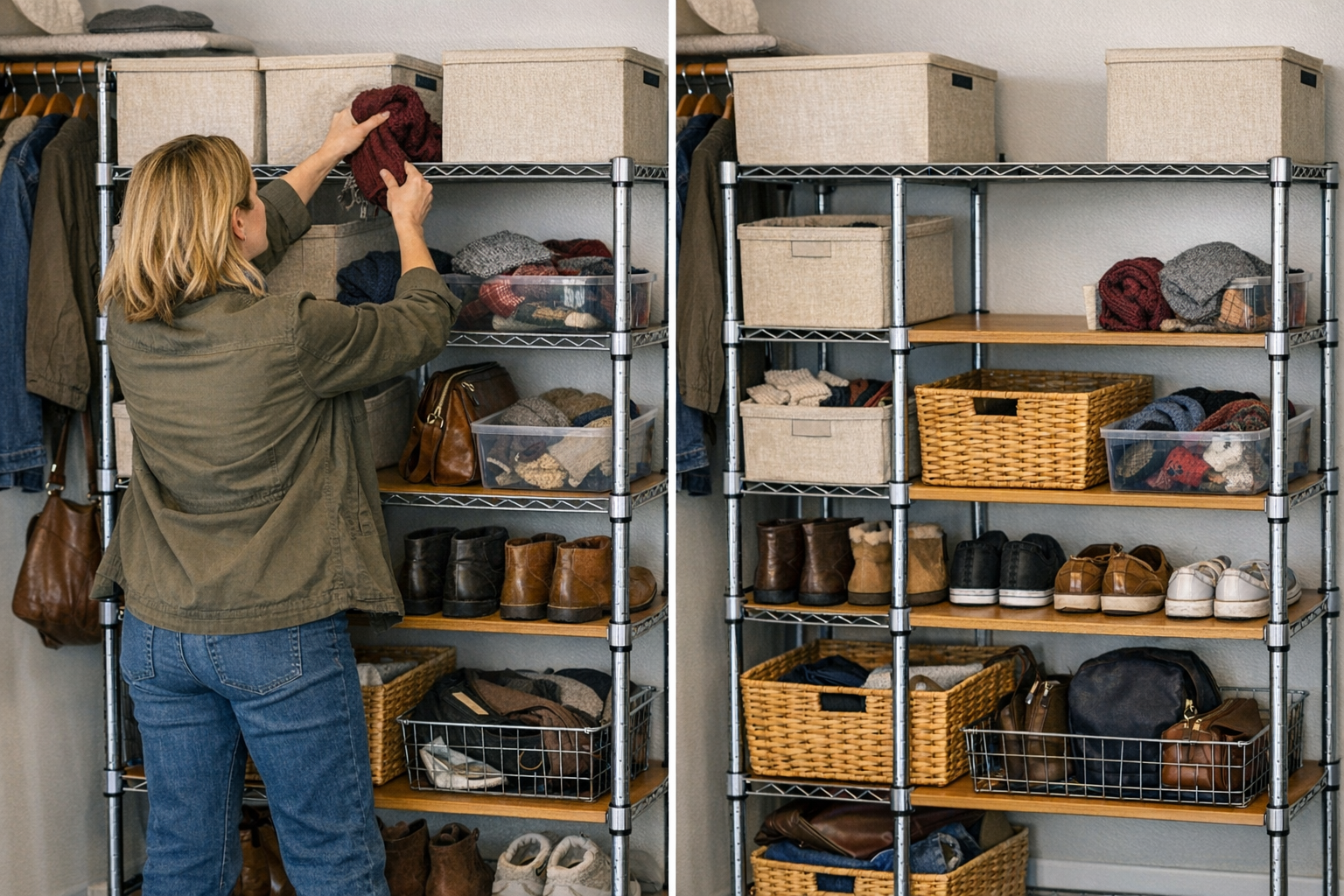
    Most closets start out looking under control—and by the end of the week, they betray you. You start with a fresh floor, sorted bins, folded shirts in satisfying rows, and shoes lined up as if everything might finally stay in place. But two or three actual mornings later, boots have crept outside their zone, a hat is missing in action, scarves are tangled, and that crisp order has given way to new clusters of chaos. The truth isn’t that you failed to organize—it’s that your closet was built for how it looks at rest, not for the thousand small moments you actually use it.

    The Real-World Storage Challenge

    The usual fix? More bins, more dividers, more labels. These work on day one: you pull out a sweater, find your gloves, and everything snaps back into place. But the first day isn’t real life. As soon as you’re running late and need your favorite pair of shoes—now buried behind three others—the cracks in the system show. You stack sweaters but, after a couple grabs, the pile starts to lean. That tight row of baskets? Every time you need the back one, you’re shuffling the whole shelf. Soon, “tidy” turns into a juggling act, and the effort required to keep it up grows with every use.

    The main storage struggle isn’t just visibility—it’s friction and access. If putting a pair of boots away means moving three bins or reaching deep into a dark shelf, you start negotiating with yourself: “I’ll put this away later.” That “later” piles up—literally—until the system itself becomes the problem you wanted to solve.

    Daily Use Quickly Breaks Good Intentions

    Imagine your entry closet at 8:15 AM. The bus is coming, someone’s digging for their backpack (shoved awkwardly on top of a basket), shoes have multiplied by the door, a coat sleeve blocks access to gloves, and you grab whatever you can before heading out. Even if you set up clear categories—hats in one bin, extra shoes in another, scarves neatly rolled—by Tuesday, those boundaries have blurred. A rogue pair of sneakers is blocking the boots, a baseball cap has migrated, and bags now lean against everything.

    This isn’t laziness. It’s inevitable when a system only looks organized standing still. The storage that “fits” the most often requires the most reshuffling—and after just a few normal days, categories dissolve and resets get slower. That row of identical baskets? Practical in theory, but if you have to pull out the front two for every reach, the rest of the shelf becomes staging for stuff you don’t have time to sort.

    Small Frictions Compound

    You barely notice the extra steps at first—the quick bin move to get a hat, the nudge of a shirt stack so the right one slips free. But multiply those little annoyances all week long. Now, two bins are out of place and it’s easier to start a pile on the floor than restore the order. What started as good intentions quickly slides into a cycle of workaround and delay.

    Does Your System Survive a Normal Week?

    The best way to stress-test your shelves: ignore resets for three days and see what happens. Open the closet, grab what you need, put things back as you’re able—but don’t stop to re-stack, re-fold, or re-categorize every time. Where does the order break down?

    • Do you need to remove two bins just to get to socks at the back?
    • Are folded shirts losing their shape by midweek?
    • Are shoes and boots spreading sideways or blocking the way?
    • Do bins end up mixed within a few normal uses?

    When those patterns show up, your system’s friction is too high. The neat surface fails the daily test: quick access, clear categories, and a reset that actually feels doable in real time.

    Why Adding More Storage Makes Clutter Worse

    It’s tempting to solve overflow by stacking in one more bin or squeezing in another shelf divider. But jamming in more storage often increases friction: blocked access, tighter shelves, and nowhere to stage items in transition. When every inch is filled, you lose the flexibility to simply set something down in its right place. Instead, gloves get tossed in the nearest gap, shoes are wedged between bins, and loose items stack up within days.

    The real improvement isn’t about hitting “maximum capacity.” It’s about keeping the system functional in the middle of a busy week—doors flung open, hands full, and zero desire to reshuffle three rows just to put away a scarf.

    A Daily-Life Fix: Make Room for Movement

    Consider the hallway closet that used to implode by Wednesday. Every item had a labeled bin—yet order still collapsed by the end of the week. The actual solution was to remove a single, barely-used bin. That freed up just enough open space—a slim gap, a landing spot—to act as a buffer for influx and quick returns. Suddenly, items stopped piling on the floor. Bins stayed sorted. Gloves were easily tossed back into place without knocking down another category. Everything flowed, not because there were more tools, but because there was finally margin to move.

    Let Shelves “Breathe”: The Pressure Valve Principle

    A purposeful gap—five inches, one missing basket, a clear end of shelf—serves as your closet’s relief valve. It breaks up crowding and gives you a spot to park in-transit items. That shelf may look a little less packed in the Sunday “after” photo, but by Friday, it’s the difference between a quick toss-back and a total reorganization.

    Apply this logic anywhere: bedroom closets where t-shirts tumble off the stack, entryways where shoes overload the mat, laundry areas where the overflow never quite fits. The best indicator you need space isn’t what you see at rest—it’s how fast you can restore order on a Wednesday night, and how distinct your categories remain after just a few family uses.

    Recognize Storage Bottlenecks Before They Cause Trouble

    Watch for these recurring pain points:

    • You avoid putting away shoes because you have to move three pairs first.
    • You hesitate to reach for a shirt at the bottom of a stack, so clothes pile on top instead.
    • Baskets that started sorted end up mixed or overflowing before the weekend hits.
    • Vertical space goes unused because everything’s jammed at shelf-level.

    If you repeatedly work around your systems—hesitating, stacking “for now,” avoiding certain shelves—it’s a sign your storage needs breathing room, not another organizing bin.

    Long-Term Function Beats Quick “Before and After”

    An organized closet only succeeds if you can use it easily three days, three weeks, and three months after you set it up. When “put away” comes with too many steps, or categories are constantly overlapping, the storage becomes one more obstacle. Real function means margins. It means clear zones that survive daily life, and open space so resets don’t require a whole afternoon.

    Try This: Build In an Open Section

    Instead of crowding every inch, reset your closet by deliberately leaving one shelf or basket empty. Notice what happens by the end of the week. Does that gap keep clutter from spreading? Do items find their way back without a shuffling cascade? If the space fills instantly, treat it as a signal: what’s actually used, and what could be let go so the rest can finally function? The right margin makes every remaining section easier to reach, reset, and keep sorted—for real life, not just photos.

    Storage That Moves With You

    If your system needs constant workarounds, the answer probably isn’t another product—it’s recognizing where daily use breaks the “just organized” surface. Look for storage solutions that stand up to repeated grabs and quick returns, not just a neat snapshot. Whether you’re overhauling a closet, taming an entryway, or rescuing a laundry shelf, check how much reshuffling you’re doing, how categories hold up by midweek, and how fast you can restore order without starting from scratch. Something as simple as removing a bin or reserving open shelf space can turn a closet from a frustration zone into a functional tool.

    If you want more ways to design spaces that actually work—day after day, through real family use—explore shelving, bins, and storage systems built for living at ClosetWorks.

  • How Modular Yard Storage Transforms Outdoor Maintenance and Flow

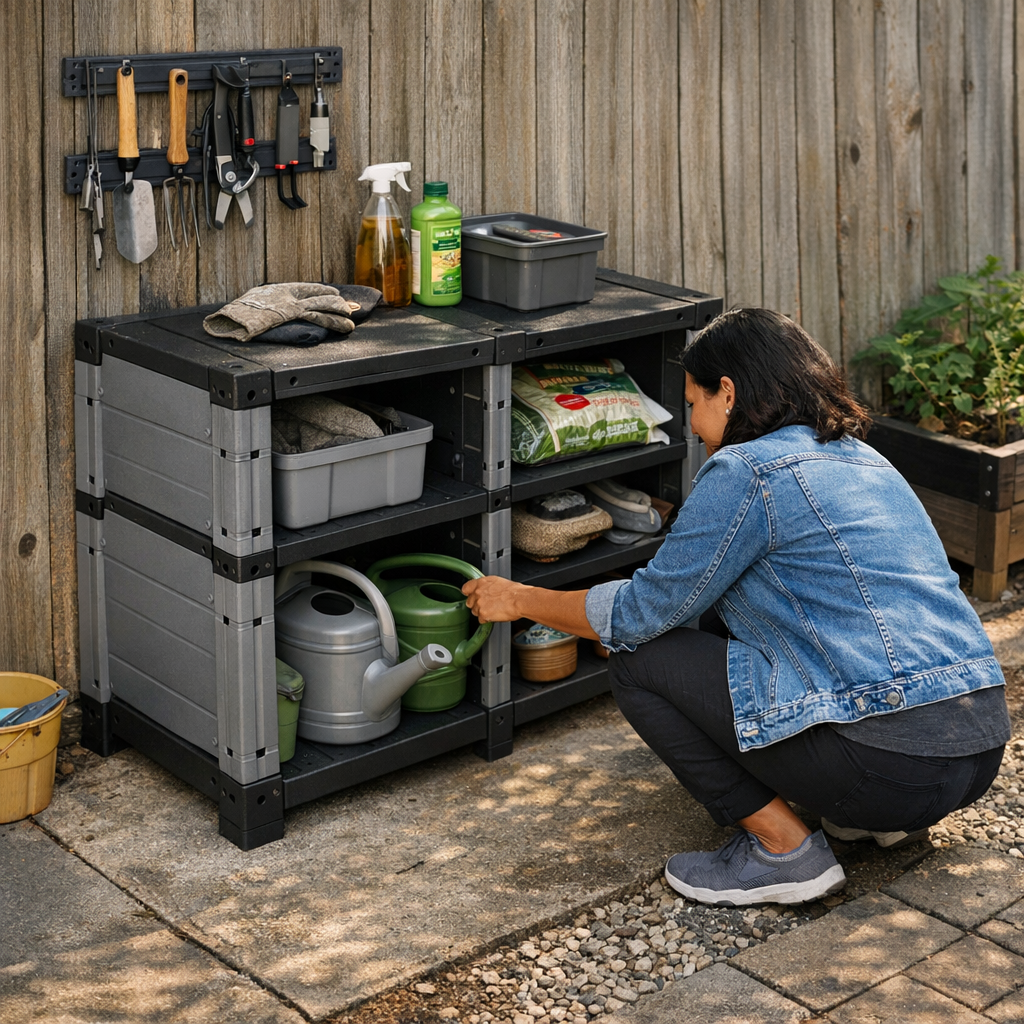
    Try walking a straight line from your back door to the garden. Most days, you can’t—not without shifting a hose with your foot, sidestepping a rake that’s balanced against the fence, scooping up a ball so you don’t kick it by mistake. The real drag isn’t one piece of clutter; it’s an outdoor setup that takes over the very paths you use. Every slight detour and each stop to nudge something aside is friction you feel, even if you don’t talk about it. That “quick tidy-up” you promise yourself becomes just another ritual, because the system silently resets itself to disarray every few days.

    Where Good Intentions Get Undone By the Week

    An organized look doesn’t guarantee easy movement. You start with a tidy bin by the patio or a new rack near the shed, imagining hassle-free access. But the real test hits midweek. Tools lean across the walkway, sports gear trickles past its zone, and that reusable bag you meant to bring in three days ago becomes a trip hazard. A system built for appearances doesn’t hold under real routine; you’re stuck doing the same shuffle, the same mental inventory every time you cross the yard.

    When Returns Create a Bottleneck

    By Wednesday, the “just for now” pile has become a real obstacle course. You drop the gardening fork near the gate—then move it again so someone can wheel the bike out. Someone leaves a soccer ball behind the trash bin, then you nudge both just to swing the door open. The setup isn’t failing because you’re careless, but because there’s no true return path. Instead of designated parking spots, you have temporary drop zones, which keep filling up and spilling over into your walkways.

    Open Storage: Why it Slips, and How Structure Holds

    Open bins, big buckets, and rack shelves look flexible but bleed into each other too easily. You return something half-focused and it nudges other things out of their lanes. A hose snakes under the folding chair, the trowel disappears behind a pile, the fertilizer mixes with stray toys. One misplaced item sets off a small cascade—turning a tidy patio edge or garage threshold into a catchall that dampens your pace and buries what you actually need.

    Closed or defined storage isn’t about hiding mess—it’s about ending the endless shuffle. When a rack has distinct hooks or a wall rail has only as much length as you need, the setup draws a line: in or out, here or not. This clarity isn’t wallpaper; it’s a living boundary, pressuring quick resets before things can pile up. You’re not fighting overflow so much as preventing it from gaining ground in the first place.

    Vertical Space: More Than Just Wall Decor

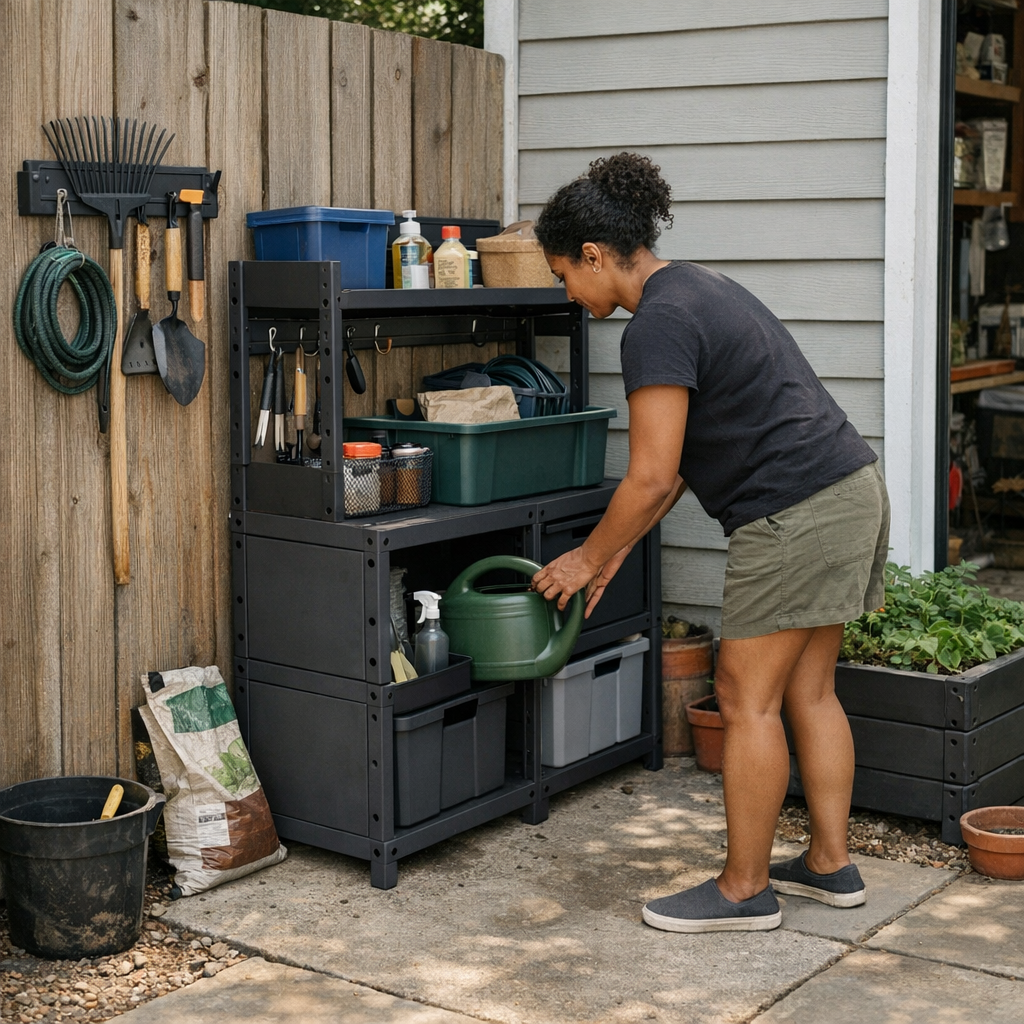
    Small yards and busy side zones don’t just hold stuff—they move people. A few wall-mounted rails, placed at shoulder height, clear the floor in spots that see the most foot traffic. Where the rake used to block the side gate, now nothing touches your ankles. Where you once fished for trimmers beneath a bench, you grab them from their hooks and keep walking. The difference is immediate and practical: clear ground is never just about the look; it’s about not breaking your rhythm every time you pass through.

    The Return Flow Test: Real Use, Real Clutter

    You can do a Saturday reset and admire how things fit—until by Tuesday, everything’s shifted again. The trouble isn’t laziness, it’s the setup’s lack of true friction for misplaced returns. Stack a trowel on the edge of an open bin “just for a second,” and days later you’re moving an entire pile to get to a bag of soil. The system invites “temporary” returns that always last too long, and the cost is time lost relocating gear on every lap through the space.

    Structured systems enforce “return discipline” that outlasts any cleaning spree. Racks with set purposes, wall rails that match the actual number and size of your tools, and weather-resistant units placed where returns naturally happen—all these shrink the time spent hunting, shifting, and reshuffling. The question is never “where does this go?”—it’s “why isn’t this already back on the wall?” The overhead to put things away fades against the bigger hassle of the pileups you never have to clear.

    Overflow Pockets and Dead Zones

    There are always corners that act like gravity wells for spare gear. A bin at the patio edge turns into the graveyard for gloves, broken pots, and soccer balls. Without a hard stop—some kind of boundary or closure—these dead zones swallow anything you’re not sure about, making every “cleanup” a round of rearranging rather than true organization. Overflow starts as a trickle and quickly becomes a block, defeating the point of sorting in the first place.

    What Actually Changes With Modular, Hybrid Systems

    The shift isn’t buying more storage, but making the footprint smarter. Picture taking your highest-use tools out of ground-level bins and up onto a short rail along the garage wall. That one move reclaims the space at your feet and instantly shows what’s out or missing, no pileup required. Add a weatherproof closed box only for backup bags and bulky items—suddenly, your overflow falls back to size, and your walkway regains its freedom. There’s no tangle of half-returned items, no shuffling just to close the gate or pass the mower. The system does the sorting for you, and evening resets stop feeling like a whole project.

    Flexibility Without Fuss—Or Reset Fatigue

    Perfect resets aren’t the goal. Routines change; some weeks are all muddy boots and ball returns, others fill up on garden tool traffic. But those boundaries stay visible: pass-throughs stay clear, storage zones actually contain, and you can adjust parts of the system without tearing everything up. The best setups resist looking full or cluttered after a long week—they invite quick tweaks, not grueling overhauls, and every returned item falls back in line without heroic effort.

    Boundaries That Change Behavior—Not Just Appearances

    The strongest cue isn’t a tidy appearance but storage that physically blocks clutter from bleeding into circulation paths. A system that works by Thursday, not just Sunday night, has proven its worth. You’re not stopping every five feet to nudge a rake or reroute around a pile of boots—the yard flexes for you, not the other way around.

    Small tweaks matter: color-coded rails or tactile markers on closed bins make it obvious—without a word—what belongs where. A green sticker on the tool hook, a rough strip on the sports section, a bright tag on the gardening side. These tiny boundaries speak to guests, kids, and tired end-of-day you, ensuring even the quickest returns hit their mark.

    Ease That Stays in the Background

    The payoff isn’t an empty yard, but a path you barely think about. When your garage edge, side yard, or patio utility zone keeps you moving without stops and sidesteps, the storage starts doing its job. You feel it not in the absence of clutter, but in routines that stop breaking your stride. Small frictions fade; movement just works. That’s how practical organization proves itself—by making life outside one step easier all season long.

    Find practical outdoor storage that matches real use at TidyYard.