
Understanding How Lens Quality Impacts Your Precision Work
Have you ever struggled to mark a precise line or thread a tiny screw, only to find your vision blurred or distorted despite wearing safety glasses? Many assume that wearing any safety glasses is enough to protect their eyes and maintain accuracy. However, when you rely on inexpensive safety lenses, you might unintentionally introduce subtle distortions that cost you precision and increase fatigue during detailed tasks.
In this article, we’ll explore why cheap safety glasses can compromise your accuracy and offer practical insights on choosing the right eyewear to ensure clarity and comfort throughout your workday.
The Hidden Cost of Low-Quality Safety Lenses
At first glance, safety glasses appear simple and uniform: clear plastic shields with arms to secure them in place. The real differences lie beneath the surface, especially in the lens material and manufacturing precision. Lower-cost safety glasses typically use polycarbonate lenses that may have inconsistent optical clarity due to lower standards in grinding, curvature, and coating application.
For example, the thickness of lenses in cheap glasses can be as thin as 1.4mm, whereas more reliable, jobsite-grade eyewear usually features lenses closer to 2mm or thicker. Even slight deviations—such as a half-degree error in lens curvature—can cause light to bend unevenly, leading to distortions that are critical during fine work.
Types of Distortion Caused by Inferior Lenses
- Edge distortions: Subtle warping at the periphery of the lens creates pincushion or barrel distortions, where straight lines appear curved.
- Magnification shifts: Slight variations in magnification near the lens edges can mislead your perception of measurement and alignment.
- Ghost imaging: Faint double images or reflections can cause confusion during close-up tasks requiring focus.
These effects aren’t always obvious at first, but they force your eyes to constantly refocus and strain, subtly undermining your accuracy and causing fatigue.
A Real-World Example: When Safety Glasses Betray Your Markings
A few years back, I spent an afternoon installing cabinet handles for a friend. Initially, I wore a cheap pair of safety glasses, confident they would protect my eyes without issue. After making a few holes, I noticed the spacing felt off—marks that should have been perfectly straight seemed slightly curved. I shifted my angle repeatedly, wondering if my technique was the problem.
When I finally removed my glasses and inspected the marked points, the lines were noticeably warped. Not my hands—the lenses were distorting my vision, shifting my perception enough to cause misalignment. This experience drove home how optical imperfections in eyewear can directly impact the quality of your work.
Why Consistent Vision Matters in Precision Tasks
Whether you’re a carpenter, electrician, automotive technician, or hobbyist, precision is often non-negotiable. The smallest misjudgments in alignment, measurement, or cutting can lead to a domino effect of errors:
- Refocusing fatigue: Inconsistent light refraction forces your eyes to constantly adjust, leading to tiredness and decreased accuracy over several hours.
- Misaligned marks: Even a 0.5 to 1.0mm deviation on a 300mm gauge can cause gaps in joints or ill-fitting trim.
- Tool misalignment: Eye strain can cause you to set saw blades, chisels, or punches off-center, compromising the finish.
These small errors compound, resulting in wasted effort, additional rework, or lower-quality outcomes.
How to Test Your Safety Glasses for Distortion
Before committing to a pair of safety glasses, it’s worth performing a simple at-home test:
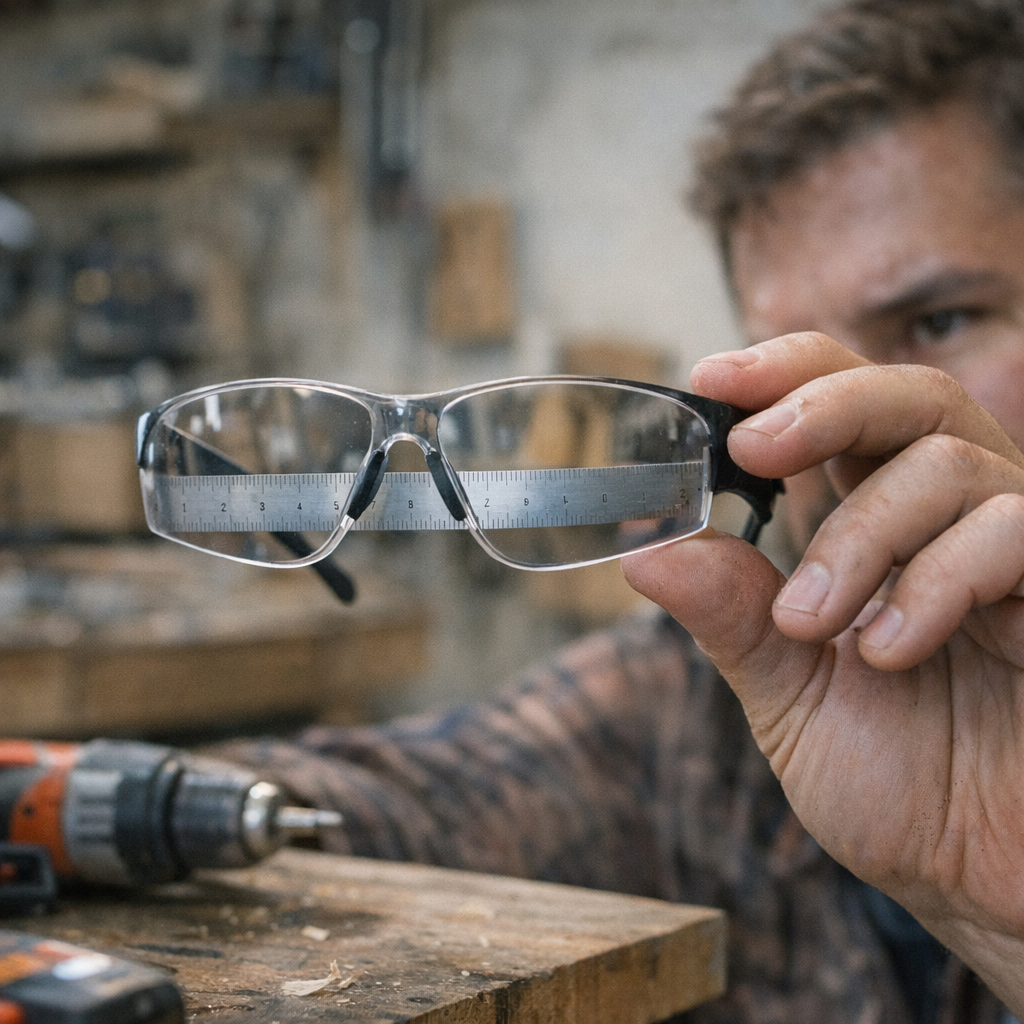
- Hold your safety glasses at arm’s length.
- Look through them at a fine, straight line—such as the edge of a steel ruler or a tile edge.
- Slowly move and tilt the glasses in various directions.
- Observe whether the line stays perfectly straight or twists, waves, or shifts as the image moves across the lens.
If you notice more than 0.5mm of distortion at arm’s length, those lenses might introduce enough error to affect your precise work.
Performing this quick check before starting a detailed task can save time and frustration later. If your lenses fail this test, reserve those glasses for rough or demolition work.
Choosing the Right Safety Glasses for Accurate Work
Investing in higher-quality safety glasses means selecting lenses designed with strict optical standards and durability in mind. Here are features to look for:
- Standards compliance: Look for EN 166 F or ANSI Z87.1+ certifications, which require minimal refractive distortion—typically less than 0.06 diopters.
- Optical quality lenses: Plano (non-prescription), distortion-free lenses with consistent thickness, usually 2mm or greater.
- Coatings: Anti-fog and scratch-resistant layers help maintain clarity throughout a long workday.
These choices ensure your vision remains clear, minimizing refocus and eye strain, so your hands and tools can perform at their best.
Refresh Tip: Swap Glasses Mindfully During Your Workday
A simple strategy to maintain comfort and precision is to keep two pairs of safety glasses on hand: one budget-friendly set for rough, messy, or demolition tasks, and a higher-end optically clear pair reserved for measuring, marking, and detailed assembly.
This small habit keeps you visually sharp when you need it most—without sacrificing eye safety during less critical phases. Switching glasses might take a few seconds but yields a substantial boost in accuracy and reduces unnecessary eye strain.
Integrating Accurate Eyewear into Your Workflow
Before starting your next project that involves tight measurements or finishes:
- Evaluate your current safety glasses using the distortion test above.
- Consider upgrading to certified, optically precise lenses if you frequently work on intricate tasks.
- Use your robust glasses consistently for layout, marking, and fine adjustments.
- Keep a secondary pair for demolition, rough cutting, or painting.
Maintaining clear vision safeguards not just your eyes but the integrity of your work results.
Conclusion
Cheap safety glasses still protect your eyes from physical hazards but often introduce optical distortions that can subtly sabotage your precision work. Lens-induced image warping and magnification shifts cause eye strain, misaligned marks, and errors in tool setup—problems that worsen over prolonged use.
Taking time to test your eyewear, investing in certified distortion-free lenses, and adopting smart habits—like swapping glasses based on the task—can significantly improve your finishing accuracy and reduce fatigue. Remember, the foundation of precise craftsmanship begins with clear, undistorted vision.