
Understanding Feed Direction and Its Importance in Routing
If you’ve ever routed edges and noticed some cuts come out smooth while others end up chipped or rough, you might be overlooking a fundamental factor: feed direction. Despite its simplicity, the direction in which you move your router relative to the bit’s rotation dramatically affects the quality of your cuts and the safety of your work.
Feed direction refers to the way you guide your router across the wood in relation to the spinning bit. Most routers spin clockwise when viewed from above, meaning the cutting edge moves left to right at the front of the bit. This direction of spin informs how you should feed the tool into the material for the best finish and safer operation.
Conventional vs. Climb Cutting: What’s the Difference?
There are primarily two ways to feed your router:
- Conventional Cutting: Feeding against the bit rotation (moving the router so it pushes into the bit’s rotation)
- Climb Cutting: Feeding with the bit’s rotation (the router moves in the same direction the bit is spinning)
Most woodworking projects benefit from conventional cutting because it offers better control and minimizes tear-out. You’ll feel a slight resistance pushing the router against the spin, which helps prevent the tool from grabbing the wood and jumping forward unexpectedly.
Climb cutting, on the other hand, can lead to cleaner surfaces in certain difficult grain situations. However, it’s riskier because the router tends to pull itself into the cut, often requiring a firm grip to keep it steady. This technique is usually reserved for final passes on small, controlled pieces or specialized applications.
Detecting the Right Feed Direction in Practice
If you suddenly find the router hard to steer or it seems to lurch ahead, you’re likely feeding it in the wrong direction—climb cutting unintentionally. A correctly performed conventional cut should feel smooth with manageable resistance.
Feed direction can also affect the finish; the wrong feed tends to create burn marks, chatter, or splintered edges, especially on end grain or cross-grain cuts prone to blowout.
Practical Tips for Managing Feed Direction and Router Setup
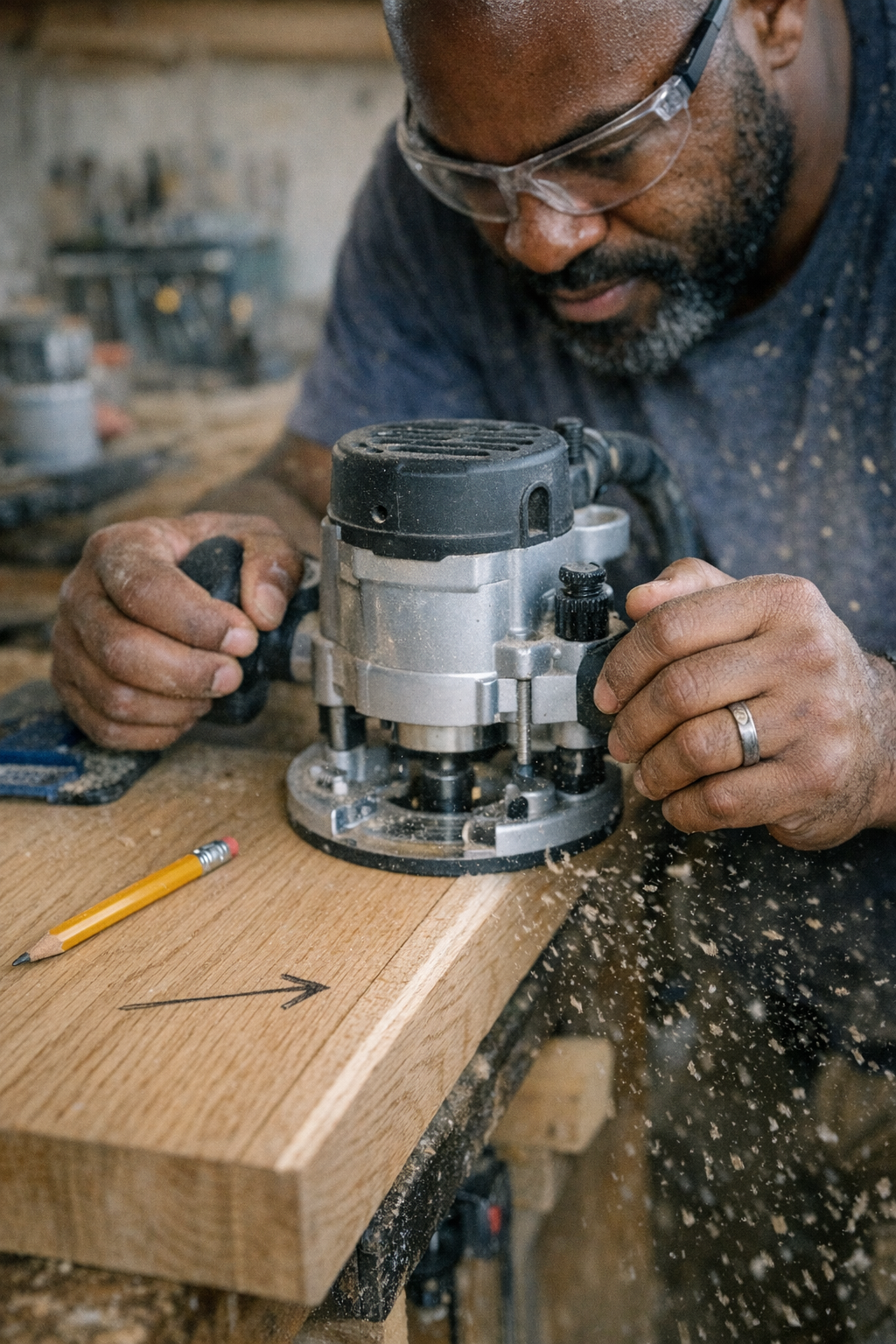
1. Mark Your Feed Direction: Before routing each board or component, take a few seconds to draw small arrows indicating the optimal feed direction right on the wood. This tiny step can save you hours of guesswork and prevent costly mistakes, especially in dusty or fast-paced environments where it’s easy to forget or lose track.
2. Match Feed Direction to Workpiece Orientation: On outside edges where you stand facing the board, you usually move the router from left to right against the bit’s clockwise spin. For inside cuts like dados or grooves, it typically reverses—feeding from right to left—to maintain the same opposing feed.
3. Optimize Bit and Speed Selection: Use sharp bits appropriate for your material—carbide-tipped 2-flute bits work well on hardwood edges. Adjust your router speed based on bit diameter; smaller bits (up to 12mm) can run at 18,000 to 24,000 SPM, but larger bits require slower speeds (under 16,000 SPM) to prevent burning or chatter.
Feed Direction and Material Considerations
Materials like MDF or veneered plywood are more prone to splintering if fed incorrectly. For these, using spiral up-cut bits with narrow kerfs (3–5mm) and taking light passes of 2–3mm will reduce tear-out and preserve surface quality.
End grain is particularly vulnerable. When routing end grain, reduce your passes to minimize chip-out or consider a very light climb cut on the last millimeter only if you’re comfortable controlling the router.
A Refresh Tip: Slow Down and Reassess Your Cutting Process
It’s tempting to speed through routing to finish a project quickly, but rushing often causes more problems than it solves. If your router starts to feel strained, noisy, or seems to push back against you, pause. Check your feed direction, bit sharpness, and router speed.
Adjusting your feed speed to a steady, controlled pace is crucial. A slower feed at optimal bit speed will consistently yield cleaner edges and less effort, particularly on hardwoods and figured stock. Remember, good routing isn’t about how fast you move, but how well you control tool and material interaction.
Common Mistakes to Avoid
- Routing all edges in a continuous loop without adjusting feed direction—this often causes improper feeds and poor finishes.
- Relying solely on climb cuts to speed up the process—increases risk of injury and work damage unless expertly managed.
- Making deep passes that overload the router and bit, leading to tear-out and tool wear.
Instead, break your routing into manageable sections. Reorient the router as needed so you can always feed against the bit’s rotation. Take multiple light passes rather than one aggressive cut.
Real-World Experience: Avoiding Expensive Errors
On one job, an apprentice accidentally used a climb cut while rounding over a bullnose edge on freshly sanded oak stair treads. This caused the router bit to grab and surge forward, chewing a significant 2-inch chunk out of the workpiece. The result was wasted materials and lost time—an hour-long delay to replace the damaged tread.
This scenario underscores how subtle mistakes around feed direction can quickly translate to real-world consequences, especially on critical or expensive parts.
Summary: Feed Direction Matters More Than You Might Think
When routing, the simplest adjustment—feeding your router against the bit’s rotation—can dramatically improve your cut quality and safety. Combining this with appropriate bit selection, speed control, and light passes leads to the best results.
Small habits, like marking arrows on your boards, and slowing down to reassess your setup, are practical ways to reduce errors and improve your woodworking outcome without extra cost or effort.
Next time you pick up your router, take a moment to visualize the bit’s rotation and plan your feed direction accordingly. This tiny act of mindfulness often separates a perfect edge from a piece that demands extra sanding or worse, replacement.