
Understanding Why Grit Order Matters in Wood Sanding
If you’ve ever admired a flawlessly smooth tabletop at a craft fair or in a professional woodshop, you’ve likely wondered what process created such a perfect finish. The secret often lies not just in the sandpaper grit itself, but in the order the grits are used. Proper sequencing prevents the dreaded swirl marks that can ruin an otherwise pristine surface.
Swirl marks typically show up as circular scratches under finishes, betraying rushed or improperly sequenced sanding. They’re especially common when you skip grits or jump from very coarse to very fine without intermediate steps. Avoiding them means respecting the progression of grit sizes, allowing each step to effectively remove scratches left by the previous grit.
Why Skipping Grits Causes Swirl Marks
The main culprit behind swirl marks is skipping grit sizes during sanding. When moving from a coarse grit to a fine grit too quickly, the fine sandpaper can’t effectively remove deep scratches created by the coarse sandpaper. Instead of eliminating those scratches, you’re just polishing them, and under wood finishes, these still show up as unsightly patterns.
For example, jumping directly from 80 grit to 220 grit is a common mistake. The fine 220 grit sanding disc will glide over the deep grooves left by 80 grit, leaving them visible even after finishing coatings are applied. This problem is particularly pronounced in hardwoods like maple or cherry, where deep scratches easily telegraph through the finish.
Recommended Grit Progression for a Swirl-Free Finish
Professional woodworkers swear by a gradual grit sequence that moves up one step at a time:
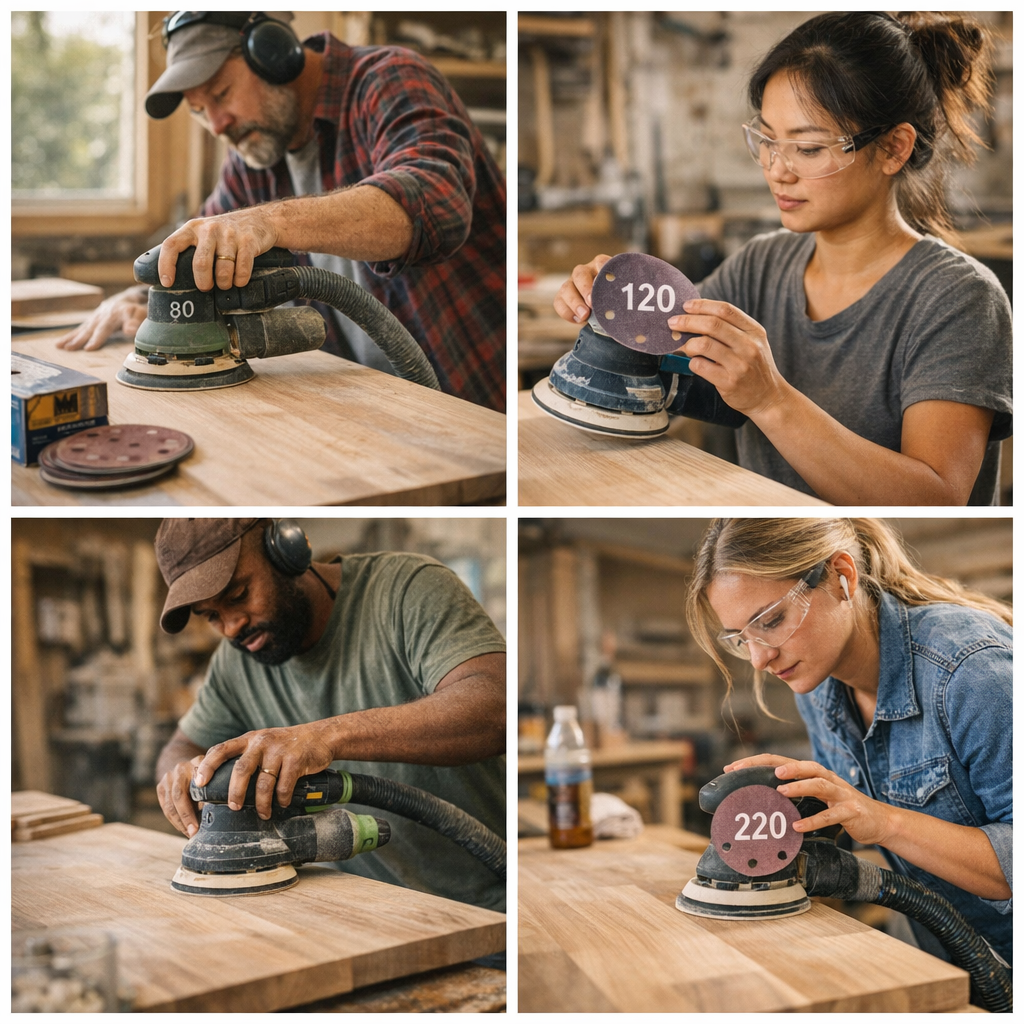
- Start with 80 grit for rough shaping or flattening surfaces.
- Progress to 120 grit to smooth and begin refining.
- Move to 180 grit for further smoothing.
- Finish with 220 grit for an ultra-smooth surface ready for finishing.
This steady progression ensures that each sanding step removes the scratches left by the previous grit completely, resulting in a perfectly smooth surface with no visible swirl patterns.
Choosing the Right Tools and Settings Matters
Equally important as grit sequence is choosing the appropriate sanding tools and settings. Random orbital sanders are preferred for their ability to reduce visible swirl marks compared to traditional rotary sanders or hand sanding.
Operating your random orbital sander at a moderate speed—typically between 10,000 and 12,000 orbits per minute (OPM)—with a 5-inch or 6-inch pad helps prevent overheating and swirl patterns. Overly fast speeds can burn the wood or create deeper scratch patterns.
Additionally, using sanding discs with an “open coat” design helps reduce dust loading by providing more space between abrasive particles. This keeps the abrasive active longer and prevents clogging, which can cause uneven sanding.
Pro Tip: Keep Your Discs Organized
A simple yet effective workshop habit is to write the grit number on the Velcro side of your sanding discs. This prevents confusion mid-project and eliminates mistakes like skipping a grit or accidentally jumping ahead.
Dust Management and Technique: Essential for a Clean Finish
Beyond grit order and machine settings, dust management dramatically impacts your sanding results. Fine dust particles left on the surface between grits can cause new scratches or imperfections.
Always vacuum or wipe down the surface thoroughly between sanding steps. Using a tack cloth or low-lint microfiber cloth helps remove any remaining dust. Some woodworkers attach a shop vacuum to their sander’s dust port (typically 1.25 inches in diameter) to reduce airborne dust and keep the work surface cleaner.
Also, maintain steady pressure—too heavy-handed sanding can cut unevenly and leave marks that require more work to remove. Let the sander’s motion do the work. Overlap each sanding pass by about a third to ensure even coverage without patchy spots.
Refresh Tip: Slow Down and Embrace the Process
Often, the biggest enemy of a flawless finish is rushing. It’s tempting to leap to the finest grit to speed things up or skip vacuuming to save a minute. However, every shortcut risks creating swirl marks that show up after finishing, forcing costly fixes.
Try this small mindset shift: treat sanding as a meditative, stepwise ritual. Spend focused time on each grit progression, check your discs, tidy up the dust, and move deliberately. This attentiveness transforms sanding from tedious labor into craftsmanship and ensures you can take pride in the finish.
Case Studies: Lessons From the Workshop
On an oak shelving project, skipping the intermediate grits turned what should have been a shining finish into a surface riddled with fine swirl patterns. When finished with oil, those imperfections became impossible to hide. The fix involved re-sanding step-by-step through all grits and thorough dust cleaning, doubling work time.
Conversely, projects where I adhered to 80, 120, 180, and 220 grit progression finished with buttery smoothness every time. The surface was so refined that even bare wood felt like glass to the touch, and finishes applied flawlessly without magnifying imperfections.
Summary: The Simple Sequence for Swirl-Free Sanding
- Choose a random orbital sander with appropriate speed settings (10,000–12,000 OPM).
- Use sanding discs starting at a coarse grit like 80.
- Progress sequentially—never skip grits.
- Use an open coat abrasive pattern for better dust management.
- Keep dust under control by vacuuming or using tack cloths between steps.
- Maintain slow, even pressure and overlapping passes.
- Label sanding discs clearly to avoid stepping out of sequence.
Following this disciplined approach will dramatically reduce swirl marks and produce wood surfaces ready for flawless finishing layers. It takes patience and attention, but the rewards are tangible in every perfectly smooth project.
Remember: sanding isn’t just a chore—it’s an essential stage of craftsmanship. Getting grit order right transforms the final look and feel, making your work stand out for its quality and polish.