
Every narrow hallway runs on a timer: by Friday, the path that felt wide and managed on Monday has shrunk to a squeezed, obstacle course. Shoes multiply, bags drift off course, and that “place for everything” dissolves into basket bulge, sneaker spillover, and jackets slouched where no one planned. The routine shifts from simply moving through the door to dodging clutter, negotiating corners, and bracing for one more drop in the wrong spot. What starts as order—bench, baskets, shoe rack—turns into a routine bottleneck, slowing everyone just when things need to move fast. This is the entryway problem that doesn’t fade with better intentions: it repeats every week, unless the way you structure the space actually changes the flow.
The Problem with Floor-Based Storage in Real Use
Floor storage feels like a fix: line up a bench, tuck in shoe racks, and stack baskets along the wall, and day one looks controlled. But repeated use breaks that surface order. Each day brings another bag that’s not aligned, another pair of shoes wedged at an angle for convenience—soon the “clear line” becomes a diagonal of tripping hazards. By midweek, passing through means sidestepping not just stuff but frustration. Design doesn’t matter if what’s tidy in theory becomes a reset chore every evening.
When “Just for Now” Blocks the Door
Picture this: someone drops a backpack just off its label—the “I’ll move it later” moment. It sits. Next day, a new drop lands alongside. Shoes that started paired migrate and spread; a single bag triggers two more. The walking lane that once seemed solid gradually closes in, each pass more awkward. This is the real cost: small deviations turn a functional entry into a pressure zone where every shortcut becomes the new rule.
Benches and Bins—Overflow in Disguise
Entryway benches promise order—sit here, stash there, store out of sight. But during real-life rush, the bench edge becomes the drop spot for whatever doesn’t fit: lunch boxes by evening, hats, then mail, then stray crucial items. Bins and baskets edge outward as more is squeezed in, making it harder to keep anything truly contained. What looked like storage ends up as overflow staging, pulling your routine off balance and swallowing the hallway’s walking edge.
Wall-Mounted Rails: Moving Storage Up, Clearing the Floor
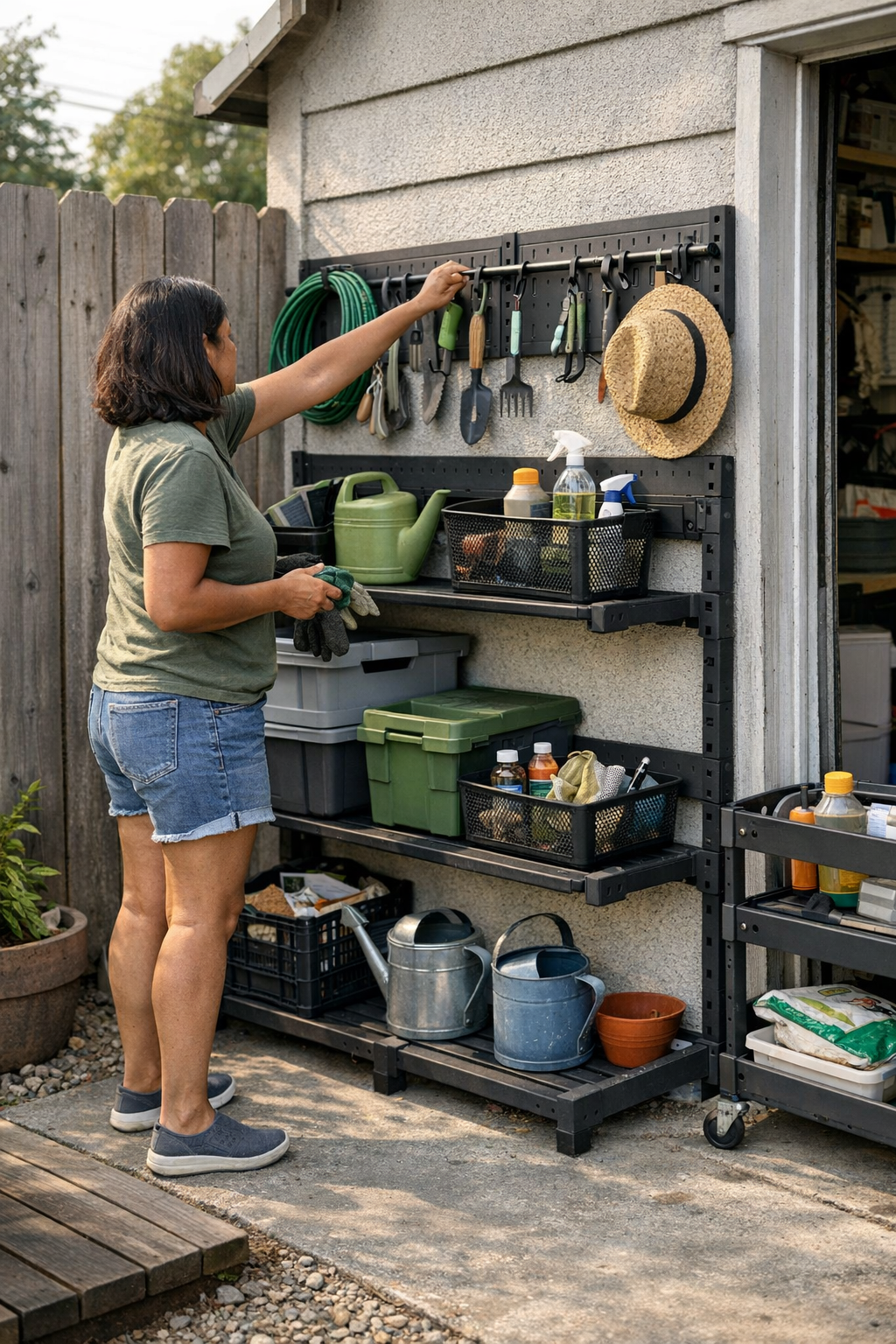
Wall rails change the logic of the entryway by lifting the clutter off the walking path. Hooks, ledges, and rails move daily storage vertical, immediately restoring floor space. What used to be a tangle at your feet becomes a visible order line: the lowest third of your hall or entry stays clear, so speed and movement come back to the zone that’s supposed to help you get out the door.
How Rails Police the Drop Zone
The effect becomes obvious after a single week. Every item above the “rail line”—coats, backpacks, bags—must claim its hook. Shoes move from scattered rows to one managed ledge or mat, so any overflow signals a problem instantly. The split is uncompromising: if something is on the floor, it’s out of place—no slow build-up, no mystery pileups. What can’t be hung reveals itself, making clean-up obvious and new clutter harder to ignore.
The Real Test: Use Patterns That Stick (or Slip)
But rails only succeed if habits cooperate. If you overload hooks or let overflow slide onto the floor, you’re back at square one: vertical storage doesn’t block “just drop it” impulses if there’s nowhere left to hang. The right match—a rail system sized for the zone and daily load—makes routines stick. When it works, the space feels balanced: people move through without bumping shoes aside or restaging baskets, and quick tidy-ups are enough to keep resets below ‘project’ level.
Everyday Scenes—Setup Influences Movement
On a hectic weekday morning: three people reach for what they need, every second matters, and the old bench-and-bin setup triggers a traffic jam—bags on the floor, shoes blocking the door, that backpack in the center just as someone steps through. With rails, bags hang in the clear, above foot level; shoes stay corralled to their zone instead of trailing everywhere. Those saved moments of not dodging piles or stepping on laces don’t stand out at first, but week after week, the entry feels less stressful, less like a recurring reset challenge.
Small Resets That Don’t Spiral
Adding a wall rail and a slim shoe ledge changed everything. Instead of reorganizing toppled baskets or shoving shoe piles back every night, the “reset” shrunk to a few seconds: line up shoes, check all bags on hooks, move anything left behind. Because the shoe ledge limits what fits, the overflow isn’t invisible—it forces a decision, or the extra pair goes elsewhere. These boundaries make the zone hold its shape longer, so even on high-traffic weeks, the hallway doesn’t default to chaos.
Where Rails Hit Their Limits
Still, no system is magic. Rails that are hung too high for kids or too cramped near corners push clutter right back to the ground. If the only storage is above natural reach or adds steps (like unlocking cabinets every time), users adapt by taking the fastest route—dumping gear on the floor where it instantly restarts the cycle. Layout mistakes get exposed fast because in transition spaces, what isn’t easy gets ignored.
Optimal Height and Flow: Entryways Are Not One-Size
The right height is non-negotiable. For adults, shoulder-level rails (typically 140–160 cm) balance reach with storage height—keeping coats and daily bags up, but always at hand. Adding a lower rail gives kids their own reach zone, removing “I can’t reach” as an excuse for floor drops. The threshold path is now mapped out for all users, reducing pileup by design rather than routine reminders.
Pair that with a narrow, honest-capacity ledge: if only three pairs of shoes fit, the edge is enforced. Instead of pretending the area can handle overflow, the setup draws a hard line—extra goes elsewhere, or the overflow signals immediately. This is how small entryways defend against sprawl that starts quietly and becomes chronic by Friday.
What Actually Changes: Movement, Reset, and Clutter Drift
The goal isn’t a catalog-perfect foyer—it’s an entry that absorbs real traffic without falling apart by Tuesday. Floor setups always break down as habits pile up; wall rails and shoe ledges keep the route open, the drops visible, and the clean-up tenable. The payoff is less friction: you move through without pausing to triage baskets or carve a path past the shoes—a reset feels baked into the flow, not like one more neglected to-do.
Stress-Test Your Setup: Imagine Next Friday
Before calling a drop zone “fixed,” picture the space a week after real use: shoes kept to the ledge, or oozing into the walking strip? Bags clipped safely on hooks, or slumping back into the corner for someone to trip on? The right entryway setup doesn’t just tidy up once—it resists the daily drift and still works when no one’s paying extra attention.