
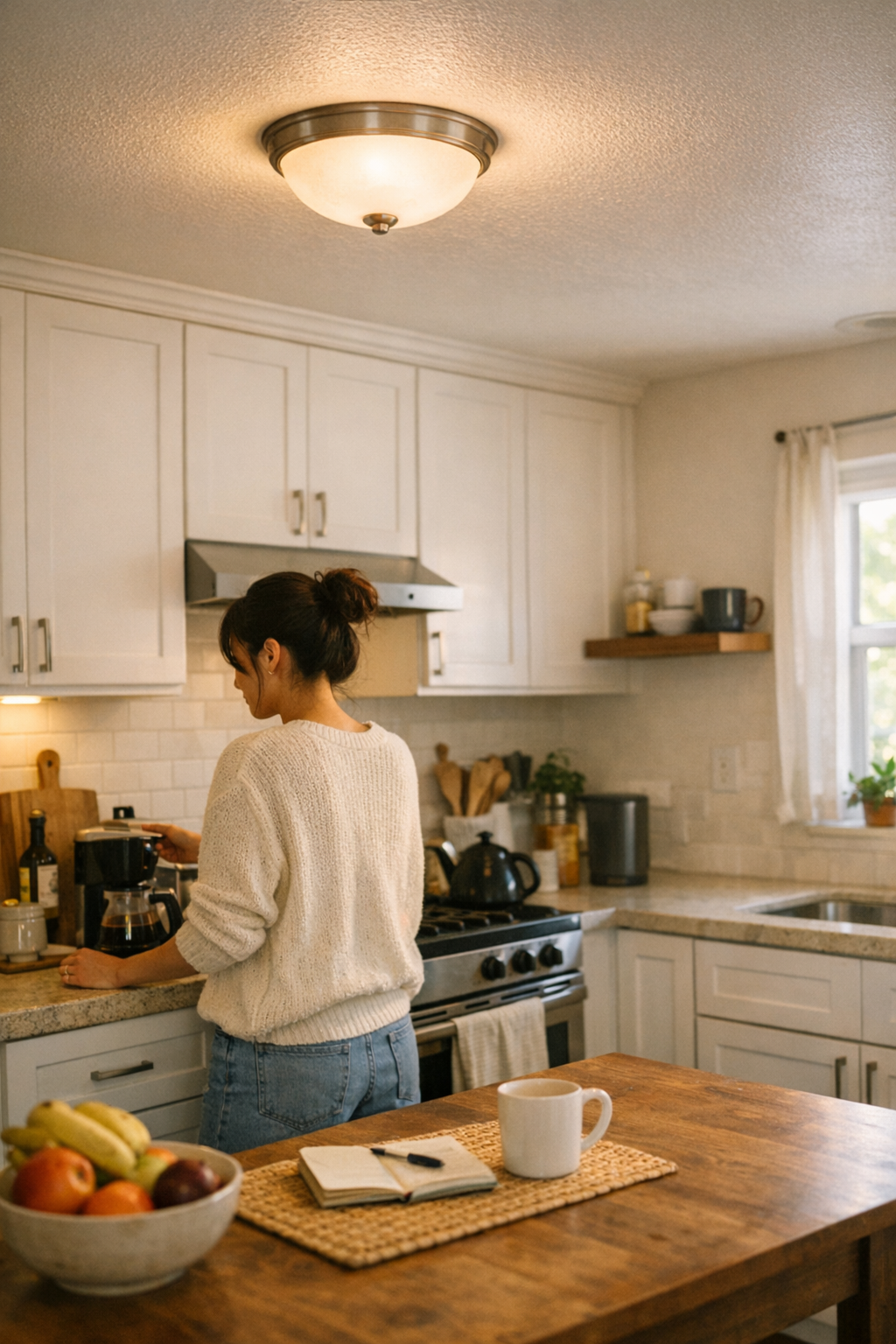
The kitchen’s light doesn’t just wake you up—it interrogates you. Even before your first sip of coffee, there’s the flat, unblinking glare from that hardwired ceiling fixture. The switch snaps, and instantly the room floods with a severe, even brightness. On paper, it’s practical. In practice, it’s punishing: every streak on the counter, every water spot on the faucet, every crumb suddenly put on display. Light pours straight down like a too-honest spotlight, making the simplest shuffle from fridge to sink feel like you’re onstage—every motion exposed, even when you want to stay half-invisible and half-asleep.
When “Good Enough” Lighting Turns Against You
For months, maybe years, you barely noticed it. The fixture is just there—centered, neutral, “efficient”—until one morning you realize it never actually helps you settle into your day. The glare is relentless where you’re meant to work most: shadows knot up behind the coffee maker, while the chopping board gets blinding reflections and the backsplash bounces light right into your eyes. Simple tasks get complicated: rinsing mugs, slicing an apple, scanning a recipe on your phone all happen under the same harsh stare. Comfort isn’t an option when the room feels like it’s turned against you.
You adjust your route across the tile—not for convenience, but to dodge the unwelcome brightness. It becomes habit to shield your eyes or turn your back as you fetch a glass. Slowly, the kitchen’s neutrality becomes a daily nag—never quite hostile, but never easy.
Moving the Light—How Little Changes Everything
Then, with one minor adjustment, things shift. The solution isn’t dramatic: the ceiling fixture nudged just enough off-center, no more than a show of inches. You hardly notice the move until you turn on the newly angled glow—and the atmosphere tilts in your favor. Straight lines of glare soften, reflections retreat, and the backsplash glows instead of searing your view.
The kitchen’s sharpness dissipates overnight. Where light once shouted, it now converses with the room. The rush of the morning routine—juggling mugs, shuffling in socks, wrestling bread out of its bag—becomes easier, somehow quieter. There’s no longer a bright rectangle boxing in your every step. Instead, illumination pools gently along the perimeter, shadows settle into corners, and surfaces are visible but not put under glass.
Everyday Relief, Not Just a Facelift
It’s not about impressing anyone or landing a magazine spread. What lands is a daily, practical relief: the work zone feels gentle on your eyes, not blinding or patchy. The whole room breathes. Your hands find things without chasing shadow. You’re not “on display” for yourself. The kitchen feels companionable for the first time all week.
Mornings Finally Match Your Pace
No more mornings that hit you like a cold interrogation room. Now, that newly positioned light fits around actual routines: quick toast, scattered lunch prep, shoes curling in the hallway, mugs waiting in a jumble by the sink. The fixture throws only enough light—not a vitamin D blast, just enough for motion and comfort. Clarity never slides into exposure. Tiles aren’t lines of glare after washing up; the room feels less like a backdrop for chores and more like somewhere to pause, think, and breathe.
The difference is everywhere you look—but not loud. The handrail, usually lost in a wash of white, now stands out cleanly for the dash out the door. Navigation is sure, not cautious. Bags and shoes are visible, but you’re not stepping through a set lit for high drama.
Midday: Let Sunlight and Ceiling Light Work Together
By noon, kitchens get crowded: mail, snacks, projects, sunlight scattered across the counters. In the old setup, glaring fixtures would war against the patchy window light. Now? The shifted ceiling glow blends with what the sun gives, not fighting it. There’s no more squinting to see what’s hiding in the corner, or wondering if you missed a spill under a dim cabinet.
Mail gets sorted without the shadow drama. Surfaces seem evenly honest, and even the flour dust near the toaster can’t hide. There are no dark pockets—or worse, eye-stinging bright pools. Everything is just visible enough to feel right, without the kitchen ever feeling over-lit.
When a Kitchen Feels Like It Belongs
No one walks in and announces the change. There’s no instant dazzle, no showroom-level statement. Instead, the kitchen stops contradicting itself. The whole place agrees with itself for a change, and you stop inventing workarounds till the light shifts with the sun outside. You simply move through, act, leave—and don’t think about the lighting at all, which is the whole point.
The Afternoon Test: Nothing to Trip Over
Laundry in the crook of your arms, bags dangling, maybe a kid trailing behind. In the past, sunlight would fade into sharp shadow lines and the odd glare would slice in from the fixture. Now, those boundaries are gone—the floor is even, the walk smooth. You don’t have to guess where the shadow ends or worry about tripping because you missed a rogue shoe in a dark patch.
Even at a glance, details are clearer but less aggressive: tile doesn’t fire reflections at your eyeline, and you don’t wince when you pass beneath the light. The fixture fades back, letting you do what you need—move through, grab towels, change plans—without wrestling against your own house.
Evenings That Invite You to Slow Down
Dinner’s done, the sky darkens, and the kitchen settles. The semi-flush fixture, now on a dimmer, nudges the mood down without leaving you fumbling. Visibility lingers just enough for an evening glass of water or the last sweep for crumbs. The rest is gentle shade. You’re not bathed in artificial cheer; you’re allowed to relax as the day ends. The room signals pause, not productivity.
A few corners vanish into softness, which, for once, feels like an invitation to breathe. There’s nothing left to glare at you for one more load of dishes, nothing shoving you back into task mode right before bed.
The Quiet Value of a Light That Sits Right
Come midnight, the kitchen holds its peace. That fixture—barely off-center—offers a faint guide for late-night feet, just enough to pour water without waking the whole house (or yourself). No more jarring bursts as you cut through the darkness for a midnight snack; the room knows to let you be. The day ends with a gentle retreat, allowing both you and your eyes to rest.
One Subtle Shift, All-Day Comfort
What’s remarkable about this change is how unremarkable it looks—a tweak you stop seeing because the friction is simply gone. The kitchen finally lines up with the way you live, not the geometry of the ceiling grid. Instead of reminding you what’s wrong, the light just helps you move, pause, work, and unwind. It’s small, steady ease, noticeable mostly when you remember how grating things were before.
If solutions like this quietly improve your day, you’ll find more worth trying at lighthelper.