
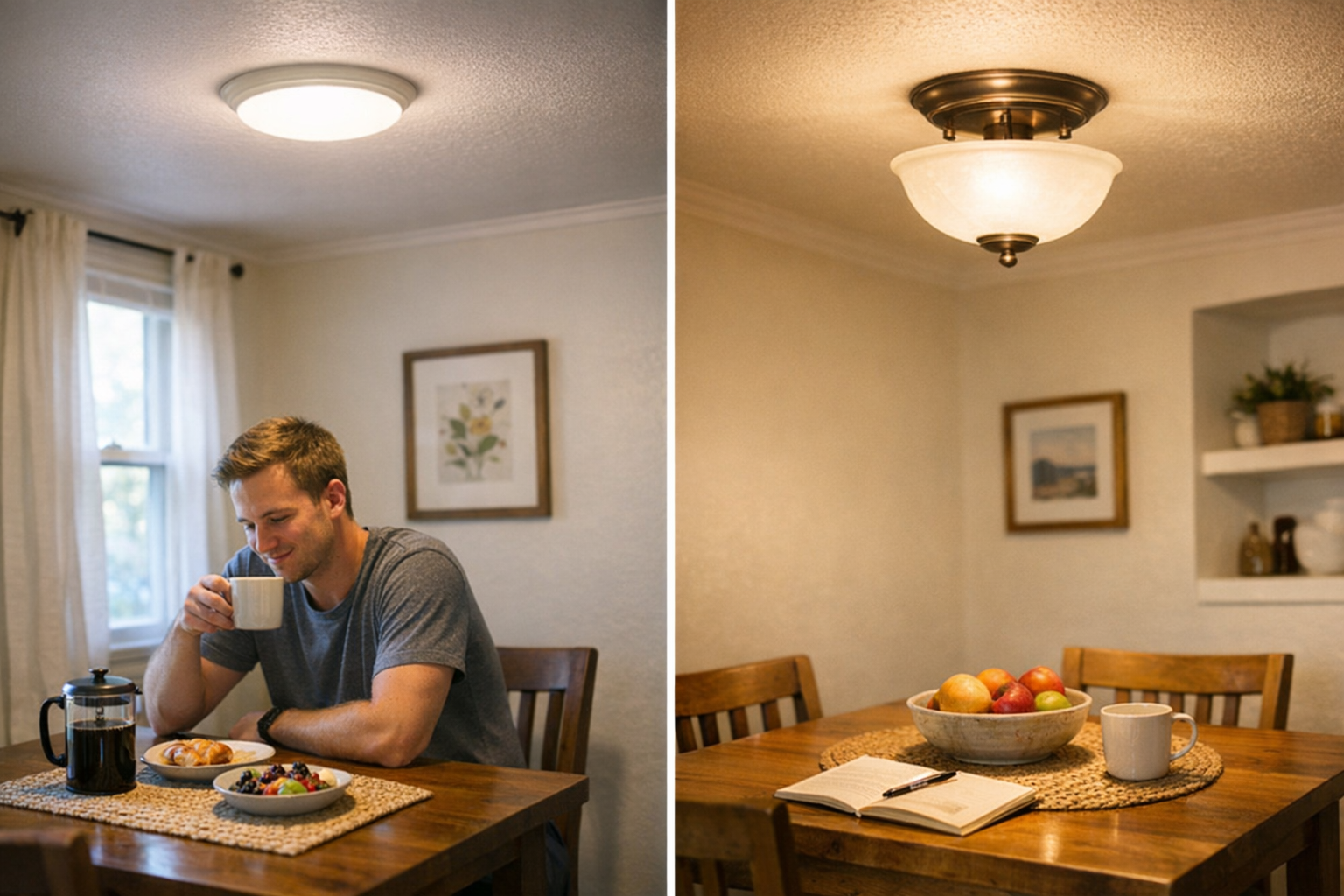
The first real test of any room’s lighting isn’t how it photographs, but how it pulls you through your first hour of the day. In our cramped dining nook—a table pressed up against drywall on one side and a walkway on the other—light isn’t an aesthetic detail. It’s a friction point. Breakfast kicks off before the sun thinks about rising, and the overhead fixture determines whether four people cross paths easily or flinch at every shadow. If the bulb above is right, you forget about it and reach for your toast. If it’s wrong—too harsh, too focused, too dim—the routine grinds. That’s why the flush mount vs. semi-flush ceiling light debate quietly decides whether small, crowded spaces feel usable or just tolerable.
Why Ceiling Fixtures Shape Everyday Friction
For most of us, the ceiling stays out of mind—until it’s not. The fixture overhead is rarely on your mental checklist when it’s a race to dodge elbows, keep juice off the floor, and rescue a dropped fork. But lighting reveals its importance in those bracing, half-awake scrambles: reaching for the edge of the table only to lose your spoon in shadow, or noticing how some seats are spotlighted and others vanish into gloom. A decision as simple as “flush or semi-flush” isn’t a catalog question. It’s a matter of whether the whole family fits into the same pool of light, or spends breakfast in tiers of visibility and second-best seats.
Flush Mount: Bright in the Middle, Fading at the Edges
With a flush mount fixture sealed flat to the ceiling, the room feels a smidge taller—a godsend when every inch counts and tall guests already lean involuntarily. The light is disciplined: it aims right down, forging a bright circle like a spotlight at center stage. Head clearance is preserved, and anything placed dead center pops in crisp detail. But you notice the borders: light fades quickly past placemats, leaving muffled shadows and odd lines across the table. If you’ve spooned up cereal under a too-bright bulb, squinting past a glare on the milk, you recognize the subtle unease. The flush mount is a specialist—great where it shines, indifferent to the rest.
Semi-Flush: Light that Actually Hits the Corners
Semi-flush fixtures hang just a touch lower—an inch or two, but it matters more than you’d expect. The effect transforms more than the silhouette. Suddenly, the light spills outward, crawling to the far edge of the table and coaxing objects in the corners out of obscurity. Ceilings drop visually, and with a table beneath, that’s a negotiation. Bang your head once and you’ll remember. But in a room packed tightly with people and things, the payoff is real: meals become collaborative, the thrown shadows blur, and every plate—edge to edge—is visible without anyone shifting for the best seat.
Lighting and Routine: Small Details, Big Differences
Flicking the switch in the fog of early morning is automatic. The flush mount snaps awake, delivering instant clarity—provided you’re lucky enough to sit in the middle. Move a plate to the perimeter and it disappears into off-color shadow. Glasses flash with rings of reflected brightness, leaving the outermost seats half-lit and indistinct. Over time, these awkward patterns repeat: the scramble to nudge homework into the light’s sweet spot, the inability to see toast crusts at the table’s edge, the daily migration of mugs and plates to wherever that spotlight lands.
Midday Reality: Where Glare and Shadows Rule
Once the sun works its way into the room, you might think the overhead fixture could rest. But natural light skips the corners; the flush mount still does the heavy lifting for the core, leaving outer spots to compete with the dull glare off windows. Across the grain of the table, light streaks and rebounds, sending phone screens into hard-to-read dazzle and kids’ pencil lines into eye strain at the far end. There’s no disaster, but anyone who uses the table for hours—meals, work, drawing—develops an almost constant urge to adjust or relocate, chasing balanced brightness that never quite arrives.
A Neighbor’s Alternative: Semi-Flush Seen Live
The real-world difference hit home at a neighbor’s. Roughly the same floor plan, same scrappy table, but their semi-flush fixture hovered lower, making you doubt if there’d be room to breathe. Then the light came on: no isolated glare, just an effortless glow blanketing every seat and brightening even the walls. Passing dishes didn’t mean squinting. Every plate became part of one large, gently illuminated gathering, not a series of underlit islands. Sitting there didn’t just change your view—it redrew the sense of who belonged at the table.
How Repeated Habits Reveal Gaps
As dinner fades to homework, laptops and toys spread out, and the first crumbs accumulate where the light starts to lose its grip. The flush mount stays stubborn, unwavering in what it lights, blind to the periphery. Stray puzzle pieces and open notebooks end up drifting along the edge, half in shadow, easy to overlook or forget. In contrast, that neighbor’s semi-flush kept everything honest—no desk toy or to-do list was left unseen, and no one’s project vanished just because it wandered to the margin.
Layering Light to Fill in What’s Missing
Nights demand improvisation. Even with a high-quality flush mount and a dimmer, edges often go dark, and plates pick up visual halos while perimeters shrink. The fix is rarely a total overhaul. Sometimes it’s about layering—setting a small lamp near the walls or a task light where the table runs long, diluting the harsh boundaries and inviting more of the room back into functional focus. The most realistic solutions don’t pretend overhead fixtures can do it all, especially when a single ceiling point is expected to carry a multi-use room from homework marauder to quiet dinner haven.
No One-Size-Fits-All—Just Noticeable Tradeoffs
When the house quiets down and you finally flick off the light, it’s easy to appreciate what the flush mount does best: clean ceilings, no ledges for dust, open air unbroken. In pure utility, it’s hard to beat. But if you’ve glimpsed what a semi-flush can do—how it includes every diner in the light, how it refocuses attention outward as well as down—the missing comfort is hard to unsee. What’s sacrificed in a little vertical clearance might be gained in daily usability, especially in rooms where the surface is always in use and the edge matters as much as the center.
Lighting That Actually Changes How a Room Works
It turns out there’s never a perfect answer. Flush mounts favor control and open space, but their sharp borders show up again and again in real-life clutter and shifting routines. Semi-flush options throw light farther, anchor every seat in the group, and let activities stretch without stumbling into gloom—even as they hover a little closer to your upstretched hand. In the end, the only difference that counts is made concrete over dozens of forgettable meals and moments: light that supports the table you have, in the space you actually use.
Better Lighting, Fewer Adjustments: Takeaways from Daily Grind
- If mealtimes are family affairs—try semi-flush fixtures to avoid the daily complaint of who lucked out with the “good” seat and who got the shadowed edge.
- Low ceilings? Use a flush mount, but don’t try to make it do everything—bring in side lamps or wall lights to smooth harsh drop-offs after dark.
- Add dimmers—every shared table moves between moods, and having a way to tweak the spread keeps tempers down when one person needs brightness and someone else wants calm.
- Favor diffusers or shades—they blur harsh glares and soften edges, making any fixture less of a visual enemy during long days at the table.
All the home stories circle back to this: light that fits your life isn’t about style points—it’s about clarity, comfort, and how many fewer times you need to squint, move the salt, or drag a chair into a “better” spot just to live the day. Nail the lighting, and the right space follows quietly behind. Miss it, and you’ll never stop noticing what’s wrong, no matter how beautiful the fixture.
For details and ideas that actually change how rooms work, there’s always more to see at fresh lighting.