
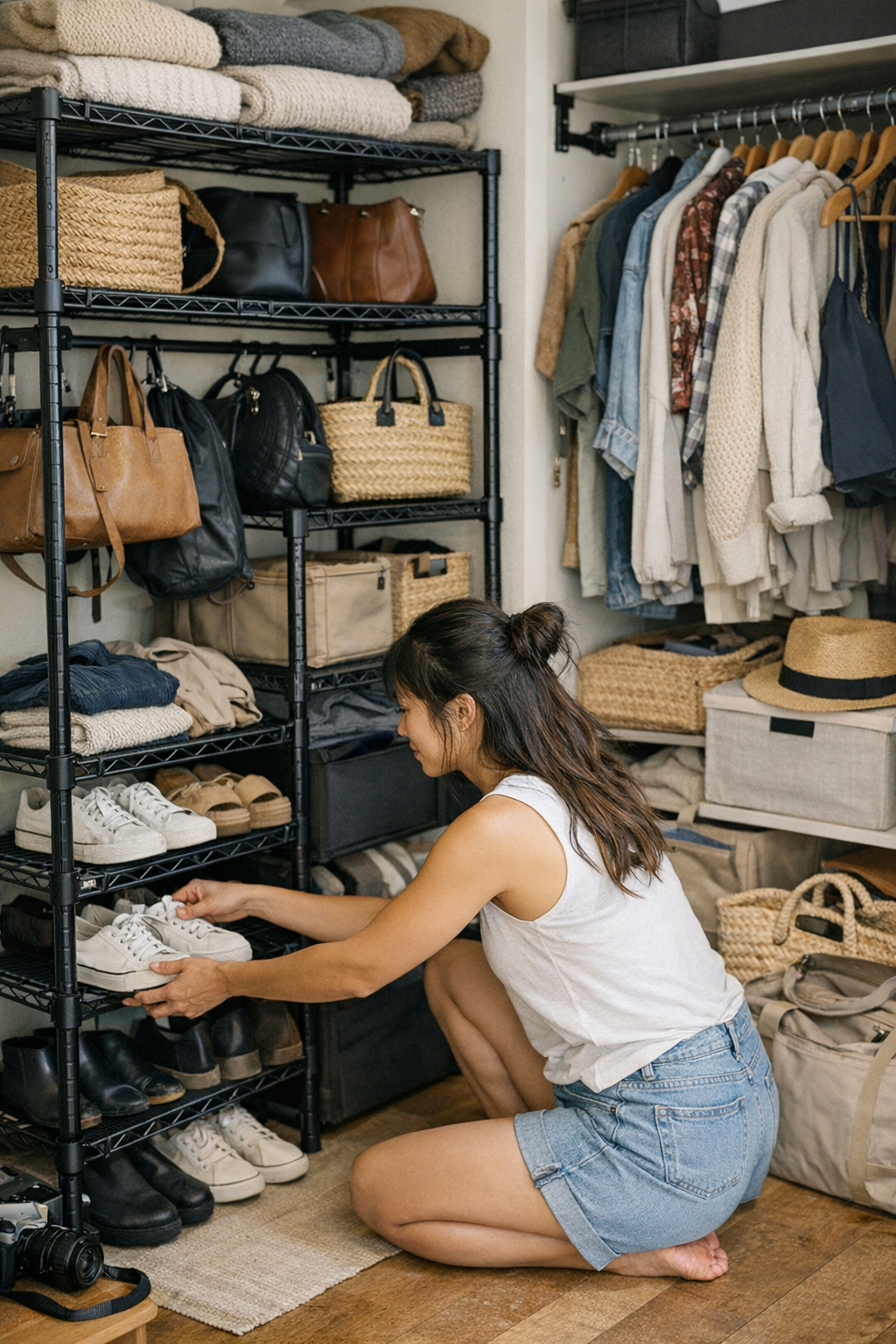
Sometimes, even with closet doors firmly shut, the disorder reveals itself: a tote bag leaning against a pile of flats, a lone scarf draped unevenly across a fabric organizer. I used to believe one more clear bin or the latest stackable basket set would be the magic fix. Instead, the overflow softened and slipped around, settling quietly where I least wanted it. Each morning starts the same: navigating a half-toppled pile, smoothing out a plan from the day before, quietly wondering if I’m addressing the right problem.
It’s tempting to think a new storage container will finally tame the chaos because it feels promising the moment you bring it home. But sometimes messes don’t truly disappear — they just rearrange while you look the other way.
Living with the Daily Shuffle
Shoes are the classic culprit. Mine tend to hover somewhere between “neatly lined up” and “nests of layered pairs” on the closet floor by midweek, especially on busy mornings. I reach for ankle boots, only to find them hidden beneath a puffed-up gym bag. As I shift one pair of ballet flats, a sweater sleeve spills halfway out of a fabric cube organizer below. And sometimes, I get an odd sense of victory discovering that bag I searched for yesterday, tucked oddly on a rolling rack by accident.
Minor fixes become routine. I straighten a crooked drawer divider or nudge a shelf up a notch to make my denim stack fit better. These simple motions take less than a minute but often signal whether the rest of the morning will be smooth or tipped by toppled bins and sliding coats. The modular shelving—minimal and narrow—offers just enough flexibility to pretend I have control, at least until I’ve had coffee.
Work-from-Home Clutter and Constant Adjustments
Working from home blurs the lines of tidiness. By midday, the mess from the morning rush lingers. The stackable baskets have slid out of place, likely disturbed during a quick lunch shuffle. I push a shelf lip back in place, tucking snack bags behind it. Then, almost absentmindedly, I reposition a shallow basket a little lower in the rails so it holds more without feeling cramped.
Small details catch my eye—a slim cabinet door slightly ajar, revealing hooks that mostly hold nothing but a stray koozie. I close it, feeling the cool metal under my hand. Often, I find items there I “tested” out, threatening to turn into clutter yet to be fully admitted as part of the system. There’s a rhythm of small adjustments: tightening a loose connector here, lifting a shelf there. Over time, I realize the things I keep visible are exactly the items I actually reach for, not the ones stashed away.
Mid-Afternoon: Accepting Small Failures
As afternoon arrives, tensions between order and chaos manifest with a subtle crash. A drawer resists opening due to a sweater caught at the edge, prompting a quick investigation. The divider has loosened and tilted at an awkward angle; I carefully realign it as my fingers press against cold metal. Nearby, an oversized clear bin leans dangerously close to falling, propped awkwardly by a stray sandal. I lift the sandal gently and reset the bin before disaster strikes.
These moments aren’t dramatic but stick with me—an ongoing tug-of-war with my setup. The urge to buy “just one more basket” flits through my mind, but I know the racks and rails themselves are fine. It’s the habits that need adapting. I slide the basket module out, glance at the whole setup, and click it back into place slightly higher. I replay the scenario in my head: if this piece shifts, will everything topple? Not today, but it’s a close call.
Evening Routine and Improvised Systems
By evening, my closet has become a small museum of trial and error. I swap my day bag onto a low rail hook—elegant compared to the disarray near the door before, yet still an evolving system. Sneakers line the lower rack in no perfect order but close enough to feel intentional. The rolling utility rack holds shoes and scarves and waits quietly in the hallway. I notice how often I move the same bins across units, clicking them into whatever fits.
Adjusting shelf heights for oddly shaped totes becomes a nightly small victory. Seeing things stand upright and within reach, even if not perfect, brings satisfaction. The real success isn’t about fitting everything into a fixed space but allowing the setup to flex with life’s daily demands. The quiet after these efforts—when I finally settle down to relax—is the true reward.
The Reality of Flexible Organization
There’s an almost gravitational pull in closets: no matter how well you place baskets or how clear your bins are, life naturally deposits new items on top or behind, quietly shifting your careful order. New hats, scarves, bags, shoes, and oddments slip in daily.
The key is building systems you can easily tweak—snapping things tighter, adjusting shelves, or repositioning rails quickens the process and keeps everything standing rather than toppling. For those who move items frequently, hand-tightening connectors offers peace of mind and prevents wobbles.
When bags and shoes stay visible—lined up along a rack or slipped onto a well-placed shelf—they’re used more often and less likely to be squeezed away into awkward spots. Organization isn’t a set of rigid rules but rather creating enough breathing room for everyday life’s ebb and flow.
Refresh Tip: Embrace the Fluidity
If your systems feel more like cages than helpers, try this: once a month, take a fresh look at how you’re using each shelf, bin, or hook. Rather than forcing each item into its “assigned” place, allow yourself the flexibility to move things where they actually end up most often. This subtle shift from “fixed” to “fluid” reframes organization as ongoing adaptation rather than a one-time chore. Not only does this lessen frustration, but it gives your closet room to breathe alongside your life.
Remember, a closet isn’t just a storage unit—it’s a living space shaped by your habits, routines, and small adjustments. By welcoming impermanence and tuning your system to the rhythms of daily use, you’ll find surprising ease amid what once felt like chaos.