
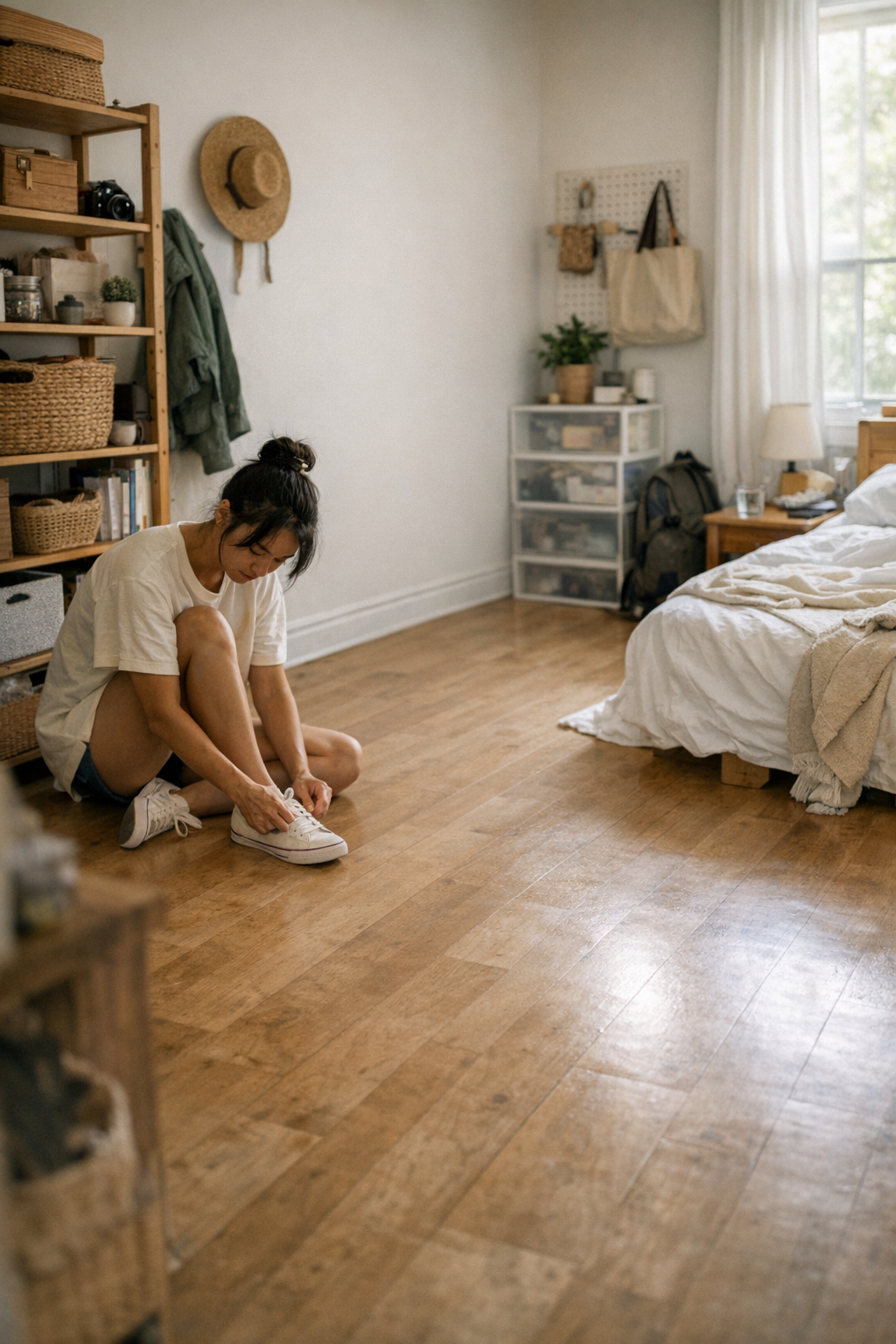
Some mornings start quietly, before the sounds of the day kick in—the water running in the bathroom, the kettle’s whistle from the kitchen. At these times, light slips gently beneath the shade and dances across the bedroom floor, settling in uneven stripes between the bed and a slender cabinet that rests unobtrusively under the window. The cabinet’s handle seems to invite a touch, a reminder that this small space is both functional and alive with potential. Standing barefoot on the cool floorboards here, it’s possible to find a moment with no unexpected objects underfoot—no stray books, no rumpled towels—just a clear path. In that fleeting hour, the small space breathes with a quiet stillness that feels like a promise: the day has not yet demanded its clutter.
The Gradual Drift of Daily Life
By midmorning, that modest order begins to ebb. Jackets and a well-worn bag cling to the wall rack, anchored but expectant. Yet the routines of living gently scatter their marks: a scarf slides off a storage bench and pools against the corner shelf’s leg; damp towels, stubbornly slow to dry, gather near underbed storage with a faint trace of yesterday’s dryer sheet. The dresser’s drop tray fills with a miscellany of items—old receipts, jewelry, the jangling keys that signal movement through the house. Shoes congregate near the door, abandoned in various directions, as if mid-escape, while the linen shelf in the hallway quietly waits, its neatly folded sheets just out of sight. There’s a subtle ebb to this migration of belongings—not chaos, but the slow imprint of everyday rhythms.
Sometimes the return bin, meant for stray socks and gloves near the door, shifts places or becomes a kind of catch-all, absorbing objects whose destinations are forgotten in the moment—a pair of gloves pulled off en route to the garden; the hose, still coiled from yesterday’s unfinished watering task, rests quietly by the side, a reminder that life won’t always be neat. Boots find hiding in the mobile chest beneath the window, accompanied by a half-used bag of soil, remnants of a weekend project. Familiar sounds punctuate this gentle disorder: the low hum of the refrigerator, a bathroom cabinet shutting with its metallic cadence, laundry baskets shuffled down hallways. In this everyday flow, even the smallest objects seem to expand, as if multiplying by lunchtime.
Afternoon Patterns and Small Victories
Afternoons bring their own tempo. Reaching behind the modular organizer for a sweater may involve a fumble or a soft thud as a misplaced drawer shifts unexpectedly. The rolling cart creaks softly as it’s nudged past the dresser, carefully avoiding cast-off magazines and an unopened package that’s destined for the garage. Nearby, a partially assembled shelf leans against the wall, its quiet promise of future order waiting patiently for a spare moment. Above the storage cabinet, a pegboard secretively offers up a long-lost pruner tangled among rubber bands and twist ties. And lingering close by, the trusty dustpan stands in silent reproach near the skirting board, a gentle prompt for upkeep yet to come.
Peace in a bedroom isn’t constant—it ebbs and flows with the pulse of daily life. The space can feel unruly one hour and somewhat tamed the next. Almost ten percent of patience is saved simply by not stubbing a toe on furniture or scattered belongings. Spotting progress, like the return bin filling as intended or the broom resting out of the way, brings quiet satisfaction, even if other small messes go unnoticed. Discovering a clean patch of floor behind the rolling cart, no longer squeaking with each turn, feels like a quiet victory.
Refresh Tip: Appreciate Movement Over Stillness
Sometimes, the most genuine sense of order isn’t found in an empty room but in the flow of movement within it. Instead of chasing a perfectly spotless floor, embrace the rhythms of tidying as part of living. Recognize that a space filled with daily life’s small disruptions is a sign of a home well used and cared for—not neglected. This perspective shift can refresh your approach to home organization and lower frustration, opening room for small, consistent wins rather than overwhelming perfection.
Evening Rituals and Quiet Closure
As evening settles, routines soften and slow. The last receipts are fished from the drop tray and tucked away in a cabinet, the latch clicking carefully shut. Socks return to the bin, books find their places on the low shelf, and shoes align gently near the door. The rolling cart, now cleared, is tucked neatly beside the modular bookcase, its handles wiped smooth from use. Pegs on the board, once brimming with items, are lightened, leaving bathrobes and clothing secured for the night. The broom’s bristles settle calmly in the corner, gathering the traces of the afternoon crumbs.
Finally, night wraps the bedroom in a hush. The gentle click of the light switch sounds soft and fabric-like in the still air. Sheets flutter slightly in the absence of breeze, while on the corner shelf, a couple of carefully stacked books stand steady, safe from tumbling out. Surfaces hold minimal clutter: a small lamp on the dresser, a freshly placed bath towel, and a floor clear of the day’s obstacles. The jacket on its hook shifts with the faint draft, and the distant hum of the garage refrigerator quietly underscores the stillness—a reminder that life continues gently around this sanctuary.
Finding Balance in Everyday Order
What makes a home livable and inviting isn’t a rigid system or perfect minimalism; it’s the small habits and mindful touches that keep things manageable. Keeping essentials like the return bin near entryways, rather than hidden away, increases the likelihood of use and decreases misplaced items. Small actions—like emptying a drop tray nightly, routinely folding spare sheets, or wiping down surfaces—don’t demand perfection but build a cumulative sense of calm.
Real life will always scatter shoes, scarves, and stray objects in its wake. Yet by honoring small moments of order and creating intentional breathing space, a home can serve as a reprieve amidst ongoing movement. It’s not about trophies for empty floors but about the freedom to navigate through the space without choreography or discomfort—an everyday victory that quietly nurtures peace.
If you’re looking to deepen your relationship with your space, consider starting small: designate one area—a cabinet, a shelf, or a bin—to act as your daily return spot for items that tend to wander. This tiny shift nurtures awareness and helps prevent clutter from growing unnoticed. Paired with regular gentle tidying, it lays the foundation for a home that supports your rhythm and nurtures your well-being.