
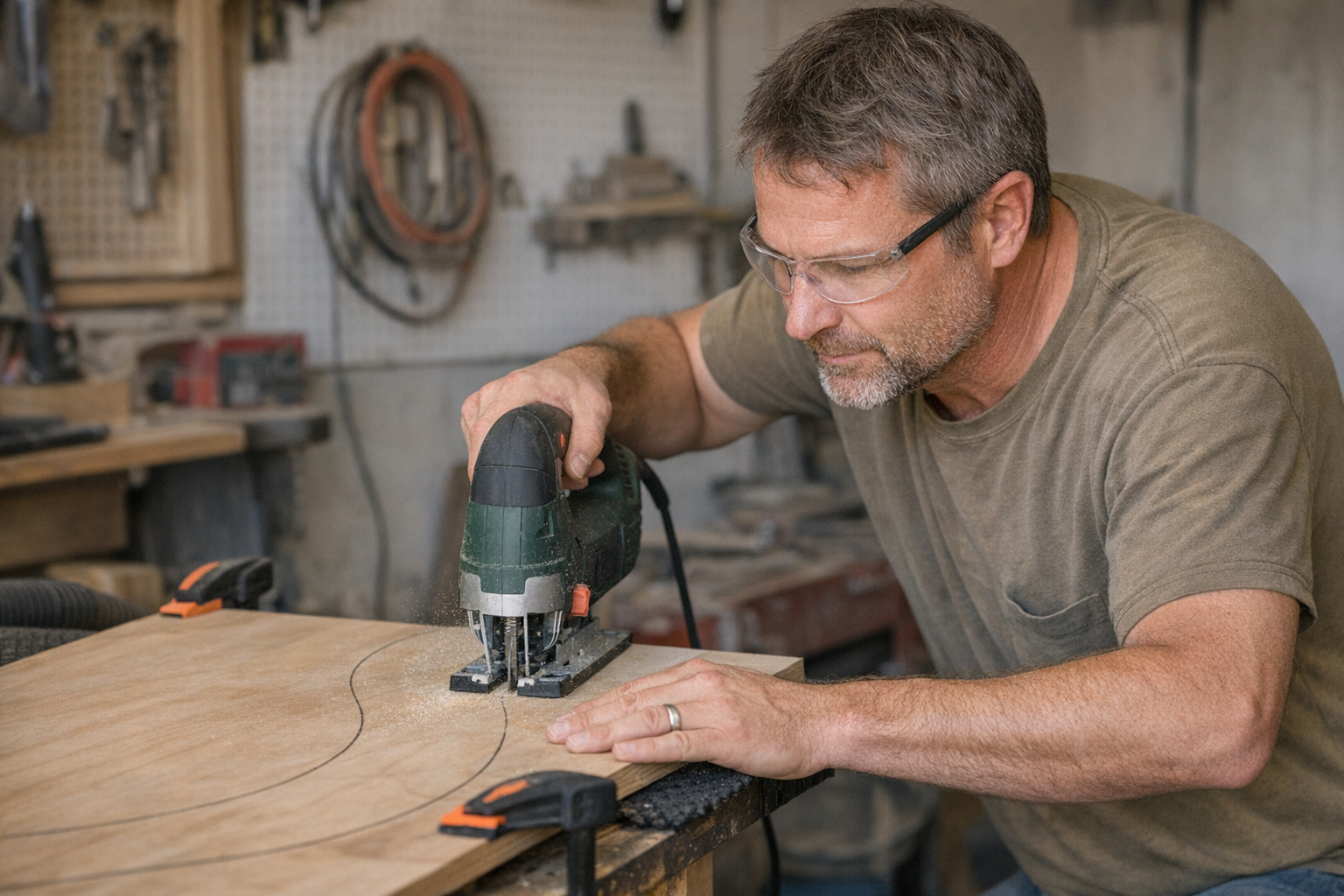
There’s something undeniably satisfying about guiding a jigsaw through wood, watching its blade effortlessly follow a curved line. However, anyone who’s tried cutting curves with this versatile tool knows it’s not always easy to achieve a clean, smooth edge. Beginners often end up with wobbly lines and rough edges that require extensive sanding to fix. The good news is that with the right approach—and a few practical adjustments—your curved cuts can become both precise and tidy, saving time and improving the final look of your projects.
Understanding the Jigsaw’s Role Beyond Straight Cuts
While jigsaws are often overlooked in favor of tools like circular saws or table saws, they actually excel at cutting curves, scrollwork, and intricate patterns. This is because a jigsaw’s blade moves up and down while allowing you to pivot the tool, tracing almost any shape you draw. You’ll find it invaluable for custom shelving, decorative pieces, or DIY signs that demand fluid curves.
Still, to make the jigsaw work for you rather than against you, certain settings matter a great deal. For example, an orbital setting controls the forward and backward motion of the blade. Typically, a low-to-mid orbital setting (levels 1 or 2 on a scale of 3–4) is ideal for curves. This reduces aggressive forward blade movement, which can cause the blade to wander and tear especially on tight radii. Additionally, keeping the blade speed, measured in strokes per minute (SPM), moderate—around 800 to 1200 SPM for detailed work—helps maintain clean tracking without chipping the material.
Choose the Right Blade: The Key to Clean Curves
One of the biggest game-changers is selecting a blade designed specifically for curves. Typical blades made for straight cuts tend to be wider (more than 1/4 inch) with fewer teeth per inch (TPI), which limits their ability to turn sharply. Using these can leave your edges jagged and force you to push harder, increasing blade flex and imperfections.
Instead, opt for narrower, fine-toothed blades with a width of 1/8 inch or less and at least 10–12 TPI. Blades labeled for “curves” or “scrollwork” feature these specifications. For softwoods and plywood, high carbon steel (HCS) blades are sufficient. For tougher materials such as laminates and hardwoods, bi-metal blades provide greater durability and maintain sharpness over time.
A frequent mistake is using a generic blade for all cuts. This lack of precision causes unnecessary cleanup and uneven edges. Take a moment to select the blade that matches your project’s material and curve radius—it’s a simple swap that will drastically improve your results from the very first cut.
The Importance of Proper Workpiece Securing
Curving isn’t just about blade choice; it’s also about controlling the workpiece. Material movement during cutting can throw you off, so securing the piece firmly is critical.
Clamps are your best friend here. Use at least two clamps positioned within 2–3 inches on either side of your cutting line, both before and after the area you plan to cut. This setup minimizes vibrations and prevents the wood or panel from pivoting unexpectedly, which is a common cause of uneven curves.
Additionally, use your non-dominant hand as a guide—not for pushing or forcing—but gently resting on the material to stabilize it while keeping fingers clear of the blade path. For slick surfaces like melamine or prefinished panels, placing a small piece of anti-slip matting under the workpiece adds extra grip and prevents slipping.
Master Your Pace: Slow and Steady Wins the Curve
Patience is crucial when cutting curves. Forcing the jigsaw too quickly through tight turns often leads to blade deflection, rough edges, or even blade breakage. Maintaining a consistent, slower speed—usually between 800 and 1200 SPM—allows the blade to track the curve smoothly without overheating or chipping.
When you approach a tight corner or complex bend, pause cutting briefly. Release the trigger and allow the blade to stop fully, then gently pivot the tool to align with the next segment of your curve before resuming. This simple pause prevents accidental notches or gouges at the start of turns and translates to cleaner edges.
Remember to take short breaks every foot or so during long curved cuts, especially in dense or hardwood materials. This helps cool both the blade and motor, improving cut quality and tool longevity.
Optimizing Sightlines and Work Positioning
How you position yourself and your workpiece can greatly affect accuracy. Trying to cut while leaning awkwardly or with your cutting line obscured makes it difficult to follow the curve precisely.
For better control, adjust your stance so your eyes look straight down the cut line rather than from above at an angle. Sometimes stepping to the side of your workbench or elevating your material slightly on a block enhances visibility. If your jigsaw has a dust blower, keep it running to maintain a clear cut line. For tools without built-in dust removal, a quick brush or puff midway through a cut keeps your line visible.
A Subtle Perspective Shift: Take Micro-Breaks and Reset
After guiding the jigsaw through several inches of a curve, pause for a moment—not just to rest your hands or cool the blade—but to consciously reset your focus. This brief mental break encourages you to reassess your hand positioning, ensure your workpiece is still secure, and clear away sawdust. Often, this subtle pause renews precision and steadiness, preventing cumulative small errors that can worsen over longer cuts.
Learning to see cutting curves as a rhythmic process of cutting, pausing, pivoting, and adjusting transforms the experience from a rushed chore into an enjoyable craft.
Accepting and Learning from Small Imperfections
Even with the best technique, some tiny imperfections are natural, especially when you’re just starting out. Instead of letting these mistakes frustrate you, recognize them as part of developing your skill and touch. Over time, your hand-eye coordination improves, and smooth, confident curves will become second nature.
Interestingly, occasional intentional rounding of sharp turns or subtle deviations can add character and individuality to handmade pieces, reminding viewers of the human touch behind the work.
Conclusion: Let the Jigsaw Work With You
Cutting clean curves with a jigsaw is less about brute force and more about technique, patience, and setup. From choosing the right blade to securing your material and managing your pace, small adjustments yield big improvements. Embrace pauses during curves, optimize your viewpoint, and treat the tool as a cooperative partner. These mindful changes turn challenging curved cuts into rewarding tasks.
Remember, mastery comes with experience. Each project builds your intuition about the interplay between blade, material, and movement. After all, the smoothest curve is a product of both skill and a respectful partnership with your tools.