
Understanding the Root Causes of Stripped Screws
If you frequently use drills or impact drivers, you’ve likely encountered the frustrating whine and slip of a driver bit spinning out of a screw head. Stripped screws aren’t merely an inconvenience—they cost you time, increase frustration, and sometimes even damage your project materials.
More often than not, stripping results from a mismatch between the driver bit and screw head, worn tools, or poor technique. Recognizing these factors is the first step toward addressing the problem.
Common Reasons Screws Get Stripped
- Incorrect bit type or size: Driver bits must match the screw head profile and size precisely for optimal grip.
- Worn or poor-quality bits: Rounded edges or fatigue reduce contact and increase the chance of cam-out.
- Inferior screws: Soft metals or previously damaged screw heads strip more easily.
- Excessive torque or angled pressure: Applying too much force or screwing at an angle encourages the bit to slip out.
How Bit Design Influences Stripping
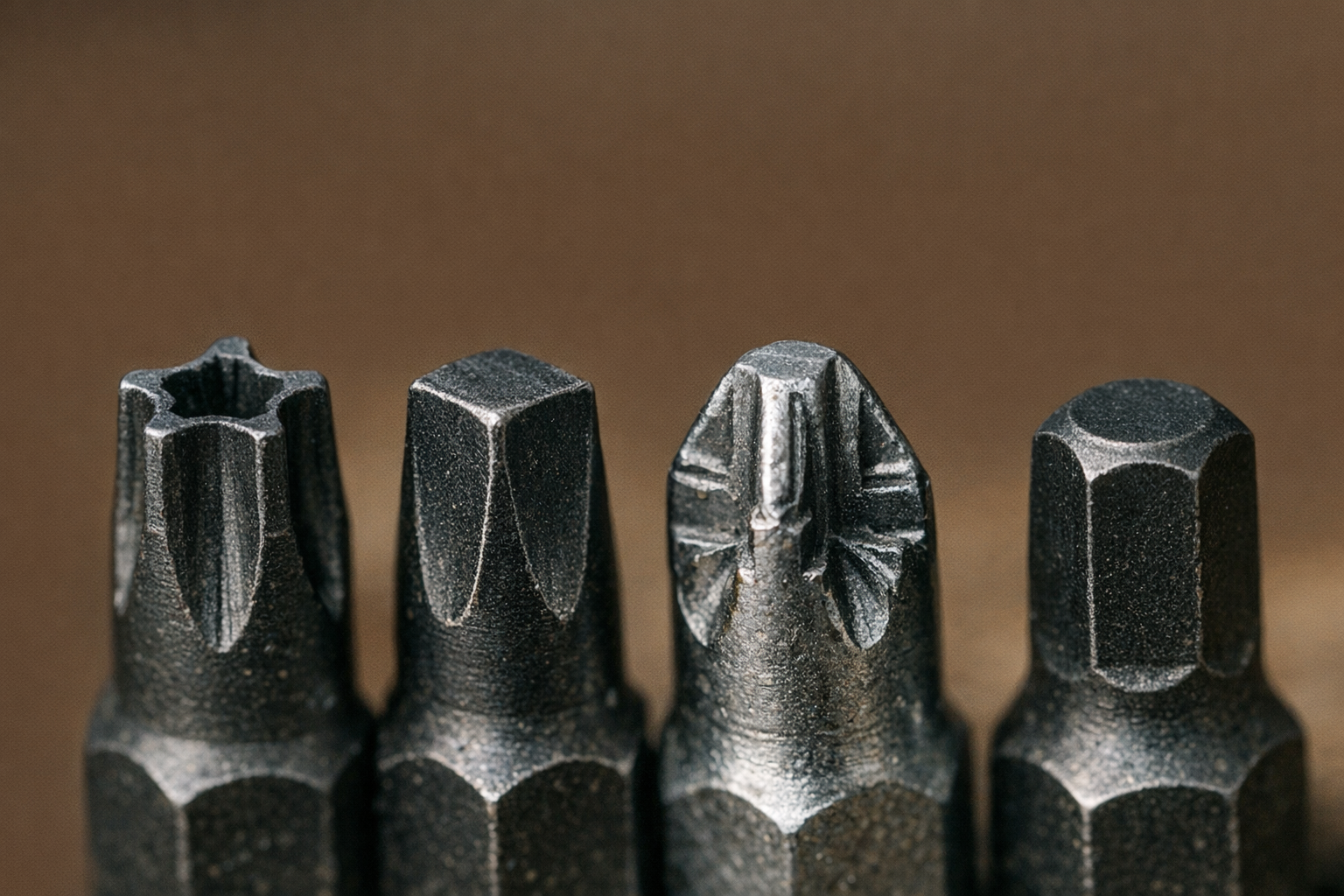
Choosing the right driver bit type matters as much as technique. Let’s explore four popular bit profiles and how their designs reduce stripping:
Torx Bits: The Star Performer
Torx bits are shaped like a 6-pointed star, offering increased surface contact with the screw head. This design minimizes cam-out, even under high torque, which is why Torx has become standard in many applications requiring durability.
For example, when driving 3” structural screws at high RPMs using an impact driver, Torx bits hold the screw firmly without slipping. Using the correct size—usually T20 or T25 for heavy wood screws—is critical to maintaining a tight fit. Any undersizing will lead to cam-out and potential strip-out.
Owners should also ensure their Torx bits have crisp edges and replace them at the first sign of wear to retain grip advantages.
Square (Robertson) Bits: Reliability in Construction
Common in North America, square driver bits feature a robust square tip that offers deep, positive engagement with the screw head. The snug fit allows you to even start screws one-handed, making them incredibly effective for repetitive tasks such as subflooring or decking.
In my experience, driving long deck screws into wet timber becomes noticeably easier with #2 Robertson bits—the bit stays firmly planted without slipping even as fatigue sets in. Choosing the correct size (#1, #2, or #3) is essential to avoid spin-outs caused by poor fit.
Pozidriv Bits: The Improved Phillips
While often confused with Phillips, Pozidriv (PZ) bits include extra ribs that prevent cam-out common in Phillips screws. Mainly used in European furniture assembly, these bits deliver better control even in particle board or composite materials.
Recognizing Pozidriv screws is easy—they have additional “tick marks” on the head. A common mistake is to use a Phillips bit (PH) on a Pozidriv screw, which leads to stripping due to poor fit. Sizes like PZ2 are prevalent in flat-pack furniture.
Hex (Allen) Bits: Simple, Slippage Resistant
Hex bits are common in bicycle repair and some furniture assembly. Their six flat sides prevent cam-out because there are no “rises” to cause the bit to slip out under torque. Using exact metric sizes is crucial; mixing imperial and metric can damage the screw head.
For deep-set screws, opting for long-shank Allen bits avoids wobbling and ensures even pressure on the fastener.
Practical Tips to Avoid Stripping Every Time
Tip 1: Always Pause and Match Bit Profile and Size
Before driving any screw, take a moment to verify both the bit type and size. Similar-looking bits can feel close but differ subtly enough to cause slippage. I’ve learned that dropping the bit into the screw head before starting—feeling for a tight, wobble-free fit—saves enormous frustration later.
Even under time pressure, committing to this habit drastically reduces stripped screws and saves time spent on screw extraction.
Tip 2: Maintain and Replace Your Bits
Worn or rounded bits are a silent enemy. If you feel the bit slip or hear clicking noises while driving screws, it’s a sign the bit edge has lost integrity. Keep commonly used sizes marked and regularly inspect their condition before starting projects.
Additionally, for heavy-duty jobs that use impact drivers delivering up to 200 Nm of torque, invest in impact-rated bits specifically designed to resist twisting and shearing.
A Fresh Approach: Shift Your Mindset on Fastening
Here’s a subtle but powerful mindset refresh: rather than rushing to drive screws fast, treat screw driving as a direct dialogue between your tool and the material. Paying attention, even briefly, to the fit of your bit turns your work from a race against time into a controlled process. This shift reduces mistakes and makes your projects more enjoyable.
Eventually, this mental shift becomes automatic, and you’ll find yourself instinctively reaching for the right bit and torque setting without breaking pace.
Conclusion: Precision Matters for Cleaner, Safer Builds
Stripped screws are rarely just bad luck—they usually signal a need to reconsider your choice of driver bits and maintenance habits. Whether you choose Torx, Square, Pozidriv, or Hex bits, each offers design advantages that minimize slippage and strip-out when paired with proper technique.
By prioritizing exact bit profiles and sizes, inspecting tool wear, and shifting your approach to screw driving, you’ll reduce frustration and achieve cleaner results. After all, smooth, reliable fastener installation is foundational to professional, high-quality workmanship.
So next time you reach for your drill, spend a moment checking your bit. Your fasteners—and your finished project—will thank you for it.